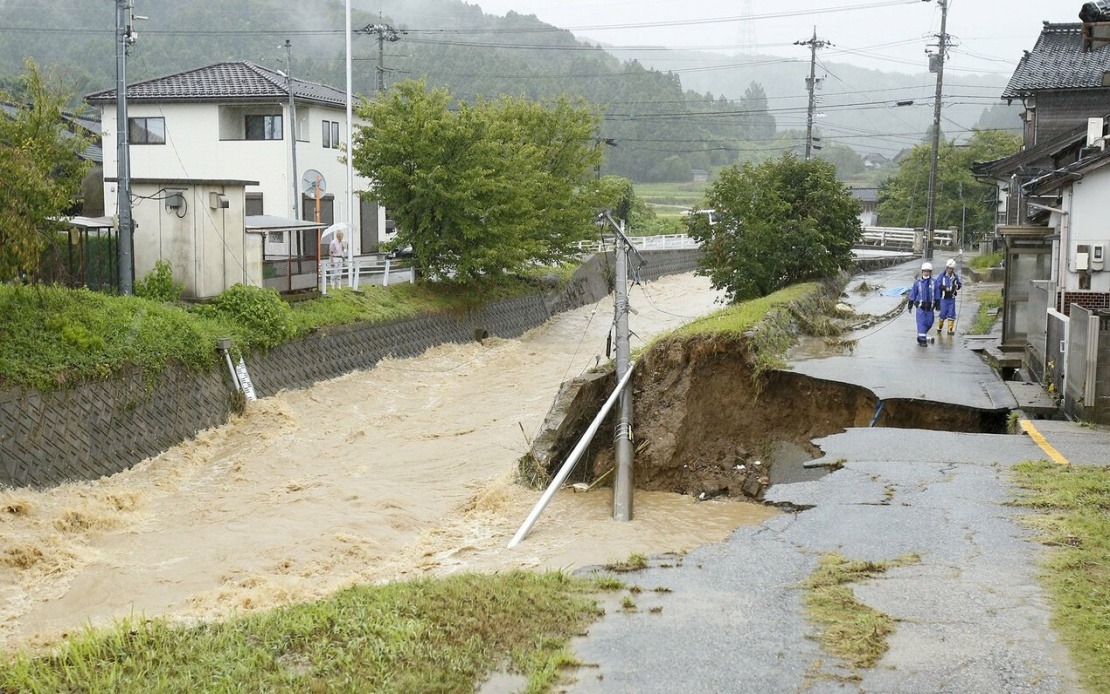
Japan's central regions faced a severe weather crisis on Thursday as unprecedented rainfall battered Ishikawa and Toyama prefectures, prompting authorities to issue the nation's highest-level alert and mobilise tens of thousands of residents to safety. The deluge unleashed a cascade of natural disasters including widespread landslides and flooding that swallowed vehicles and overwhelmed infrastructure, though emergency responders have so far prevented casualties, according to the Ishikawa prefectural government.
The Japan Meteorological Agency activated a Level 5 heavy rain warning—its most critical alert indicating that catastrophic conditions have either materialised or are about to occur—across multiple municipalities in both prefectures. The designated danger zones encompassed Himi in Toyama Prefecture alongside Hakui, Shika, Hodatsushimizu, and Nakanoto in Ishikawa Prefecture, affecting approximately 180,000 people across five municipalities. This classification demands immediate action rather than mere preparation; residents were instructed to evacuate to designated shelters or barricade themselves indoors, depending on local guidance.
The rainfall intensity set alarming records for the region. Within a twelve-hour window ending at 7:20 am, Himi and Hakui experienced unprecedented downpours exceeding 300 millimetres, while Hodatsushimizu received more than 200 millimetres—all surpassing historical benchmarks for those specific locations. A local firefighter in his 50s, stationed in Himi, reported to Kyodo News that rivers had burst their banks, completely submerging multiple vehicles beneath floodwaters. Such scenes have become distressingly familiar across Japan's weather-prone regions in recent years.
Meteorologists attribute the catastrophe to a convergence of atmospheric phenomena that have created an exceptionally unstable environment. A cold-air mass colliding with a trough of low pressure has generated conditions primed for extreme precipitation. A weather front extending eastward from the Sea of Japan through northern and eastern portions of the country continues to drift southward, with forecasters expecting this threatening system to persist through Friday. The agency predicted that Hokuriku would receive up to 200 millimetres over a 24-hour period through noon Friday, while the Kanto-Koshin and Tokai regions faced prospects of 150 millimetres.
Neighbouring Niigata Prefecture also fell within the storm's destructive reach, expanding the geographic footprint of the emergency beyond initial projections. The cumulative impact across multiple prefectures underscores the scale of this meteorological event and the challenge facing rescue and relief operations stretched across a wide territory. Transport networks have been disrupted, communications networks strained, and local government resources diverted toward emergency response.
For Malaysian observers and readers familiar with monsoon-driven weather patterns in Southeast Asia, the Japanese scenario offers instructive parallels and contrasts. While Malaysia experiences distinct wet seasons, Japan faces a different seasonal risk calendar where late-summer frontal systems can produce comparable devastation. The Japanese response apparatus—with its colour-coded warning system and established evacuation protocols—reflects decades of experience managing natural disasters in a tectonically and meteorologically volatile archipelago.
The timing of this crisis compounds concerns about climate resilience and infrastructure durability. Earlier in August, a comparable Level 5 warning issued for municipalities in Chiba Prefecture near Tokyo had resulted in catastrophic flooding that claimed thirteen lives. That disaster left approximately 2,500 vehicles immobilised across prefectural roads at its peak, creating scenes of urban chaos and illustrating how quickly extreme weather can overwhelm even developed nations' capacity to manage mass emergencies. The recurrence of such high-level alerts within weeks suggests potentially shifting patterns in Japan's climate and weather behaviour.
For regional security and economic analysts monitoring developments in Northeast Asia, these recurring natural disasters carry implications beyond immediate humanitarian concern. Japan's logistics infrastructure and manufacturing supply chains—which feed into regional and global commerce—face periodic disruption when major prefectures experience flooding. Toyama and Ishikawa, while not Japan's largest economic centres, maintain significant industrial and agricultural output. Disruptions to transportation corridors, power distribution networks, and commercial operations ripple outward across interconnected regional economies.
Japanese authorities have learned through hard experience that early warnings, clear communication, and rapid evacuation capability represent the most effective defences against meteorological hazards that cannot be prevented or significantly mitigated. The decision to issue Level 5 warnings represents a commitment to erring on the side of caution, recognising that false alarms cost far less than delayed evacuations. This approach contrasts sharply with some other regions where authorities hesitate to sound maximum alerts, fearing economic disruption or accusations of crying wolf.
The unfolding situation emphasises how natural disasters remain among the most consequential policy challenges facing developed democracies. Despite advanced technology, wealth, and institutional capacity, Japan cannot eliminate the risks posed by its geography and climate. The nation instead invests heavily in early warning systems, disaster preparedness education, and emergency response infrastructure. For smaller or less wealthy nations in the Asia-Pacific region facing comparable or greater exposure to extreme weather—whether tropical cyclones, monsoon flooding, or other phenomena—Japan's systematic approach offers a model for consideration, even as observers recognise that resource constraints may limit replication elsewhere.
As the weather front continues its southward progression through Friday, meteorological agencies will maintain close monitoring and continue issuing updated forecasts and guidance. The evacuation of 180,000 residents, while economically disruptive and logistically complex, represents the prioritisation of human safety over material concerns—a principle that should guide policy decisions wherever extreme weather threatens.

