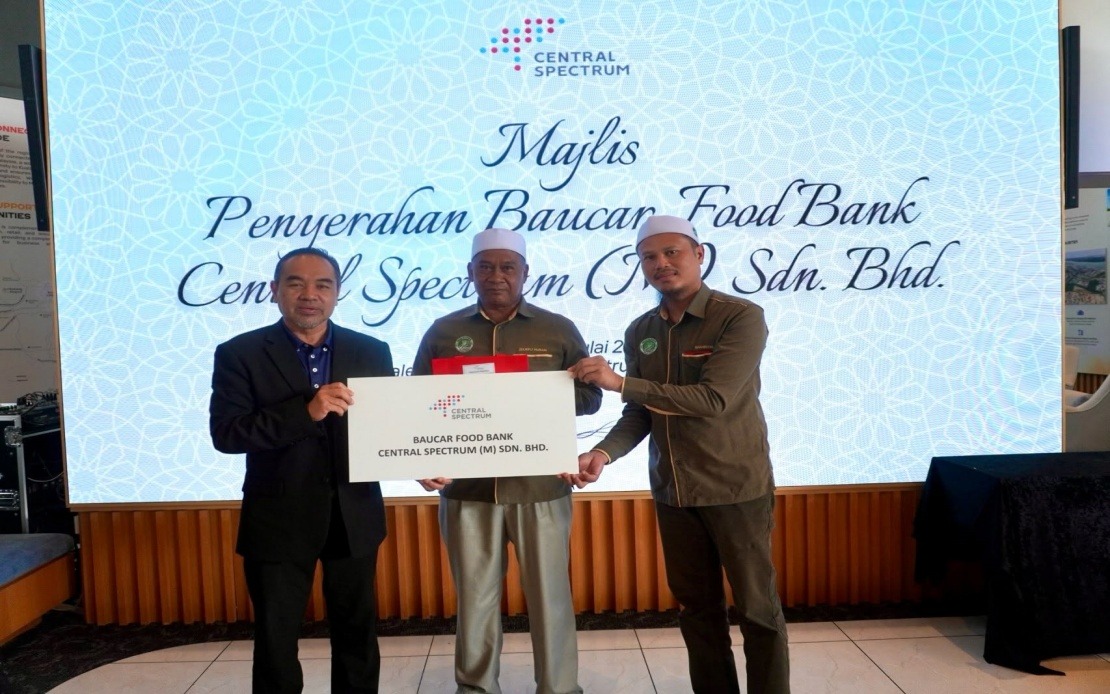
Central Spectrum (M) Sdn Bhd has pledged RM10,000 in financial assistance to residents of Pulau Indah in Klang, Selangor, through a structured Food Bank voucher distribution programme targeting vulnerable households. The initiative represents the property developer's latest effort to embed itself within the communities where it operates, leveraging local religious institutions as trusted intermediaries for welfare delivery.
The programme, unveiled at Central Spectrum's sales gallery in Pulau Indah on July 31, distributed 500 food vouchers to four neighbourhood mosques serving the area. Masjid AlQayyum in Bandar Armada Putra, Masjid Ar-Rahman in Kampung Sungai Pinang, Masjid Ar-Raudhah in Kampung Sungai Kembong, and Masjid Sultan Abdul Aziz in Kampung Perigi Nanas each received an allocation, tasked with identifying and supporting eligible families and individuals from their respective congregations. The presentation ceremony was led by Central Spectrum acting chief operating officer Edi Zuhri Abd Rahim.
The decision to channel assistance through mosques reflects a deliberate corporate strategy increasingly adopted by Malaysian developers seeking to establish authentic community partnerships. Rather than distributing aid directly, Central Spectrum positioned mosques as institutional gatekeepers with deep knowledge of local welfare needs and strong reputational incentives to ensure fair allocation. This approach acknowledges the mosques' traditional role as community anchors and welfare coordinators, particularly significant in predominantly Muslim residential areas across the Klang Valley.
For Selangor's growing suburban communities, such initiatives address real vulnerabilities exacerbated by rising living costs and economic pressures on working-class households. The Klang district, home to over 900,000 residents and characterised by a mix of established villages and newer residential developments, contains pockets of persistent household hardship. Food security remains a genuine concern for many families despite Malaysia's overall development status, making targeted voucher schemes a pragmatic response to immediate nutritional needs.
Central Spectrum's corporate social responsibility positioning emphasises transparency and community ownership. The company framed its partnership with mosques not merely as charity distribution but as collaborative welfare infrastructure, suggesting that religious institutions' embeddedness in neighbourhood life makes them superior arbiters of assistance allocation compared to external actors. This rhetoric resonates within Malaysian corporate culture, where businesses increasingly seek legitimacy through demonstrated sensitivity to community structures rather than top-down welfare approaches.
The RM10,000 commitment, while modest relative to the developer's overall operations, serves multiple strategic purposes beyond immediate poverty relief. Such programmes generate positive media coverage, build goodwill with local authorities and community leaders, and create informal networks that facilitate future property sales and relationship-building. For a developer operating in an increasingly competitive Selangor property market, community integration represents a competitive differentiator, particularly when targeting middle and lower-income buyer segments.
Edi Zuhri's remarks emphasised Central Spectrum's desire to position the Food Bank programme as an ongoing platform for community engagement rather than a one-off donation. This language suggests the company envisions repeated annual or periodic voucher distributions, potentially institutionalising its presence within Pulau Indah's welfare ecosystem. Such regularised engagement builds institutional memory and strengthens claims to community partnership status, advantages that extend beyond immediate charitable impact.
The programme also reflects broader shifts in how Malaysian corporations approach corporate social responsibility in response to government expectations and social media scrutiny. By partnering with mosques and leveraging their congregational networks, Central Spectrum demonstrates alignment with Islamic values and community-centred development, messaging that holds particular resonance in Selangor's political and social environment. The choice to distribute assistance through religious institutions rather than secular channels suggests strategic awareness of cultural preferences and trust patterns within the target communities.
For residents of Pulau Indah and surrounding villages, the immediate benefit manifests as purchasing power for essential food items during a period of inflationary pressure on household budgets. The 500 vouchers distributed across four mosques represent a meaningful injection of support, particularly for households already managing multiple financial constraints. While the per-household value remains modest, Food Bank vouchers typically maximise impact by targeting staple items, making them an efficient vehicle for temporary relief during economic strain.
The initiative also illuminates evolving relationships between commercial entities and community institutions in Malaysia's urban periphery. As suburban expansion accelerates across Selangor, developers increasingly recognise that community integration demands engagement with established local structures rather than purely transactional relationships with buyers. Mosques function not only as religious centres but as community anchors, welfare intermediaries, and social coordinators, making them logical partners for developers seeking sustainable local presence.
Central Spectrum's framing of mosques as partners in "ummah development" signals recognition that corporate welfare efforts gain legitimacy when aligned with community values and institutional priorities. This approach avoids paternalism by acknowledging that local institutions possess both better information about genuine need and greater social authority to oversee fair distribution. It also distributes reputational benefit to mosques themselves, recognising their welfare functions and strengthening their institutional role within the broader community.
Looking forward, such initiatives may establish templates for how Malaysian developers navigate community engagement in increasingly dense suburban areas. As competition for market share intensifies and communities become more discerning about corporate citizenship, programmes that institutionalise relationships with trusted local actors offer strategic advantages. The Food Bank programme suggests that effective corporate community engagement in Malaysia increasingly requires authentic partnership with existing institutions rather than parallel programmes delivered through external actors.

