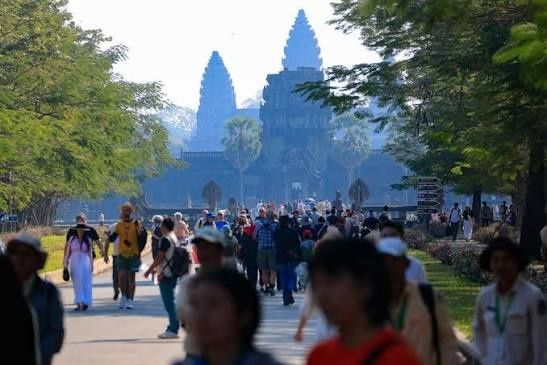
Cambodia's world-renowned Angkor Archaeological Park achieved a notable milestone in July when Chinese visitors surged to 5,751, marking a modest 0.54 per cent gain compared with the same month last year and establishing China as the leading source of international tourists during that period. The result, disclosed in an official report released Saturday, August 8, provides a rare bright spot in an otherwise challenging tourism landscape for one of Southeast Asia's most iconic cultural destinations.
The sprawling Angkor complex, encompassing 401 square kilometres in north-western Siem Reap province, stands as Cambodia's signature tourist draw and a gateway to the country's archaeological heritage. The park's collection of 91 ancient temples, constructed between the ninth and 13th centuries during the height of the Khmer Empire, attracts visitors from across the globe seeking to experience one of humanity's greatest architectural achievements. For decades, Angkor has served as a cornerstone of Cambodia's tourism industry, generating substantial foreign exchange and employment across the entire Siem Reap region.
However, the July uptick in Chinese arrivals masks a concerning underlying trend that threatens the sector's recovery. During the first seven months of 2026, the park received only 39,742 Chinese tourists, representing a steep 25.4 per cent decline compared with the equivalent period last year. This sharp contraction underscores the magnitude of headwinds buffeting Cambodia's tourism ecosystem and the fragility of the rebound witnessed in a single month's data.
Cambodian Minister of Tourism Huot Hak attributed the persistent weakness in international arrivals to a convergence of regional and global challenges that have reshaped travel patterns across Southeast Asia. According to statements delivered Tuesday, the minister identified a constellation of factors constraining visitor flows, beginning with negative media coverage that has discouraged potential tourists from booking trips to the kingdom. The proliferation of online scams targeting travellers and connected to Cambodia has inflicted reputational damage that extends beyond the country's borders, creating a perception of safety and security concerns that dissuades visitors.
Border friction between Cambodia and Thailand has emerged as another significant deterrent. The two nations' historical tensions periodically resurface in ways that dominate regional headlines and create an atmosphere of uncertainty. Such geopolitical friction, though often not directly affecting tourists, contributes to an overall sense of instability that weighs on travel decisions, particularly among family groups and leisure travellers who prioritise predictability and safety.
Meanwhile, external global forces have compounded Cambodia's domestic challenges. Ongoing geopolitical conflicts centred in the Middle East have triggered volatility in crude oil markets, pushing fuel costs substantially higher across global aviation networks. Elevated airfares and increased travel expenses have dampened enthusiasm for international leisure travel, forcing consumers to reassess holiday budgets and defer planned trips. These macroeconomic pressures affect travellers from both developed and emerging economies, limiting demand for regional destinations including Cambodia.
The contrast between July's monthly performance and the cumulative seven-month decline illustrates a critical dynamic: while single-month figures can occasionally reflect localised surges—perhaps driven by specific marketing campaigns, seasonal promotions, or coincidental timing—the broader trend remains unambiguously downward. For Malaysia and other regional tourism-dependent economies, Cambodia's experience serves as a cautionary tale about the vulnerability of heritage tourism to external shocks and reputational challenges. The Angkor situation demonstrates how quickly negative publicity, security perceptions, and macroeconomic headwinds can erode competitiveness in a globally competitive tourism marketplace.
For Cambodia specifically, the reliance on Chinese tourists—who have become increasingly important to regional tourism economies in recent years—introduces both opportunity and vulnerability. While China's position as the leading source market offers potential for substantial recovery once global conditions normalise, the sector's dependence on a single major source market creates concentration risk. Should circumstances deteriorate further or if Chinese tourists redirect their spending toward alternative Southeast Asian destinations offering perceived advantages, Cambodia's recovery timeline could extend significantly.
The path forward for Angkor and Cambodia's broader tourism sector will likely require multifaceted intervention addressing both perception and reality. Addressing scam networks and security concerns demands coordinated law enforcement efforts and public information campaigns to rebuild confidence among international travellers. Simultaneously, diplomatic engagement to ease regional tensions and strategic tourism marketing emphasising Cambodia's safety and archaeological significance could help reverse negative perceptions. However, the ministry's acknowledgment of global headwinds highlights the reality that some obstacles lie beyond Cambodia's direct control, requiring patience as international economic conditions stabilise.
The July statistics, while encouraging in isolation, arrive within a context demanding realistic assessment and strategic patience. Cambodia's tourism stakeholders must balance optimism about monthly improvements against acknowledgment of the substantial recovery required to restore visitor volumes to healthy levels, particularly given the pressures that have accumulated across multiple fronts throughout 2026.

