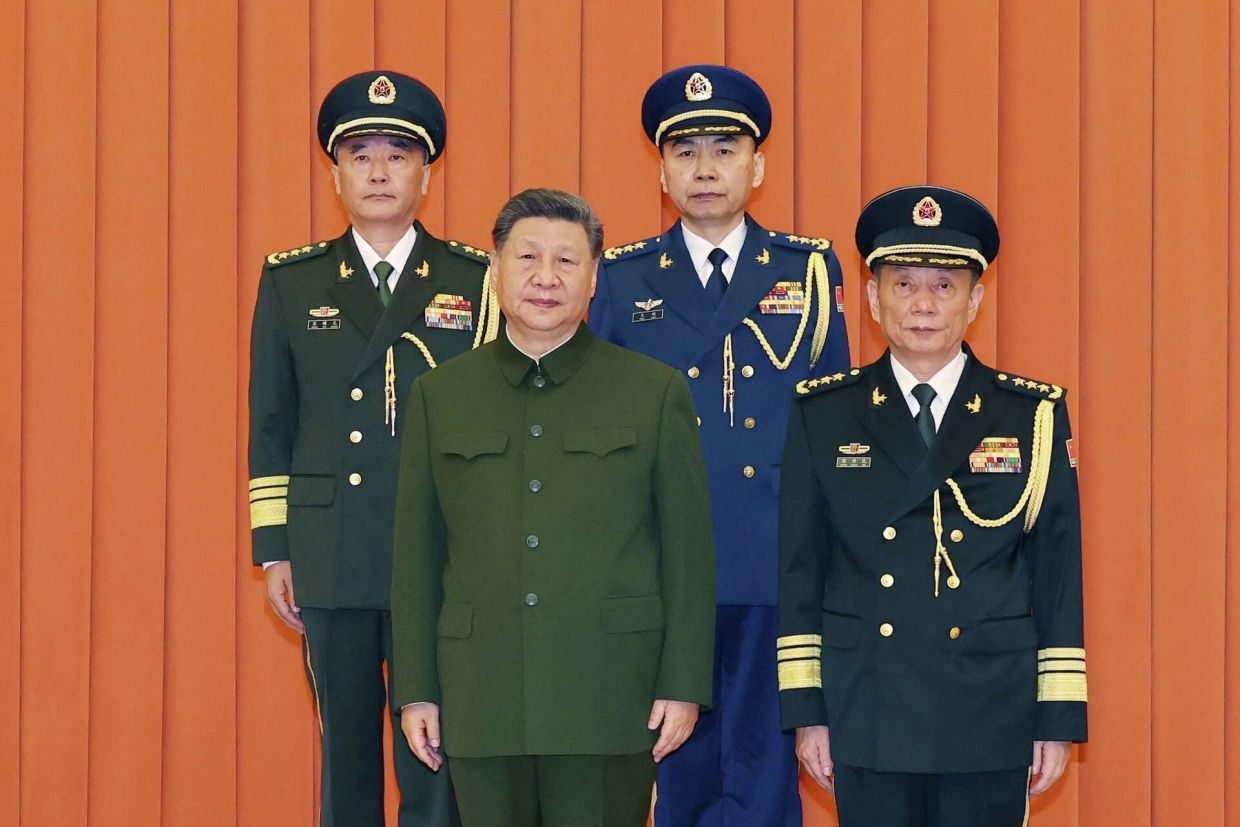
China's military has elevated two senior officers to the rank of general, signalling an imminent reorganisation of the country's top defence apparatus following a sweeping anti-corruption investigation that has systematically removed numerous commanders from their posts. The promotions of Zhang Shuguang and air force commander Wang Gang, announced at a state ceremony on Friday, July 3, represent a significant reshuffle in the highest echelons of the People's Liberation Army as it contends with depleted leadership ranks resulting from years of graft investigations.
The two promotions sit within a broader strategic effort by the Chinese Communist Party to reinforce military allegiance to party leadership and, more specifically, to Xi Jinping, who simultaneously serves as chairman of the Central Military Commission, the apex governing body of China's defence establishment. Xi's role as military commander provides him with unprecedented authority to reshape the officer corps and entrench party control over what has traditionally been a source of internal power dynamics within Beijing's upper echelons.
Zhang Shuguang's elevation carries particular significance beyond his new rank. In addition to his promotion to general, he has been assigned responsibility for leading the division of the Central Military Commission tasked with investigating and rooting out corruption among military personnel. This dual appointment consolidates both investigative authority and command status in a single figure, effectively positioning him as both prosecutor and senior officer within an institution where such concentration of power carries substantial implications for internal military politics.
The state of the Central Military Commission itself underscores the magnitude of the purge affecting China's military leadership. The seven-member body, designed to provide collegial oversight of defence matters, has been functionally reduced to just two active members following the removal or effective removal of several senior commanders. Beyond Xi, who chairs the commission, only Vice Chair Zhang Shengmin remains in an active capacity, a depletion that reflects the aggressive scope of the anti-corruption drive.
Two former vice chairs have departed from their positions either through formal removal or through circumstances effectively excluding them from meaningful participation. The military's top general, historically one of the most powerful positions in the defence establishment, has similarly been pushed out of active leadership. This turnover at the vice-chair level represents not merely routine personnel management but a fundamental restructuring of power relationships within an institution of approximately two million active personnel.
The promotions of Zhang and Wang position both officers as credible candidates to fill vacancies expected to materialise on the Central Military Commission. By elevating them to general rank and, in Zhang's case, assigning him oversight of the very corruption investigations that have created these vacancies, the party signals its intention to fill senior positions with officers deemed ideologically reliable and personally loyal. Such appointments carry implications for broader strategic decision-making within the military, particularly regarding military spending priorities, force modernisation, and responses to regional security challenges that affect the entire Asia-Pacific region.
For Southeast Asian nations monitoring China's military trajectory, the timing and nature of these leadership changes warrant close attention. Military modernisation programmes, defence spending allocations, and the operational posture adopted by the People's Liberation Army towards surrounding waters and airspace depend substantially on decisions made by the Central Military Commission. Leadership transitions within this body potentially signal shifts in strategic orientation or priorities that ripple across the region.
The anti-corruption campaign itself, while publicly justified as necessary housekeeping, has operated as an instrument of centralisation that concentrates decision-making authority within the party structure and, more specifically, within Xi Jinping's personal network. By systematically removing officers and replacing them with officers positioned as loyal to his leadership, the party ensures that military decision-making aligns with broader party objectives. The removal of competing power centres within the defence establishment reduces the possibility of institutional resistance to party directives.
Looking ahead, the Central Military Commission is scheduled for comprehensive restructuring in autumn of next year, coinciding with the conclusion of the current commission's five-year term. This timing creates a natural opportunity for introducing a fully reconstituted leadership structure reflecting the changed conditions created by the anti-corruption purge. The appointment of new members will likely determine the strategic direction of the Chinese military for the subsequent five-year period and establish the leadership framework through which major decisions regarding defence budgets, force deployments, and operational priorities will be made.
The mechanics of these promotions and assignments reveal how China's leadership employs anti-corruption investigations as tools of institutional control. Individuals elevated during such periods are implicitly understood to owe their advancement to the party apparatus that enabled their promotion. This creates reinforcing cycles of loyalty, where officers dependent on Xi and the party structure for their positions are presumed to execute party decisions without institutional resistance. The result is a military establishment increasingly aligned with centralised party direction rather than functioning as an institution capable of advancing separate institutional interests.
For regional observers, the consolidation of authority within the military and its subordination to centralised party control carries implications for military decision-making and crisis management. Officers who fear that expressing independent judgment or institutional perspectives might be interpreted as disloyalty may be reluctant to counsel caution or raise concerns about proposed military operations. This potential dynamic could affect how military calculations are conducted regarding regional disputes, military exercises, or responses to perceived challenges to Chinese interests.

