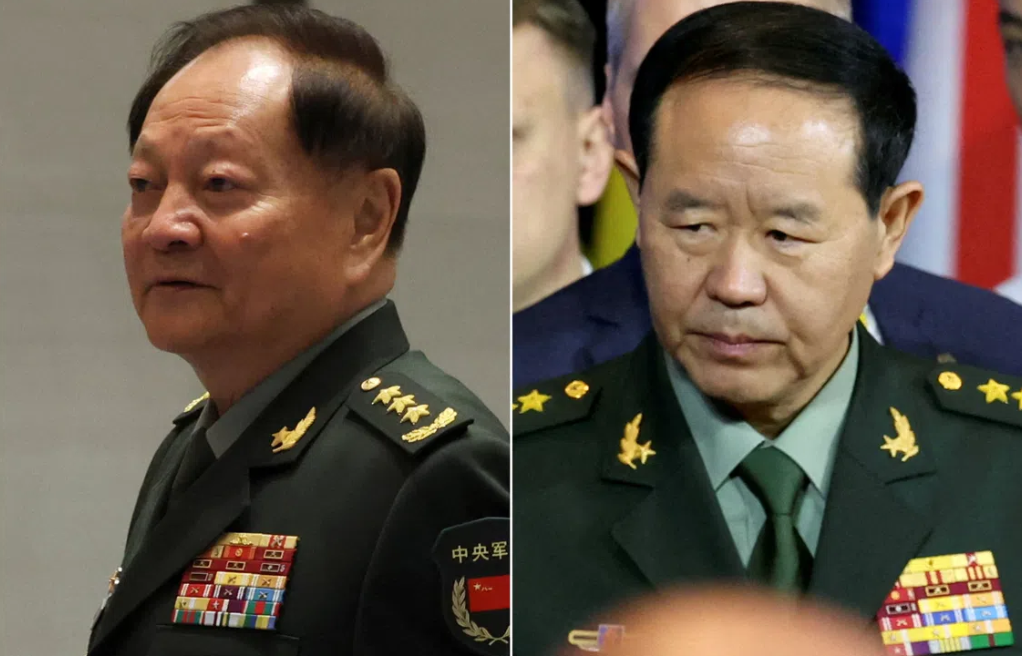
China has moved to eliminate two of its most powerful military figures from the Central Military Commission, the nation's highest defence authority, following investigations into alleged serious breaches of discipline and law. The removal of Zhang Youxia and Liu Zhenli represents a dramatic escalation of the corruption purge that has reshaped China's military leadership over the past decade, leaving the commission with just two functioning members alongside President Xi Jinping himself.
Zhang Youxia held one of the most senior positions in China's defence establishment as vice-chairman of the CMC and a standing member of the Politburo, the Communist Party's supreme decision-making body. His departure signals a major restructuring at the apex of military power. Liu Zhenli, serving as both a CMC member and chief of staff of the Joint Staff Department, occupied another critical post responsible for coordinating military operations across all service branches. Their simultaneous removal suggests a coordinated action rather than isolated disciplinary matters.
The parliamentary announcement came via the Standing Committee of the National People's Congress, which released an updated roster of deputies on Friday that conspicuously omitted both officers' names. This formal removal from state CMC positions represents the public acknowledgement of their downfall, though official statements have not yet clarified whether they have similarly been stripped of their roles within the ruling Communist Party's parallel military commission structure. China maintains two nominal CMC frameworks—one under party control and one under state authority—though they function as a unified institution in practice.
The military has emerged as a primary focus of Xi Jinping's broader anti-corruption offensive since he assumed power in 2012. This sweeping campaign has transformed the armed forces from an institution riddled with patronage networks and factional rivalries into a more centralised apparatus directly accountable to Xi's authority. Over more than a decade, the crackdown has ensnared dozens of high-ranking officials and senior commanders, fundamentally reorganising the military hierarchy and eliminating potential power centres that might challenge Xi's consolidation of control.
As recently as last month, Xi publicly exhorted senior Communist Party leaders to intensify their focus on rooting out corruption within military ranks, signalling that the campaign shows no signs of abating. This rhetorical push appears to have translated into immediate action, with Friday's announcement demonstrating that even the highest echelons of the defence establishment remain vulnerable to investigation and removal. The timing and scope of these removals underscore Xi's determination to maintain absolute command over the armed forces as he enters what many analysts expect to be an extended tenure as paramount leader.
Beyond the two principal figures, China's parliament also formally removed ten other lawmakers from their positions, revealing the breadth of the current purge. Among them is Lieutenant General Zhong Shaojun, who previously headed the CMC General Office—a sensitive position overseeing administrative and potentially classified functions of the commission. General Ju Qiansheng, former commander of the military's Strategic Support Force, also lost his seat, indicating that the removals extend across multiple command structures. The Strategic Support Force, a relatively new and highly technical branch responsible for information warfare and cyber operations, represents one of China's most critical military capabilities, making Ju's removal particularly significant.
The purge also extends beyond active military figures into the civilian-military nexus. Gao Shiwen, a former mayor of Nanchang in southern China, was stripped of his parliamentary position despite his background in state aerospace and defence industries. His connection to China Aerospace Science and Technology Corporation—a behemoth state enterprise central to China's space and missile programmes—suggests that the anti-corruption drive encompasses not merely uniformed military leaders but also defence-industrial officials who wield substantial influence over weapons development and procurement.
In a related development, China's top political advisory body, the Chinese People's Political Consultative Conference, separately removed Zhao Zongqi from membership this week. Zhao commanded the Western Theatre Command during the 2020 border clashes between Chinese and Indian forces in the Ladakh region, a conflict that killed at least twenty soldiers on the Chinese side and marked the bloodiest Sino-Indian military engagement in decades. His removal raises questions about accountability for the conflict's conduct and outcome, though official statements have attributed his removal to unspecified disciplinary violations rather than the border crisis specifically.
For Malaysia and other Southeast Asian nations, these developments carry significant implications for regional security calculations. A Chinese military in flux presents both opportunities and risks—uncertainty about command structure and leadership stability can complicate crisis management, yet a more cohesive and centralised military under Xi's personal control may prove more aggressive in pursuing territorial claims in disputed waters. The disappearance of two of China's most senior military officials without public explanation or trial also reflects the opaque nature of elite Chinese politics, making it difficult for foreign governments to assess whether these removals signal policy shifts or merely reflect internal power struggles within the military bureaucracy.

