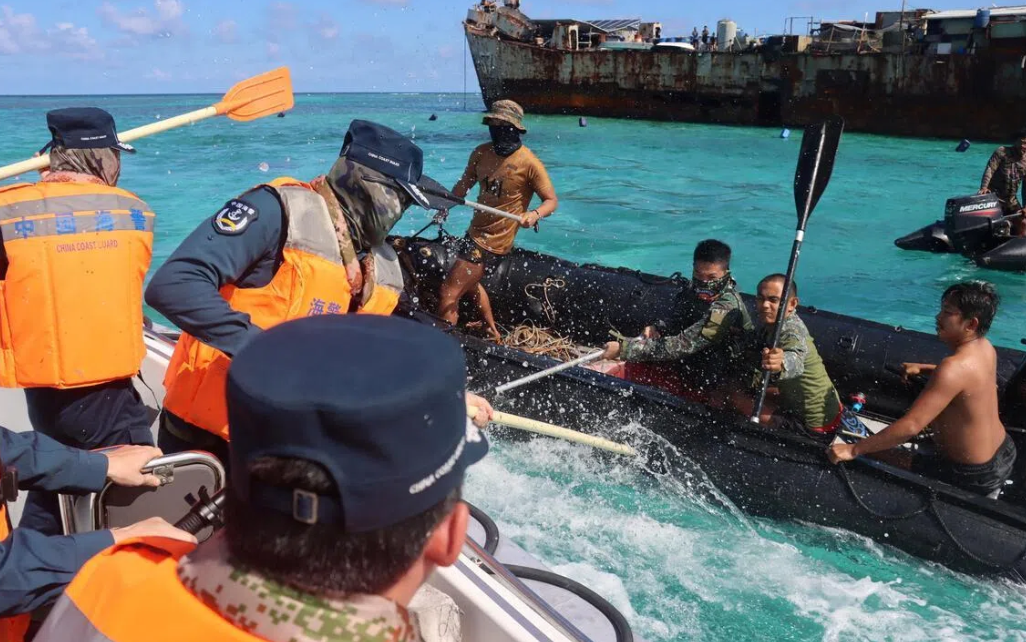
Diplomatic tensions between China and the Philippines have escalated sharply following a confrontation in the South China Sea, with Beijing summoning Manila's ambassador to lodge formal protests over what it characterises as deliberate provocation. The incident, which unfolded at Ren'ai Reef—also known as the Second Thomas Shoal—represents the latest flashpoint in a region where competing territorial claims and strategic interests regularly collide. The summons on Tuesday underscores how quickly disagreements in these contested waters can transform into high-level diplomatic incidents with ripple effects across the Indo-Pacific.
According to Philippine military accounts, Chinese Coast Guard personnel allegedly used a baton to strike a Filipino sailor on Monday as vessels approached a grounded Philippine military outpost that has functioned as a long-standing garrison at the shoal. This allegation of physical violence marks an escalation from previous encounters, which have typically involved water cannons and aggressive maneuvering. The incident triggered immediate condemnation from Manila, which characterises Chinese actions as unlawful interference in Philippine territorial interests and a threat to the safety of seafaring personnel engaged in legitimate military and supply operations.
Beijing's response has been characteristically defiant. China's Foreign Ministry rejected Philippine accusations, insisting instead that Manila initiated the confrontation and subsequently distorted the narrative for international consumption. Official statements accused the Philippines of deliberate provocation at the reef and claimed that China's response was entirely justified given what Beijing frames as illegal intrusions into waters under its jurisdiction. This rhetorical battle reflects the fundamental disagreement underpinning regional tensions: China asserts sovereignty over nearly the entire South China Sea based on historical claims, while the Philippines and other nations maintain overlapping territorial claims recognised through international maritime law.
The legal and political architecture surrounding these disputes has been clearly established, yet remains persistently contested by Beijing. A 2016 international arbitration tribunal ruled that China's sweeping claims to the South China Sea lack legal foundation under the United Nations Convention on the Law of the Sea. Despite this binding legal determination, China has refused to recognise the verdict and continues asserting control over vast maritime expanses. For Southeast Asian nations like the Philippines, this creates an untenable situation where international law provides legitimacy but enforcement remains elusive without great-power support.
The timing of this latest confrontation proved particularly significant, coinciding with US Secretary of State Marco Rubio's arrival in Manila for an Association of Southeast Asian Nations summit. Rubio's presence underscored Washington's continued commitment to regional stability and freedom of navigation principles that align directly with Philippine interests and oppose Chinese hegemonic aspirations in the waterway. The geographic and economic importance of the South China Sea—through which roughly one-third of global maritime trade transits—ensures that regional disputes inevitably attract great-power attention and intervention.
Rubio's public statements reinforced American determination to counter what Washington characterises as Beijing's dangerous and aggressive conduct in the region. In a newspaper column published across Philippine media platforms, Rubio articulated the US vision of a South China Sea where freedom of navigation remains guaranteed and no single power exercises monopolistic control through coercive economic or military means. His language deliberately invoked the spectre of Chinese dominance, warning that if Beijing gained unchallenged control over these waters, both American interests and Southeast Asian sovereignty would face unprecedented threats. This framing transforms the dispute from a purely bilateral Philippine-Chinese matter into a broader contest over regional order and great-power influence.
Australian Foreign Minister Penny Wong joined Western allies in condemning Beijing's conduct as destabilising and dangerous, extending international concern beyond the traditional US-China dynamic. Canberra's involvement reflects how South China Sea tensions have become embedded within the broader Indo-Pacific security architecture, where Australia, the United States, Japan, and India increasingly coordinate positions on regional maritime disputes. For Malaysia and other Asean members, this internationalisation of South China Sea issues presents both opportunities and complications, as it elevates regional concerns while simultaneously inviting external power competition into Southeast Asian waters.
The prospect of bilateral talks between Rubio and Chinese Foreign Minister Wang Yi at the Asean summit offered a potential diplomatic opening, though no formal negotiations had been confirmed publicly at the time of reporting. The two officials had previously met at an Asean gathering in Kuala Lumpur and subsequently in Munich earlier in the year, establishing channels of communication despite fundamental strategic competition. Such high-level engagement demonstrates that despite rhetorical hostility and military posturing, great powers maintain diplomatic mechanisms for managing disputes and preventing escalation.
For Malaysia and the broader Asean community, these recurring South China Sea incidents underscore persistent vulnerabilities in the regional security environment. While Asean has historically pursued consensus-based diplomacy and sought to maintain strategic autonomy between great powers, the frequency and intensity of maritime confrontations increasingly force individual member states to align more explicitly with either Beijing or Washington-led frameworks. Malaysia's own territorial claims in the South China Sea, though less publicised than those of Vietnam or the Philippines, remain subject to similar pressures and uncertainties regarding enforcement and international protection.
The incident also highlights the practical dangers inherent in contested waters where military and coast guard vessels operate in close proximity without clear rules of engagement or mutually agreed protocols for safe interaction. Previous incidents have occasionally resulted in casualties, environmental damage, and resource losses, yet comprehensive maritime safety agreements remain elusive due to fundamental disagreements over sovereignty and jurisdiction. Establishing mechanisms to prevent escalation and protect personnel engaged in routine operations represents a shared interest that transcends political divisions, yet implementation requires acknowledgment of disputed sovereignty claims—precisely what China refuses to concede.
Longer-term implications extend beyond immediate bilateral tensions between China and the Philippines. The incident reinforces perceptions among Southeast Asian nations that great-power competition in the region is intensifying rather than stabilising, and that individual Asean members must cultivate external partnerships to maintain security. This dynamic potentially undermines Asean's traditional emphasis on non-aligned cooperation and collectively addressing regional challenges. Conversely, it reflects the reality that in an era of intensifying US-China competition, pure neutrality increasingly carries costs that smaller nations struggle to absorb.
The Asean summit itself acquired additional significance as a venue for discussing South China Sea tensions and coordinating regional responses to Chinese assertiveness. Secretary of State Rubio's participation and his explicit messaging about freedom of navigation signalled American determination to remain central to regional security architecture despite recent political changes in Washington. For Malaysian observers, the gathering offered an opportunity to assess how Asean member states were balancing Chinese economic integration with concerns about military pressure and strategic autonomy.

