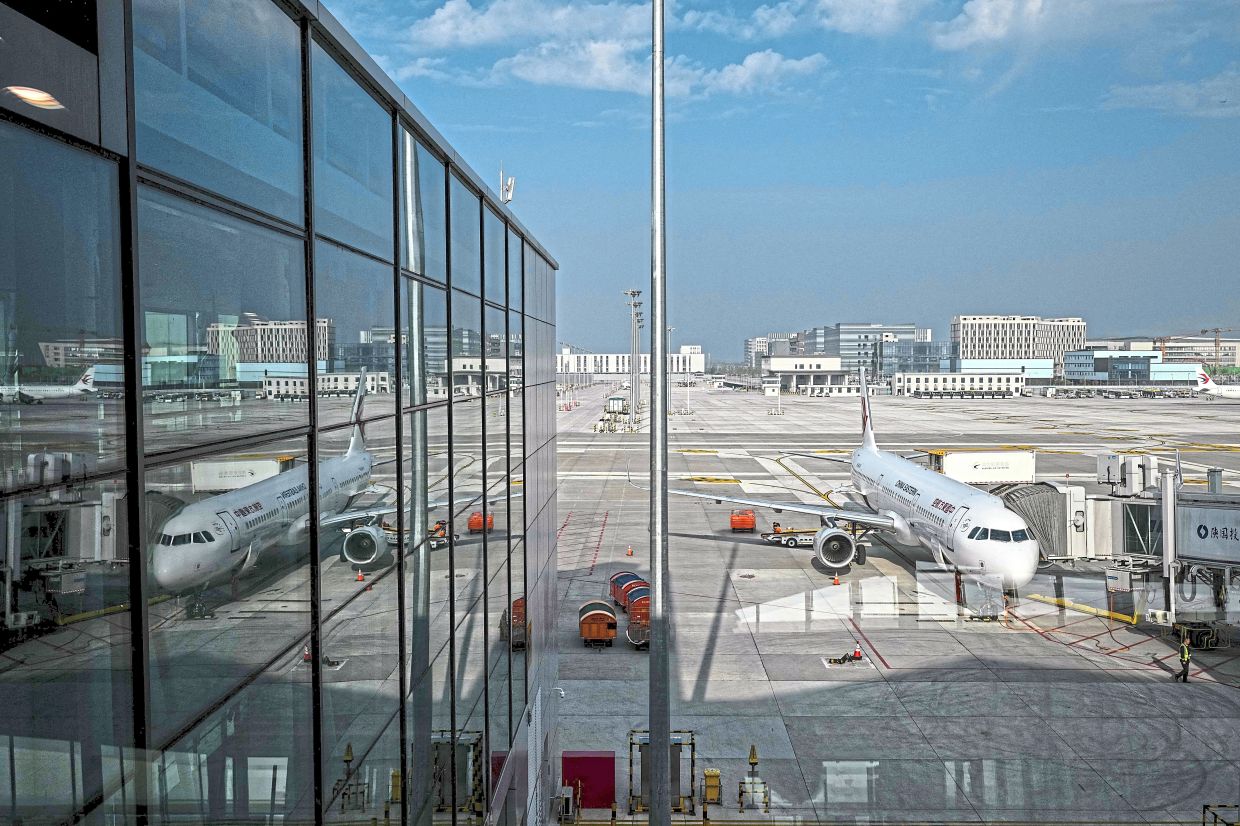
China's three dominant state-owned airlines have sunk deeper into the red, reporting combined first-half losses of approximately 8.2 billion yuan as elevated jet fuel expenses and dampened travel demand continue to erode profitability across the sector. Air China, China Eastern Airlines and China Southern Airlines disclosed the disappointing results on Monday, marking the seventh consecutive year these carriers have reported first-half losses—a stark reminder of how fragile recovery remains in Chinese aviation following the pandemic era.
The magnitude of the financial deterioration is particularly striking when compared to earlier momentum. These three carriers had generated a combined profit of 4.82 billion yuan in the first quarter, buoyed by robust Lunar New Year travel demand. The reversal into losses during the second quarter underscores just how sharply conditions deteriorated mid-year, and the results triggered immediate weakness in airline shares across both Shanghai and Hong Kong exchanges. Air China recorded a net loss of 2.3 billion yuan, nearly 27 percent worse than the 1.81 billion yuan loss it posted in the corresponding period of 2025. China Eastern's loss widened to 2.2 billion yuan from 1.43 billion yuan year-on-year, while China Southern—the hardest hit of the trio—reported a loss of 3.7 billion yuan, more than double its 1.53 billion yuan loss from the same period last year.
The primary culprit driving these losses is the sustained elevation in jet fuel costs, which remain fundamentally disconnected from the broader energy market recovery. Fuel expenses at each carrier climbed between 35 and 38 percent during the first half, directly attributable to geopolitical tensions in the Middle East that have kept oil prices elevated. China Eastern explicitly cited a profit environment "severely undermined" by disrupted international routes and persistently high jet fuel prices linked to regional conflict. Notably, Chinese airlines operate with minimal fuel hedging compared to many international competitors in Asia and Europe, leaving them substantially more vulnerable to oil price volatility. China Southern acknowledged in regulatory filings that "no effective means" currently exist to adequately manage exposure to jet fuel price fluctuations, essentially admitting the carrier operates without adequate protection against energy market shocks.
Despite these challenges, the carriers have achieved meaningful revenue growth that demonstrates underlying demand strength, yet this growth has proven insufficient to overcome fuel headwinds. Air China recorded a 10.5 percent revenue increase, China Eastern grew revenue by 11.1 percent, and China Southern expanded revenues by 9.7 percent, all driven substantially by international route expansion and strong customer demand. European routes particularly benefited as certain passengers deliberately rerouted away from Middle Eastern hub airports disrupted by conflict. This geographic shift reveals how geopolitical factors are reshaping aviation networks across Asia and Europe. However, the domestic market has proven much less accommodating, with Chinese carriers unable to implement substantial fare increases without depressing passenger volumes—a sharp contrast to the pricing power enjoyed by American carriers during comparable recovery periods. Intense competition from high-speed rail networks and driving holidays has constrained the pricing flexibility that could otherwise help offset fuel expenses.
The outlook for the remainder of 2026 appears decidedly bleak based on current conditions and analyst projections. Although jet fuel prices have retreated from their second-quarter peaks, they remain anchored at levels more than 50 percent above pre-conflict benchmarks, suggesting sustained structural pressure on margins. The third quarter, which traditionally represents the most profitable period for Chinese carriers, has failed to deliver typical seasonal relief. An exceptionally aggressive typhoon season has disrupted domestic routes precisely when passenger volumes typically peak during summer holidays. Meteorological records indicate 21 typhoons have developed across the northwestern Pacific Ocean and South China Sea thus far in 2026—nine additional systems beyond historical averages for this period. Flight Master, an aviation data analytics firm, projects Chinese airline traffic during July and August will contract 3.6 percent year-on-year to 142 million passengers, marking the first summer season contraction since 2022 when pandemic lockdowns paralysed the economy.
Longer-term financial projections from major investment banks paint an even darker picture than current performance might suggest. HSBC analysts project the three carriers will post combined losses of approximately 16.8 billion yuan throughout 2026—a figure that stands starkly against market consensus expectations of merely 1.3 billion yuan in combined profit. This analytical divergence suggests either dramatic near-term improvement or that consensus expectations have failed to incorporate the full extent of structural headwinds. Shanghai-listed shares of all three carriers have declined at least 36 percent since the year began, reflecting investor concerns about persistent domestic travel weakness and deteriorating profit forecasts. Notably, none of the carriers declared interim dividends, signalling management expectations that cash preservation takes priority over shareholder distributions during this extended crisis period.
One significant bright spot amid the industry gloom involves the carriers' continued embrace of domestically produced aircraft. China Eastern expanded its fleet of COMAC C919 narrow-body aircraft to 17 units after accepting three deliveries during the first half, while both Air China and China Southern operate 11 C919s each following two and three additional deliveries respectively. This fleet modernisation demonstrates China's commitment to developing indigenous aviation manufacturing capabilities and reducing dependence on foreign aircraft suppliers. However, even this positive development carries clouds: China Eastern revised downward its anticipated C919 deliveries between 2026 and 2028, now expecting 13 fewer aircraft than previously forecast, presumably reflecting weakened cash generation capacity and reluctance to take on additional capacity amid demand uncertainty.
The struggles of China's aviation giants carry meaningful implications throughout East and Southeast Asia, where carriers compete for regional traffic and code-sharing partnerships. Persistent weakness in Chinese carriers could cede market share to better-capitalised Asian competitors, potentially reshaping competitive dynamics across critical regional corridors. For Malaysian and Southeast Asian airlines, Chinese weakness creates both opportunities—capturing diverted passengers and gaining scheduling slots at congested hubs—and risks should the Chinese carriers engage in aggressive promotional pricing to stabilise market positions. The sector's vulnerability to external shocks like fuel price swings and weather disruptions also underscores systemic fragility that could spread if conditions deteriorate further. Understanding these dynamics matters increasingly as economic integration deepens across the region and travel patterns reflect shifting geopolitical balances.

