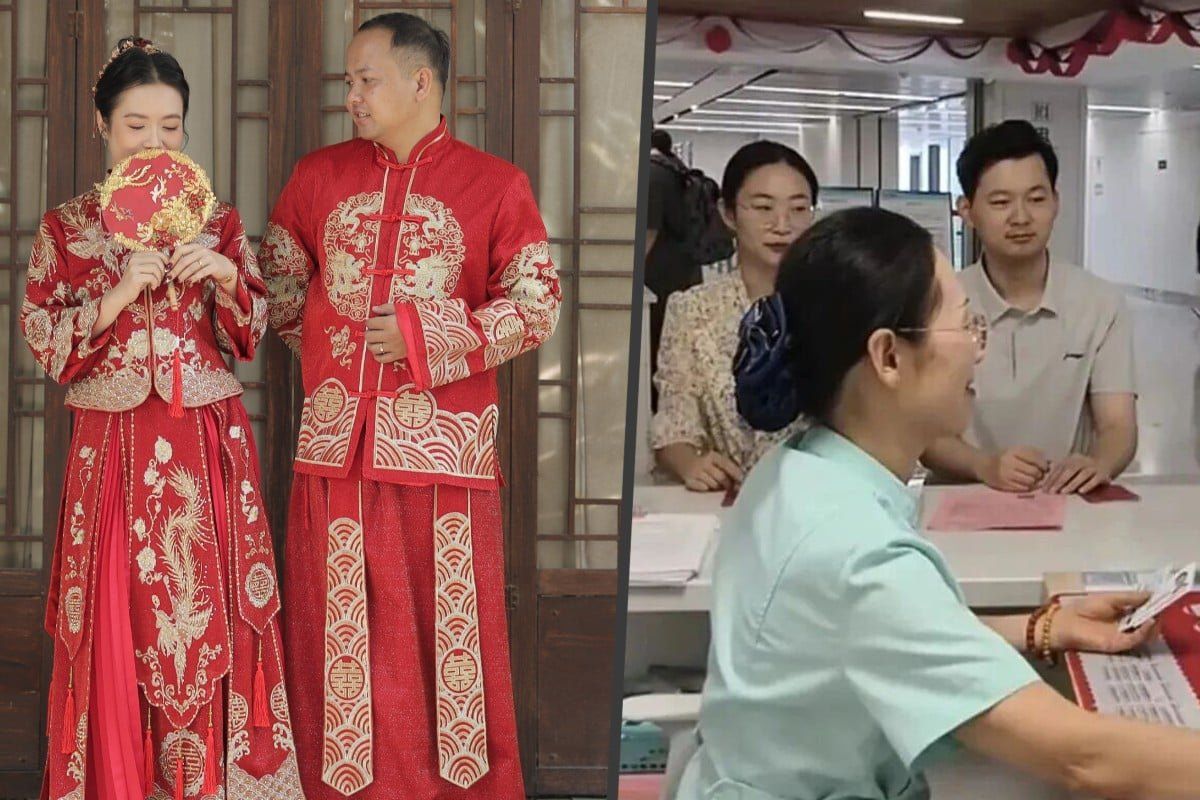
China's government is deploying an unconventional strategy to combat one of its most pressing demographic challenges: the stubborn refusal of young people to marry. Across the country, hospitals, banks, airports, and nightclubs have joined temples and public parks in offering marriage registration services, transforming what was once a purely bureaucratic affair into a diversified ecosystem designed to reduce friction and encourage couples to formalize their unions. The campaign reflects mounting anxiety in Beijing about population decline and generational attitudes toward matrimony, with authorities essentially competing to make getting married as convenient and appealing as possible.
The trend accelerated dramatically after May last year, when China overhauled its marriage registration regulations to eliminate longstanding bureaucratic obstacles. Couples no longer need to present their household registration booklets, and they can register in any location regardless of where their official hukou, or household registration, is held. These changes eliminated what had been significant procedural barriers, particularly for migrant workers and those marrying outside their home provinces. The simplification was intended as a small but meaningful step toward normalizing marriage across China's vast geography, yet it unexpectedly opened the floodgates for creative venues eager to capitalize on the trend.
The expansion of registration venues has been remarkably swift and diverse. In August, the Postal Savings Bank of China established marriage registration at a Tianjin branch, becoming the first financial institution nationally to offer the service. That same month, during China's Qixi Festival—the traditional equivalent of Valentine's Day—the Maternal and Child Health Hospital in Zibo, Shandong province announced it would handle marriages alongside premarital examinations and preconception guidance, consolidating several life-stage services under one roof. The hospital framed this as a convenience initiative, allowing newlyweds to complete essential health checks and receive counseling in tandem with their legal registration.
Airports have also entered the competition. Guangzhou Baiyun International Airport in Guangdong became the nation's first airport to issue marriage certificates in January, sweetening the deal by offering couples complimentary access to its observation deck. Shanghai's nightclub partnership with the civil affairs bureau brought marriage ceremonies into nightlife venues, representing perhaps the most culturally incongruous pairing. In Beijing and Nanjing, historic temples provide traditional settings for ceremonies, while Hefei's metro station became the first transport hub to offer registrations. By May this year, just one year after the regulatory changes, China had established over 500 dedicated marriage registration sites outside traditional civil affairs bureaus, with a further 1,300 outdoor locations collaborating to issue certificates.
The rapid proliferation of venues suggests genuine government commitment to addressing marriage decline, yet the results reveal a more complicated picture. In the third quarter of last year, 1.61 million couples registered marriages nationwide, a 22.5 percent increase year-on-year, suggesting the initiatives gained immediate traction. For the full year, China recorded 6.76 million marriages, an increase of 657,000 from the previous year. These figures seemed to validate the convenience-focused approach. However, the momentum proved ephemeral. During the first half of this year, marriages dropped 7.5 percent year-on-year, with just 3.28 million couples formalizing unions, indicating that the initial boost has dissipated.
The public reception to these initiatives has been mixed, with social media commentary revealing skepticism about whether procedural convenience actually addresses the underlying causes of marriage avoidance. Online critics argue that the proliferation of registration venues is fundamentally misdiagnosed as a solution. One widely circulated comment asked pointedly: "Do people not get married because they can't find a place to register?" Another user sarcastically suggested the civil affairs bureau establish divorce services atop Mount Everest, highlighting the absurdity of expanding venue options without tackling substantive obstacles.
What emerges from public discourse is a clearer articulation of the real barriers keeping young Chinese from marriage. Multiple commenters pointed to psychological and financial anxieties rather than administrative inconvenience. One observation noted that young people fear the financial burdens of matrimony, potential family conflicts, and erosion of personal autonomy—concerns that no airport registration or hospital partnership can alleviate. Another contributor suggested that marriage no longer holds the aspirational or obligatory status it once commanded in Chinese society. Younger generations increasingly view matrimony as discretionary rather than inevitable, a fundamental shift in cultural values that cannot be reversed through procedural streamlining.
The demographic context lending urgency to China's marriage push is severe. The country faces a rapidly aging population, a shrinking workforce, and below-replacement fertility rates that threaten long-term economic viability. The government has repeatedly adjusted family planning policies, relaxing restrictions to encourage births, yet young people continue deferring or rejecting marriage altogether. This disconnect suggests that policy responses operating at the procedural level may miss the deeper economic and social transformations reshaping Chinese family formation patterns. Young people navigate precarious job markets, soaring housing costs, and mounting pressure to support aging parents—circumstances that make the commitment of marriage feel increasingly risky.
Divorce registration has not received equivalent convenience treatment, with most outdoor marriage sites declining to offer dissolution services, citing documentation requirements. This asymmetry itself carries symbolic weight, suggesting that authorities view marriage and divorce as fundamentally different endeavors worthy of different levels of accessibility. The implications for marriage stability and commitment remain unclear, though critics might argue it sends a contradictory message about society's actual stance toward the institution.
For Malaysia and Southeast Asia broadly, China's struggle illuminates demographic challenges increasingly shared across the region. Rising costs of living, changing gender roles, female workforce participation, and declining cultural emphasis on traditional family formation are pressuring marriage rates across developed and developing economies alike. China's experience suggests that convenience-based solutions alone prove insufficient when confronting systemic economic anxiety and shifting generational values. Policymakers in other countries watching this experiment may recognize that addressing marriage decline requires confronting housing affordability, wage stagnation, work-life balance, and the genuine freedom young people now exercise in rejecting traditional life trajectories—factors far more complex than streamlining bureaucracy.

