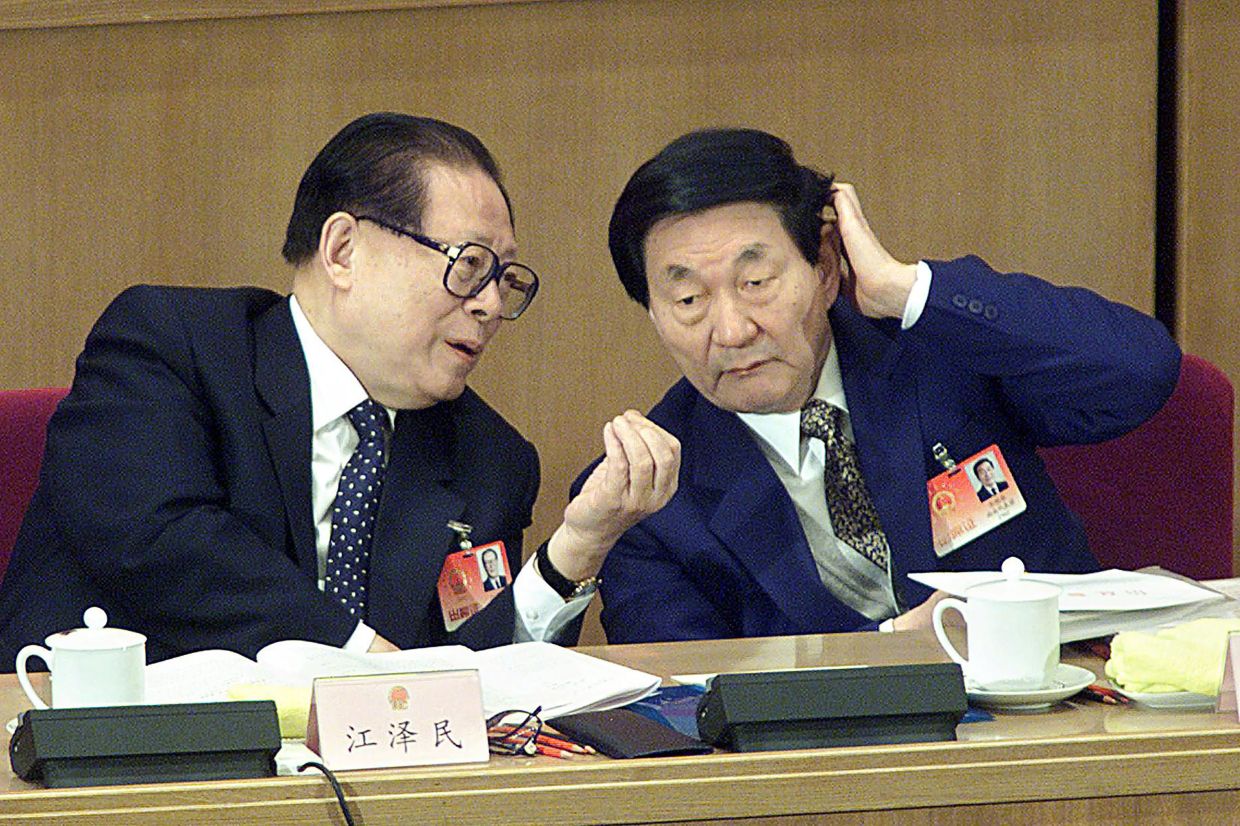
China's recent twin tributes to two towering figures of its late 20th-century transformation have become a lens through which the country is reassessing its trajectory. Within the span of days, the nation honoured Jiang Zemin, the former president and paramount leader who shaped Chinese politics for nearly a decade and a half, on what would have been his 100th birthday, and said farewell to Zhu Rongji, the trenchant premier whose economic restructuring fundamentally altered the nation's relationship with market forces. The back-to-back remembrances have opened a cultural conversation about the nature of progress and continuity, even as official channels carefully frame these legacies within Xi Jinping's contemporary political narrative.
Zhu's passing on August 12 at 97 years of age was marked by a full state funeral on August 18, with flags lowered to half-mast across the country in a gesture of national mourning. The ceremony took place at Babaoshan Revolutionary Cemetery, where Xi Jinping and members of the Communist Party's highest councils performed ritual bows and extended condolences to the family. A day earlier, Beijing had mounted an elaborate celebration of Jiang's centennial, a high-profile gathering in the Great Hall of the People that drew thousands and featured a 40-minute address from Xi himself. The timing of these two events, occurring within hours of each other, has given them a combined resonance that single memorials rarely achieve, prompting reflection on an era when these two men governed in tandem from 1998 to 2003.
The official response has been carefully orchestrated to present continuity rather than nostalgia. Xi's commemorative speech dwelled extensively on Jiang's personal qualities—his steadfastness of conviction, his unwavering party loyalty, his commitment to citizens' welfare, and his capacity for visionary decision-making during crises ranging from the catastrophic 1998 floods to the Asian financial turmoil. These virtues were explicitly connected to what the party terms the "new journey"—a governing slogan that has gained prominence since 2022, emphasising national rejuvenation and Chinese-style modernisation. By framing Jiang's achievements as historical steps leading toward Xi's current agenda, the leadership has essentially positioned the former president not as an alternative model but as a predecessor within an unbroken lineage of party wisdom.
Yet beneath this controlled narrative lies a more complicated emotional reality. Across Chinese social media, nostalgic imagery has proliferated—old photographs and video clips of Jiang and Zhu, often depicting moments of camaraderie, have circulated widely. Users have shared content highlighting Jiang's distinctive public personality and Zhu's reputation for blunt, sometimes refreshingly candid speech. This popular outpouring reveals a hunger among many Chinese citizens to recall the confidence and dynamism associated with that era of rapid economic expansion. However, the political sensitivities around such comparisons between past and present have forced those expressing these sentiments to resort to coded language and oblique references. Internet users have employed nicknames and euphemisms—such as "the Elder" for Jiang—to evade automated censorship systems that scrutinise content perceived as implicitly criticising current governance.
The suppression of these nostalgic expressions points to a fundamental tension at the heart of the official commemoration. An essay by prominent economist Zhao Jian, published in the aftermath of Zhu's death, captured this undercurrent by contrasting the sense of security and forward-looking optimism of three decades ago with contemporary feelings of uncertainty and anxiety. The piece was swiftly removed from the messaging platform WeChat, illustrating how sensitive Beijing remains about narratives that implicitly judge the present against the past. The Communist Party's concern is not merely about historical accuracy but about control of the frame through which citizens evaluate their circumstances.
Observers of Chinese elite politics have noted that the timing of these commemorations carries significance beyond its surface meaning. As the party prepares for its next major congress in late 2027, when substantial leadership reshuffles are expected to occur, the current leadership appears acutely conscious of image management and party cohesion. Daria Impiombato, a senior analyst at the Mercator Institute for China Studies, has observed that at this juncture, the paramount concern is demonstrating loyalty to the party hierarchy and securing ideological consensus. The narrative surrounding Jiang and Zhu serves partly as a mechanism for reinforcing party unity and subordinating individual ambition to collective institutional purpose.
The substantive legacies of Jiang and Zhu, however, reveal complexities that selective commemoration glosses over. Jiang rose to prominence through Deng Xiaoping's intervention following the 1989 Tiananmen upheaval, eventually consolidating control over China's turbulent political apparatus while steering the nation out of international isolation. His tenure witnessed China's integration into global institutions and the maintenance of a measured relationship with the United States despite persistent friction. Yet his era was simultaneously marked by pervasive corruption and forceful suppression of movements he deemed threatening, including the sustained crackdown on Falun Gong practitioners. These contradictions—advancement alongside restriction—characterise his rule in ways that official commemorations prefer to minimise.
Zhu's legacy, centred on radical economic restructuring, presents a different set of ambiguities. His tenure as premier coincided with China's successful entry into the World Trade Organisation, a transformative moment that opened markets and accelerated growth. His sweeping reforms of lumbering state-owned enterprises and the fiscal system were economically significant, yet they exacted enormous social costs. The shake-up in state enterprises displaced more than 30 million workers, creating waves of unemployment and social dislocation that reverberates in contemporary discussions of state-citizen relations. Beyond the immediate human toll, economists now recognise that Zhu's 1994 tax-sharing reform, by forcing local governments to depend on land sales for revenue, inadvertently created the structural conditions that have culminated in today's property sector crisis and the accumulation of dangerous local government debt. The reforms that appeared salutary at the time have generated long-term liabilities that Xi's administration now confronts.
The broader context of these commemorations illuminates why they have become politically delicate. China today faces a markedly different economic environment than the 1990s and early 2000s, when growth was boisterous and the nation's rising trajectory seemed unambiguous. Contemporary challenges—slowing GDP expansion, a foundering property market that accounts for a substantial portion of local government finances and household wealth, mounting debt burdens, and escalating geopolitical tensions with major Western powers—create a backdrop against which comparisons between past and present become fraught. The "reform era" is increasingly viewed through the prism of these difficulties, with some implicitly asking whether the confidence and flexibility of Jiang and Zhu's time might offer lessons for addressing current impasses.
Lee Jong-hyuk, a scholar of Chinese politics at South Korea's Sungkyunkwan University, has emphasised that while Jiang and Zhu's legacies are not identical, the temporal proximity of their commemorations necessarily invites reflection on the broader reform trajectory they embodied. The fact that these reflections occur at a moment of economic strain and international friction, rather than during a period of unchallenged prosperity, intensifies the psychological resonance. The question implicit in public mourning—was it better then?—becomes simultaneously a question about governance and direction.
The state's response has been to emphasise party loyalty and institutional continuity while subtly warning against nostalgia that might undermine confidence in current leadership. The duality of the official narrative—celebrating Jiang and Zhu's achievements while subordinating them to Xi's vision—reflects the Communist Party's awareness that these figures commanded genuine affection and admiration, and that dismissing them entirely would ring hollow. Instead, the strategy is to absorb their legacies into a seamless historical narrative in which each leader contributes to an unfolding party mission. Yet the gap between this managed narrative and the genuine sentiment circulating on social media reveals a population with more complicated feelings about continuity and change than official ceremonies acknowledge.
As China navigates slowing growth, property-sector turbulence, and geopolitical challenges, the memory of Jiang Zemin and Zhu Rongji has become a mirror reflecting both accomplishment and limitation. The generation that came of age during the heady expansion of the 1990s and early 2000s carries living memory of different possibilities and different confidence levels. The Communist Party's careful orchestration of these commemorations suggests a recognition that these historical figures, and the era they represented, retain symbolic power that cannot be entirely subordinated to present agendas. The tension between official narrative and popular sentiment will likely persist, shaping how China's leadership legitimacy is constructed in the years ahead.

