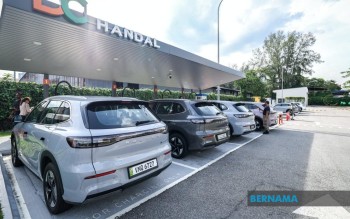
Chinese electric vehicle charging technologies are making inroads into Malaysia as the country's automotive sector pivots toward electrification, with analysts projecting significant market growth over the coming three to five years. The trajectory of this expansion, however, hinges on something beyond merely shipping proven technologies across borders—successful deployment demands fundamental redesign to account for Malaysia's distinct environmental and operational contexts.
Xi'an LINCHR New Energy Technology Co Ltd, a major player in smart charging infrastructure, is actively positioning itself within this emerging landscape. The company's leadership argues that while neighbouring China blazed an early trail in both EV adoption and the charging ecosystem required to support it, the lessons drawn from that experience cannot be mechanically transplanted to Malaysia's unique conditions. Speaking at the Global Automotive and Technology Expo at MITEC from August 26 to 28, LINCHR chairman Yuan Qingmin articulated a nuanced position: technology transfer is fundamentally different from technology replication, requiring deliberate localisation efforts and investment in region-specific research and development.
The interplay between vehicle electrification and charging infrastructure forms a chicken-and-egg dynamic that has long preoccupied policymakers and investors. Growth in one sector generates demand for the other, yet insufficient charging networks can dampen EV uptake, which in turn discourages further investment in charging stations. Yuan underscored this mutual dependency, suggesting that any bottleneck in infrastructure development risks constraining the overall transition to electric mobility. This consideration carries particular weight in Malaysia, where the automotive industry remains strategically important and where transport electrification is increasingly embedded in national energy and climate policies.
LINCHR's entry into the Malaysian market is not taking place in isolation. The company has forged a partnership with local manufacturer Swift Bridge Technologies Sdn Bhd to jointly develop charging infrastructure tailored for domestic deployment. This collaboration extends across multiple dimensions—from establishing appropriate technical standards and designing products suited to local conditions, through to engineering specifications and laboratory testing protocols. Such a partnership structure reflects international best practice in technology transfer, where foreign expertise combines with local knowledge to produce solutions genuinely optimised for their operating environment.
The company boasts considerable credentials in its home market, commanding over seventy per cent of China's testing technology market share. Yet Yuan was candid about the challenges of international expansion: success depends not on exporting the same products that succeeded domestically, but on partnering with local entities capable of conducting the research, testing, and refinement necessary to adapt those solutions. Simply importing Chinese designs without substantial modification might satisfy basic functional requirements, but risks inadequacy for Malaysian-specific challenges.
A concrete illustration of this adaptive philosophy emerged in LINCHR's engineering decisions. The company has modified the insulation design of printed circuit boards in its charging stations, shifting to an oil-immersed approach intended to strengthen resistance to salt spray corrosion. This adaptation directly addresses Malaysia's combination of high humidity, heat, and coastal salt exposure—environmental stressors that differ markedly from conditions in inland Chinese industrial regions. Such seemingly technical adjustments, multiplied across numerous components and systems, constitute the difference between infrastructure that merely functions and infrastructure that durably serves its intended purpose.
Formalising this commitment to local adaptation, LINCHR, Swift Bridge, and the Standards and Industrial Research Institute of Malaysia signed a tripartite cooperation agreement in March of the previous year. Since that arrangement took effect, the three parties have collaborated on establishing testing and certification standards appropriate to Malaysia's requirements, as well as upgrading the physical laboratory infrastructure needed to validate equipment before deployment. This institutional framework provides the scaffolding within which technology transfer can occur systematically rather than haphazardly.
Beyond immediate infrastructure concerns, Yuan flagged a broader evolution in the charging technology landscape. As electric vehicles become increasingly connected and computer-enabled, charging infrastructure must similarly advance. He envisioned a future in which vehicles charge opportunistically—at home overnight, at workplaces during business hours, or whenever parked for extended periods. This vision extends further still: surplus electricity stored in vehicle batteries could flow back to the grid during peak demand periods, transforming EVs from mere electricity consumers into mobile energy assets that actively stabilise grid operations. Realising such a vision requires charging standards and backend systems capable of facilitating bidirectional power flows and sophisticated demand management.
For Malaysia, these developments carry several implications. The country's electricity grid, already contending with rising demand and the complexities of integrating renewable energy sources, would benefit substantially from the grid-stabilisation potential of vehicle-to-grid technology. However, deploying such systems at scale necessitates not only appropriate technical infrastructure but also updated regulatory frameworks, standardised protocols, and coordination between automotive, energy, and telecommunications sectors. The work now underway through LINCHR's collaboration with local partners and SIRIM represents an early step toward building the institutional and technical foundations this transition will require.
The broader lesson from LINCHR's experience extends beyond electric vehicle charging. It speaks to how developing nations can engage meaningfully with advanced foreign technologies without surrendering agency or incurring the costs of failed implementation. By insisting on localisation, investing in local R&D capacity, and establishing standards appropriate to local conditions, Malaysia can absorb cutting-edge solutions while ensuring they serve genuine local needs. This approach, now increasingly visible in the EV charging sector, offers a template applicable across multiple technology domains as Southeast Asia navigates the twin challenges of development and sustainability.

