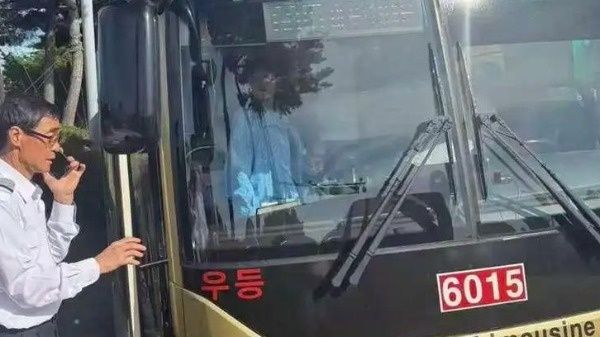
A harrowing incident on a Seoul airport highway last Saturday highlighted the power of collective action under extreme pressure, when a group of Chinese tourists transformed a potential disaster into a story of human courage and coordination. As the No 6015 airport bus sped towards Incheon International Airport carrying more than a dozen passengers, predominantly visitors from mainland China, the driver suddenly lost consciousness without warning. The vehicle began veering dangerously across its lane, scraping against a roadside guardrail as it threatened to careen out of control with dozens of lives at stake.
Sun Qian, a health sector professional from Nanjing in Jiangsu province, was seated in the second row directly behind the driver's cabin when she immediately sensed something was catastrophically wrong. Without hesitation, she lunged forward and seized the steering wheel, using her full strength to stabilise the careening bus as it continued to drift. In that same critical moment, another passenger instinctively moved toward the brake mechanism, demonstrating the kind of coordinated response that would save lives. "The bus was veering badly, so I rushed forward and grabbed the steering wheel to try to stabilise it," Sun explained to China Daily. The initial phase of the emergency lasted mere seconds, yet within that compressed timeframe, the passengers managed to activate the emergency brake system and engage the handbrake, bringing the multi-tonne vehicle to a safe stop.
Sun's companion Du He, also 33 and likewise from Nanjing, played an equally vital role in the unfolding crisis. While Sun maintained control of the steering mechanism, Du attempted to apply traditional first-aid techniques, pinching the driver's philtrum in the hope of reviving him. However, Du quickly realised the gravity of the situation when she observed the driver's face turning purple and recognised the absence of breathing. The driver was no longer unconscious—he appeared to be in cardiac arrest. Rather than succumb to panic, the group of tourists transitioned seamlessly into a new emergency protocol, with multiple passengers taking turns performing cardiopulmonary resuscitation in coordinated efforts to restore the driver's vital functions.
The language barrier that might have paralysed others became immaterial as Sun, who possessed fluent Korean language skills, grabbed the driver's mobile phone and dialled emergency services in Korean, providing responders with critical information about the medical emergency unfolding on the highway. Other passengers maintained continuous chest compressions while Sun communicated with first responders, ensuring that professional medical teams understood the urgency and location of the incident. By the time emergency medical personnel arrived and transported the driver to hospital, he had been without detectable pulse or respiration for approximately one to two minutes. Medical teams attempted resuscitative procedures for roughly two hours, but the driver ultimately succumbed to what appeared to be acute cardiac arrest. South Korean authorities have launched an investigation into the precise medical cause of the collapse.
The fortuitous circumstances surrounding the incident highlighted how readily tragedy could have escalated had conditions been even marginally different. Du noted with evident relief that traffic density on the highway was relatively light at that particular time, meaning the out-of-control bus did not collide with other vehicles or trigger a cascade of secondary accidents. The passengers, all originally bound for Incheon International Airport, quickly flagged down another airport bus to resume their journey, demonstrating the kind of practical resilience required to process traumatic events and move forward with their travel plans.
Both Du and Sun expressed genuine sorrow regarding the driver's death, emphasising that they and their fellow passengers had exerted maximum effort attempting to preserve his life. Yet both women also acknowledged that the full emotional weight of their ordeal did not crystallise until considerably later. Du disclosed that her immediate response during the emergency was surprisingly detached—"I didn't really feel anything"—but once she reached the airport terminal, the psychological reality of what had unfolded suddenly overwhelmed her. She described the experience as almost surreal, comparable to witnessing a dramatic television scene unfold in real time with minimal opportunity for conscious deliberation.
When confronted with the substantial wave of digital recognition flowing across both Chinese and South Korean social media platforms, both women exhibited a striking modesty and humility that resonated with observers. Du characterised her actions as entirely consistent with her capabilities and values, suggesting that any competent person presented with identical circumstances would have responded identically. She articulated a philosophy of collective responsibility and mutual aid, asserting that "Chinese people are united and always ready to help. That's our nature." Rather than seeking individual accolades, Sun emphasised the collaborative nature of the rescue effort, stressing that success emerged from coordinated action rather than isolated heroism. She highlighted the emotional sustenance provided by compatriots working in harmony during genuine crisis.
The incident generated considerable digital discussion across multiple platforms and cultural contexts. South Korean social media users expressed admiration for the tourists' composure and decisive action despite navigating a foreign country with limited language proficiency, acknowledging that remaining calm and responding swiftly in such circumstances represented a remarkable achievement. Chinese netizens circulated accounts of the rescue across platforms including Xiaohongshu, generating widespread commentary celebrating the women's actions as emblematic of broader values around community responsibility and crisis response. The narrative transcended typical rescue stories to become a commentary on human behaviour under extreme duress and the capacity for ordinary people to perform extraordinary actions when circumstances demand.
For Malaysian and broader Southeast Asian observers, the incident carries particular resonance given the region's substantial Chinese diaspora communities and the frequency of cross-regional travel. The story underscores how emergency preparedness transcends nationality and language, requiring fundamental human instincts—rapid assessment, decisive action, and coordinated teamwork—that appear relatively consistent across populations. The incident also highlights the practical vulnerabilities inherent in mass transportation systems, where driver incapacity poses genuine risks requiring either technological safeguards or passenger training protocols. Beyond these practical considerations, the narrative provides a refreshing counterpoint to narratives emphasising social fragmentation, instead documenting instances where strangers united by circumstance demonstrate remarkable capacity for collective action and mutual preservation.

