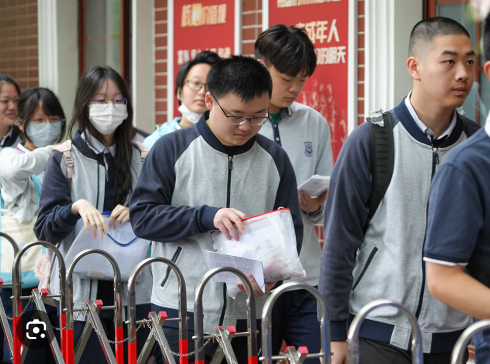
China's higher education institutions are implementing stringent security measures in examination halls, prohibiting students from bringing an array of technologically advanced wearable devices that can facilitate academic dishonesty. The escalating crackdown follows a series of documented incidents where students exploited smart devices to obtain examination answers, prompting universities across multiple provinces to issue stern warnings and establish explicit prohibitions against such equipment.
South China Agricultural University in Guangdong province became one of the first institutions to formally announce comprehensive restrictions on July 1, explicitly barring candidates from bringing mobile phones, smart glasses, smartwatches, Bluetooth earbuds and invisible earpieces into testing venues. The university's notice reflected growing institutional concern about the sophistication of cheating methods, revealing that multiple students had already been apprehended attempting to use electronic devices to circumvent examination integrity. Those caught faced significant consequences, including zero scores in the affected subject and demit marks that would restrict their access to scholarships, awards and Communist Party membership opportunities.
The disciplinary framework established by South China Agricultural University demonstrates how seriously Chinese educational institutions are treating this issue. The university clarified that simply bringing prohibited devices into examination halls—regardless of whether they remain powered off or unused—constitutes an automatic violation. This strict interpretation effectively shifts responsibility to students, eliminating any possibility of claiming accidental possession or claiming lack of intent. The university strengthened its enforcement capacity by deploying artificial intelligence-powered proctoring systems capable of monitoring examination halls in real time, detecting suspicious patterns such as students handling unidentified objects, exchanging materials, making frequent head movements or keeping their hands concealed beneath desks.
Other major universities have publicly disclosed their own cases of high-tech cheating attempts, illustrating the scale of the problem across China's tertiary education system. Xuchang University in Henan province reported on June 29 that five students had brought electronic devices into final examinations, either containing pre-loaded examination materials or capable of transmitting and receiving information to facilitate real-time answer acquisition. Hubei University of Technology similarly announced a case where a student received extended disciplinary action for attempting to introduce electronic devices containing study materials into an English examination. Zhongnan University of Economics and Law in Hubei province issued specific warnings about smart glasses, emphasizing their particular danger given their capacity to wirelessly transmit answers, store instructional materials and photograph examination papers without obvious detection.
The acceleration of these university-level initiatives reflects broader governmental concern about examination integrity. China's Ministry of Education has established explicit regulations classifying any device capable of sending or receiving information as prohibited cheating equipment in examination venues. The ministry took the unusual step of issuing a public warning on June 2 specifically targeting candidates for the 2026 gaokao, China's national college entrance examination, emphasizing that bringing smart devices into testing environments constitutes misconduct regardless of whether the devices are activated or actually used during the examination. This blanket approach effectively transfers the burden of compliance to test-takers, requiring them to ensure complete device-free access to examination spaces.
The regulatory response becomes increasingly comprehensible when examining the technological capabilities now available to potential cheaters. Recent research conducted by researchers from Hong Kong University of Science and Technology demonstrated that commercially available smart glasses could be modified by integrating them with GPT-5.2 artificial intelligence models, enabling students to read answers projected on the device's lenses during examinations. In controlled testing scenarios, a wearer completed a Computer Network Principles examination in merely 30 minutes while achieving a score of 92.5 per cent, suggesting that such devices could provide substantial academic advantage if undetected during high-stakes testing situations.
Industry insiders acknowledge that the rapid miniaturization and increasing sophistication of wearable technology presents genuine challenges for examination proctoring systems. Lin Che, a product manager with extensive experience in smart eyewear manufacturing, noted that university regulations frequently lag behind technological advancement, creating windows of vulnerability that students may exploit. More concerning, as smart glasses continue shrinking and increasingly resemble ordinary eyewear, distinguishing prohibited devices from legitimate spectacles becomes progressively difficult for examination supervisors. Lin suggested that manufacturers should voluntarily incorporate more visibly distinctive design elements—such as conspicuous camera indicators—to facilitate easier identification by proctoring personnel and thereby reduce the practical utility of such devices for cheating purposes.
For Malaysian and Southeast Asian educational institutions, these developments carry significant implications. As wearable technology becomes increasingly affordable and accessible across the region, and as students gain greater familiarity with these devices' capabilities, the risk of similar cheating methods spreading beyond China's borders appears substantial. Malaysian universities, particularly those administering high-stakes examinations or conducting national qualification assessments, may need to revisit their own examination protocols and consider implementing comparable restrictions and detection technologies before cheating incidents proliferate.
The Chinese response also raises broader questions about the appropriate balance between technological innovation and institutional security. While the prohibition approach addresses immediate cheating concerns, it reflects a fundamentally reactive posture rather than addressing underlying drivers of academic dishonesty. The sophistication demonstrated by recent cheating attempts suggests that many students possess both technical capability and sufficient motivation to circumvent security measures, indicating that examination design and assessment methodology themselves warrant critical examination. Universities across the region might benefit from considering whether alternative assessment approaches—emphasizing application, critical thinking and problem-solving over memorization—could reduce both the incentive and feasibility of technological cheating while improving educational outcomes.

