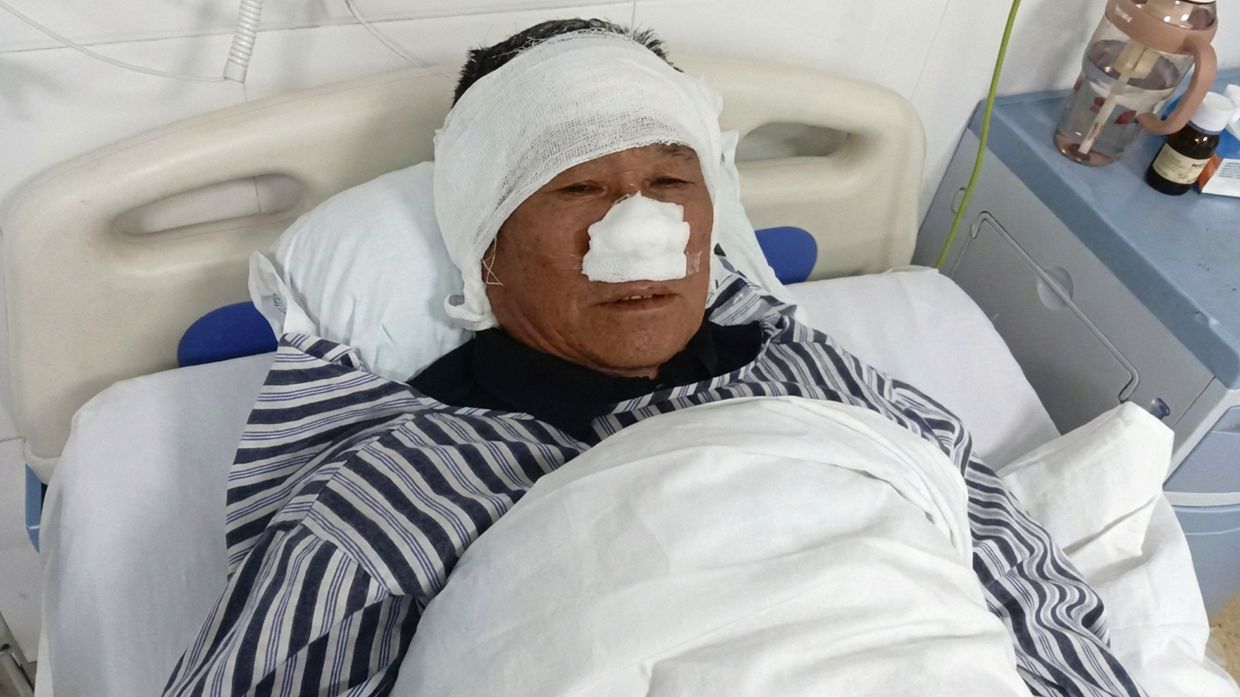
Zeng Fanlin, a 69-year-old from Chenzhou in Hunan province, has been officially recognised as a national hero by the Chinese government after a harrowing April incident left him permanently disfigured. His act of courage—tackling a violent attacker to prevent a woman from being strangled—resulted in the assailant biting off a significant portion of his nose during the struggle. The recognition, announced on July 9, places Zeng among 86 individuals named in Beijing's latest roster of "national heroes for a just cause," underscoring how his selfless intervention resonates deeply within Chinese civic values.
The incident unfolded when a man in his twenties descended into a violent rampage through the village, attacking random passers-by and kicking at doors. Witnesses observed his erratic and threatening behaviour with alarm, yet fear prevented many from stepping in when he suddenly stopped a woman riding an e-bike and seized her by the neck, creating an immediately life-threatening situation. As bystanders hesitated and contacted police, Zeng—who happened to be nearby—made the instantaneous decision to act. He rushed forward and physically subdued the attacker, with two other villagers quickly joining him to restrain the man until law enforcement could arrive.
During the violent struggle to hold the assailant at bay, the attacker bit down hard on Zeng's face, severing most of his nose. Rather than releasing his grip in response to this gruesome injury, Zeng maintained control of the suspect, enduring the pain until police officers reached the scene. The suspect was subsequently arrested and taken into custody, whilst Zeng was transported urgently to hospital for emergency treatment. The case remains under investigation by authorities, with police indicating that the suspect lost emotional control and attacked strangers without apparent provocation.
The medical aftermath proved complex and sobering. Doctors informed Zeng that the extent of tissue loss made reconstructive surgery exceptionally challenging, with warnings of potential long-term complications and prominent scarring. According to People's Daily, the medical team devised a multi-stage surgical plan requiring at least six months of recovery. Remarkably, the total medical costs exceeding 70,000 yuan—approximately US$10,000—received government financial support, reflecting official recognition of Zeng's injury as a public concern. He subsequently underwent two operations, during which surgeons grafted skin from his scalp and reconstructed his nasal passages to restore basic breathing function, though he continues to experience daily pain from the injuries.
Beyond the government's official honours, Zeng's sacrifice attracted recognition from the private sector. The Alibaba Foundation, the charitable arm of the e-commerce giant, awarded him 20,000 yuan for his bravery, whilst local media outlets amplified his story to broader audiences. The public recognition appears to have struck a chord, with online commentators framing Zeng as embodying the moral character many feel society should celebrate. One observer's remark captured the sentiment: "Zeng is a true everyday hero. The attacker should be severely punished. Good people should not have to shed their blood in vain."
Zeng's background provides crucial context for understanding his willingness to risk personal safety. Orphaned in childhood, he was raised by his community with village support and later benefited from government-sponsored education. This experience of collective care shaped his philosophy that repaying society represented a moral obligation. His professional trajectory reflected this commitment—he served previously as a village official and later volunteered as a mediator resolving disputes among residents, roles that positioned him as a community pillar invested in public welfare. His daughter characterised him as possessing an acute sense of justice, someone constitutionally incapable of remaining passive when witnessing wrongdoing. Historical records indicate this wasn't his first intervention; he had assisted police in apprehending a thief back in 2016.
When local media asked about his willingness to sacrifice so much for a stranger, Zeng responded with remarkable philosophical composure: "Compared with saving a life, everything I have given is worth it." This statement encapsulates a particular worldview—one that privileges human life above physical integrity—that aligns with the Confucian emphasis on moral duty that permeates much of East Asian ethical thinking. It also reflects a pragmatic calculation that survival with disfigurement exceeds the cost of inaction that would have allowed a woman to be murdered or seriously harmed.
Under Chinese criminal law, intentionally causing serious bodily injury typically results in imprisonment ranging from three to ten years, a sentencing framework that may apply to the assault case once investigation concludes. The incident and Zeng's subsequent recognition illustrate the tension between individual safety and collective responsibility—a tension that China's government appears eager to resolve by lionising those who choose the latter. The July 9 announcement naming Zeng alongside 85 other national heroes suggests that Beijing views such public recognition as reinforcing social cohesion and moral exemplarity in communities nationwide.
For readers across Southeast Asia, Zeng's story offers reflection on how different societies valorise civic heroism. While Malaysia, Singapore, and other regional nations maintain their own frameworks for recognising extraordinary public service, the Chinese approach of formalising such recognition through government honours demonstrates one model for institutionalising respect for selflessness. The incident also highlights ongoing challenges with mental health and public safety in rapid-development contexts, where access to psychiatric intervention and de-escalation training might prevent such violent episodes.

