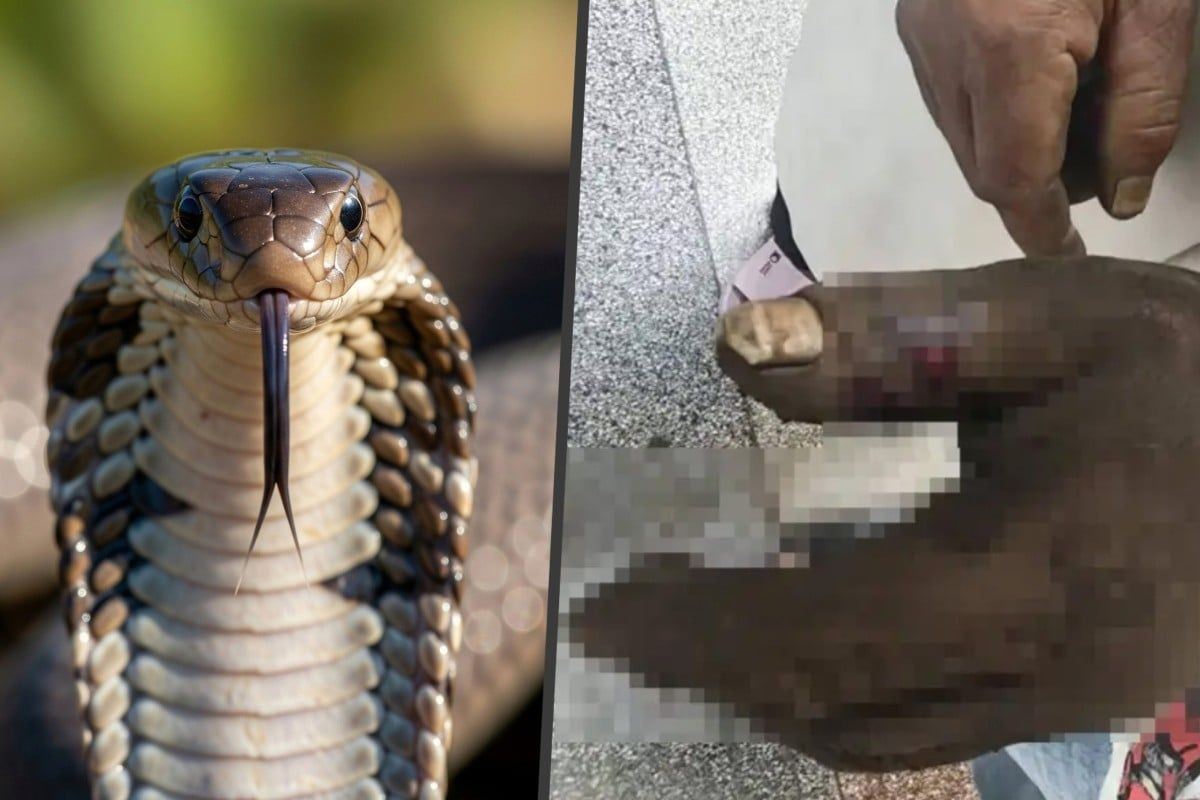
A dramatic incident in Yunnan province has become a cautionary tale about the gap between medical reality and television fiction. When a farmer in Yuanyang county suffered a cobra bite while working his fields, his wife responded instinctively by attempting a rescue method she had observed on screen—sucking the venom directly from his wound. Neither anticipated that her act of desperation would lead to her own hospitalization alongside her husband.
The farmer's injury began as a small puncture wound when the cobra struck his finger. Within moments, the typical symptoms of envenomation manifested: his hand swelled dramatically and he experienced dizziness and severe weakness. Seeing her husband's rapid deterioration, his wife acted without hesitation, applying direct suction to the bite site in an attempt to extract the venom. She employed no protective equipment or precautions—a decision that would have serious consequences.
Both were soon transferred to Honghe Prefecture No 3 People's Hospital in Yunnan, where medical staff diagnosed cobra envenomation in each patient. The couple received antivenom serum injections and supportive treatment to counteract the poison's effects. Yet the wife's condition diverged from the expected recovery pattern. Several hours after admission, she began experiencing numbness spreading through her mouth, tongue, facial muscles and limbs. By the following day, severe exhaustion had set in, confirming that venom had entered her own bloodstream.
The incident underscores a widespread misunderstanding about snake venom and first aid that persists across popular media. Doctors at the Yunnan facility explained that the oral mucosa—the soft tissue lining the mouth—contains an extraordinarily dense network of capillaries. When venom makes direct contact with these tissues, it penetrates rapidly into the bloodstream, poisoning the rescuer rather than preventing the victim's envenomation. Television dramas depicting this rescue technique as heroic and effective have misled generations of viewers.
Another critical medical reality complicates matters further. Snake fangs typically create wounds resembling tiny pinholes, deceptively small given the volume of venom they deliver. Once injected, the toxin disperses almost immediately into subcutaneous tissues and deeper blood vessels. The window for extracting venom through suction, if it ever existed, closes within seconds. Medical professionals emphasize that attempting to remove venom after the initial envenomation is futile and only introduces additional risk to both victim and would-be rescuer.
Beyond the suction method, medical personnel at the hospital noted several other dangerous first aid misconceptions that endanger snakebite victims. Some people attempt to widen the wound through cutting or incision, believing this allows the venom to drain. Such intervention inevitably causes severe blood loss and dramatically increases infection risk without removing any venom. Similarly, folk remedies involving heat application or ice therapy remain popular despite offering no therapeutic benefit and potentially causing additional tissue damage alongside the venom's effects.
The correct response to a snakebite demands a fundamentally different approach. Medical authorities advise victims and bystanders to immediately contact emergency services, providing precise location details and remaining as motionless as possible. Immobility slows lymphatic circulation and delays systemic venom distribution, buying critical time for hospital intervention. Equally important, observers should note and ideally photograph distinctive features of the offending snake—coloration, scale patterns, head shape—enabling physicians to identify the species and administer appropriate antivenom formulations.
The Yunnan couple's ordeal reflects a broader pattern of snakebite incidents across China capturing public attention and sparking online discourse. Earlier in May, a fourteen-year-old student in Guangdong province experienced a harrowing brush with death following an unidentified snakebite on his school campus. Initially dismissing the incident due to absent pain, the boy delayed reporting the injury until neurological symptoms—limb numbness and visual disturbance—became impossible to ignore. Medical teams subsequently revealed that hospital treatment arrived mere hours before the venom would have caused complete respiratory paralysis, transforming a survivable injury into a fatal outcome.
Such incidents highlight the stakes involved in snakebite management, particularly across Southeast Asia where venomous species inhabit agricultural regions and residential areas. Malaysia, with its tropical climate and diverse serpent fauna, presents similar risks to farmers, construction workers and residents in rural and semi-rural zones. The principles established by Chinese medical professionals apply directly to Malaysian contexts: immediate professional intervention, species identification when possible, and strict avoidance of traditional remedies or improvised treatments that delay appropriate medical response.
Online reaction to the Yunnan case has been notably mixed, with observers acknowledging both the wife's genuine concern and the serious consequences of her misguided intervention. Social media commentary increasingly recognizes that television dramatizations routinely present medically inaccurate information for narrative purposes. The episode serves as a powerful reminder that entertainment media, while often entertaining, cannot substitute for professional medical guidance in genuine emergencies. For viewers across Malaysia and the broader region who may encounter snakebite situations, the lesson is unambiguous: abandon preconceptions formed from television and instead prioritize immediate contact with qualified medical professionals equipped with appropriate antivenom and emergency protocols.

