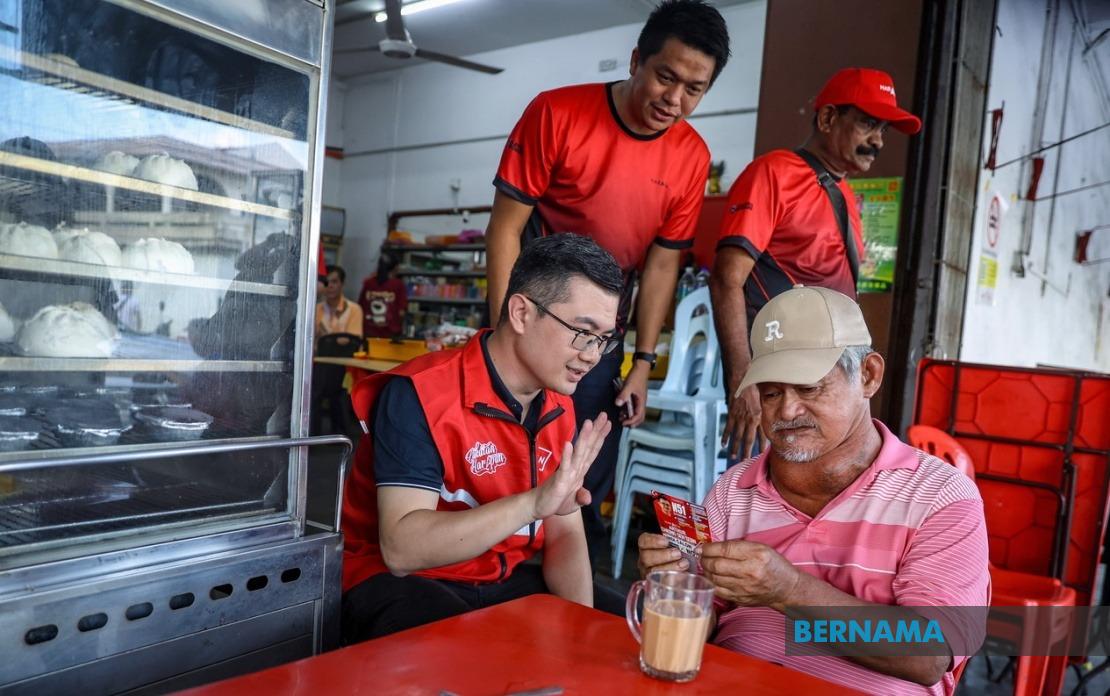
Bukit Batu assemblyman Arthur Chiong Sen Sern is placing considerable emphasis on his demonstrated commitment to constituency work as he seeks re-election in the 16th Johor State Election scheduled for July 11. The Pakatan Harapan candidate believes his track record of direct engagement with residents and tangible development projects will translate into a more decisive victory than his narrow 137-vote margin in the 2022 polls.
Chiong's transformation of a razor-thin victory into a springboard for accelerated service delivery represents a calculated strategy employed by several first-term assemblymen across Malaysia. His narrow win—secured with 9,439 votes in a four-way contest—evidently motivated him to strengthen his grassroots presence across the 49,963-registered-voter constituency. This approach reflects an emerging pattern in Malaysian state-level politics where incumbents facing electoral vulnerability respond by intensifying ground-level activity rather than shifting policy positions.
The 36-year-old assemblyman has documented his activities through consistent visits to Felda settlements and engagement with neighbourhood concerns spanning infrastructure and water management. His claimed RM20,000 contribution toward futsal court lighting in one area exemplifies the micro-scale infrastructure investments that constitute the backbone of contemporary Malaysian constituency politics. These relatively modest expenditures, while sometimes dismissed as symbolic, generate sustained goodwill within target communities and create visible markers of representative presence that voters encounter regularly.
Flood mitigation efforts have emerged as a defining focus for Chiong's tenure. He highlights interventions at Kampung Rahmat and Kampung Seri Paya, areas historically vulnerable to flash flooding, working through formal coordination with the Department of Irrigation and Drainage. His emphasis on personal visibility during flooding incidents—positioning himself among initial responders rather than distant administrators—reflects deliberate cultivation of a hands-on image. Such positioning carries particular resonance in constituencies where infrastructure inadequacy remains a chronic grievance.
Chiong's campaign messaging emphasizes service delivery unbounded by partisan or demographic lines. His framing of constituency work as non-selective across racial and religious communities addresses a significant consideration in Malaysian electoral politics, where constituencies often comprise diverse populations requiring careful balancing of resource allocation and visibility. This inclusive framing, while politically standard, carries tangible implications for how incumbent representatives allocate their limited time and resources.
The upcoming contest represents a significantly crowded field for Bukit Batu. Beyond Chiong, the ballot will feature R. Kumaran representing Barisan Nasional, M. Premanand of Ikatan Demokratik Malaysia-MUDA, G. Tamili representing Bersama, and independent candidate Kamaruzaman Ali. This fragmentation may work in Chiong's favour if opposition votes divide effectively, though it simultaneously suggests dissatisfaction across multiple voter segments that he must address beyond his base.
The BN presence through Kumaran, identified as PKR Kulai chief, signals potential defection or realignment dynamics within local party structures. Such configurations often indicate internal organizational tensions or personality-driven divisions that can substantially influence ground-level campaign effectiveness. The emergence of MUDA as a competing force reflects broader attempts by newer political entities to penetrate established strongholds, while Bersama's participation suggests coalition-building efforts beyond the traditional BN-PH binary that increasingly characterizes Malaysian electoral contests.
Chiong's explicit gratitude toward Prime Minister Datuk Seri Anwar Ibrahim and Pakatan Harapan leadership serves multiple functions within his campaign narrative. It anchors him to national coalition legitimacy while signaling continued central party support—a crucial consideration for undecided voters assessing whether an incumbent benefits from sustained backing. Such positioning also implicitly frames the Bukit Batu contest within broader coalition dynamics, suggesting that local voting preferences carry implications beyond immediate constituency concerns.
The structural context surrounding Malaysian state elections in Johor holds particular significance. State-level contests frequently serve as barometers for national coalition performance, with results in economically significant regions like Johor influencing broader political calculations. Bukit Batu, positioned within Kulai district, represents one constituent element within this larger electoral landscape. Chiong's performance will contribute to the overall PH narrative regarding its capacity to defend existing territorial gains—a politically vital consideration ahead of potential federal elections.
Early voting scheduled for July 7 precedes the main polling date, potentially advantaging candidates with superior organizational capacity to mobilize supporters during compressed timeframes. Chiong's emphasised ground presence during ordinary circumstances may translate into superior turnout mechanics when mobilization becomes time-critical. Conversely, opposition candidates benefiting from coordination advantages or superior financial resources could exploit early voting periods to accelerate their campaigns.
The electoral mathematics favour Chiong modestly given his incumbent status and apparent organizational presence. However, his previous narrow victory indicates underlying vulnerability that competing candidates have clearly identified. The crowded field presents both opportunity—through vote fragmentation benefiting the plurality victor—and risk, should opposition consolidation occur around a single challenger capable of uniting anti-incumbent sentiment. His campaign strategy of emphasizing accumulated service delivery acknowledges this underlying weakness while attempting to transform marginal support into more durable backing through demonstrated constituency dedication.

