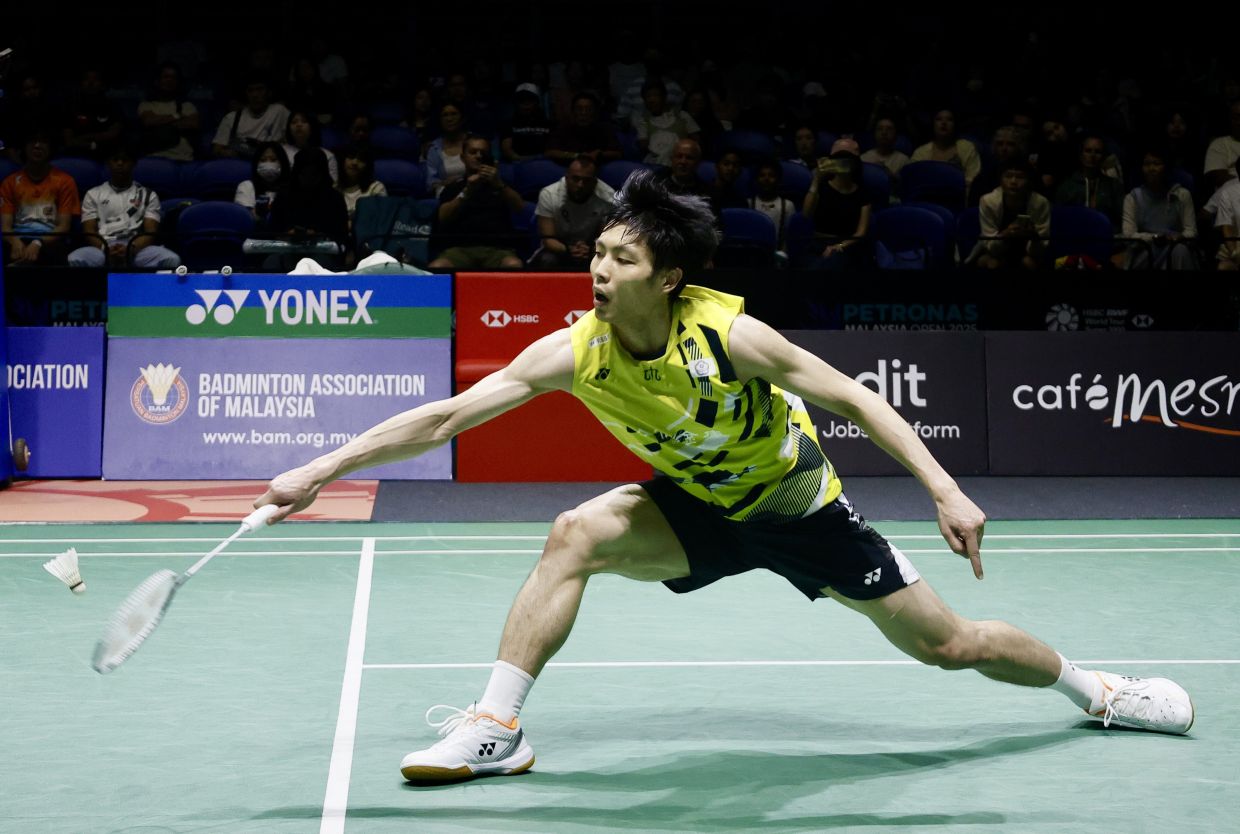
Taiwan's badminton maestro Chou Tien-chen has rewritten the record books at the China Open, claiming his maiden Super 1000 title at an age when many athletes have long since retired. The 36-year-old's commanding performance in the men's singles final at the Changzhou Olympic Sports Centre has proven that longevity and excellence in professional sport need not be mutually exclusive, delivering a watershed moment for Taiwan's badminton programme after three decades without a men's singles champion at this prestigious tournament.
Chou's path to victory was far from straightforward. Facing France's Toma Junior Popov, a player a full decade his junior, the Taiwanese shuttler demonstrated the tactical maturity and physical resilience that can only come from decades competing at the highest level. The match itself—a 64-minute battle that stretched across three tightly contested sets—saw Chou prevail 21-15, 7-21, 21-13, showing the composure to recover after surrendering the second set and sealing his triumph in the decider with clinical precision. This breakthrough achievement carries particular significance for Taiwan, which has endured a three-decade absence from the winners' circle at the China Open since Fung Permadi's triumph in 1996.
What makes Chou's accomplishment even more remarkable is the context in which it occurred. Just seven days earlier, the veteran had suffered a humbling first-round elimination at the Japan Open to Ireland's Nhat Nguyen, a result that would have prompted younger players to question their continued competitiveness. Instead of spiralling into self-doubt, Chou's response demonstrated the psychological fortitude that separates champions from the merely talented. Rather than dwelling on disappointment, he and his support team—most notably physiotherapist Victoria Kao—conducted a methodical analysis of what went wrong in Japan and implemented systematic improvements for the Chinese leg of the tour.
Chou's historic win carries implications beyond the individual achievement. At 36, he has officially become the oldest player ever to capture a BWF World Tour Super 1000 title, a record that underscores how modern professional badminton rewards sustained excellence and meticulous physical maintenance. The Chinese badminton federation has invested heavily in top-level tournament infrastructure, and Chou's victory demonstrates how superior facilities and competition attract and inspire players from across Asia. For Southeast Asian badminton programmes, particularly in Malaysia where the sport commands substantial public interest, Chou's achievement offers a compelling narrative about the extended career trajectories now possible through scientific training methods.
The veteran's humble response in the immediate aftermath of his triumph revealed much about his character and approach. Chou freely acknowledged his own surprise at reaching the final, let alone winning it, emphasizing the role of faith and gratitude in sustaining his motivation. His decision to credit the Almighty reflects the deeper philosophical grounding that often accompanies longevity in elite sport. More significantly, his recognition of the crucial contributions from his physiotherapy team underscores a modern reality: individual brilliance now operates within sophisticated support ecosystems encompassing sports science, nutrition, mental conditioning, and recovery protocols.
Chou's comments about the daily grind of professional badminton carry particular resonance for younger athletes watching his career trajectory. He stressed that the real challenge lies not in occasional victories but in maintaining discipline across unglamorous, repetitive daily training sessions. This philosophy extends beyond the badminton court—the emphasis on attention to detail, incremental improvements, and sustained mindset work reflects principles increasingly recognized across professional sports. For Malaysian badminton players navigating their own careers, Chou's example demonstrates that setbacks need not precipitate career decline if confronted with proper perspective and systematic adjustment.
The China Open itself remains one of badminton's most prestigious tournaments, holding Super 1000 status that places it among the sport's elite competitions alongside the All England Championships and the Malaysia Masters. Taiwan's 30-year absence from the men's singles podium at this level represents a significant gap in the island's tournament record, making Chou's breakthrough particularly poignant for Taiwanese badminton supporters. This victory will likely energize Taiwan's badminton development programmes and inspire younger Taiwanese players still building their international records. The psychological benefit of having a proven champion as a contemporary role model cannot be overstated in sport, especially at the developmental levels.
From a regional competitive perspective, Chou's triumph signals that age and experience continue to hold decisive advantages in badminton's demanding singles format. The sport requires a sophisticated blend of court intelligence, shot selection, movement efficiency, and the capacity to manage stamina across three-set matches. These elements compound with experience in ways that raw athleticism, however impressive, cannot entirely overcome. His defeat of Popov, despite the Frenchman's obvious physical advantages, illustrates how veterans can leverage accumulated knowledge and tactical acumen against younger opponents still perfecting their craft. This dynamic maintains opportunities for established players in their middle and later thirties, provided they maintain the discipline and infrastructure support that Chou exemplifies.
The broader China Open results highlighted competitive depth across multiple categories. Indonesia's Fajar Alfian and Shohibul Fikri captured the men's doubles title with a hard-fought victory over Korea's Kim Won-ho and Seo Seung-jae, extending Indonesia's strong performance in mixed team badminton. Japan's Akane Yamaguchi demonstrated her status as a leading women's singles contender by defeating China's Chen Yufei, reflecting the intense competition that now characterizes the women's singles division. China's dominance in doubles categories continued with victories in women's doubles and mixed doubles, consolidating their position as the tournament's strongest overall performer. These results paint a picture of a sporting landscape where no single nation holds overwhelming superiority, with success distributed across multiple countries and requiring sustained excellence at every competitive level.
Chou's career trajectory offers instructive lessons for Malaysian badminton stakeholders and players contemplating their professional longevity. The investment in support infrastructure—particularly physiotherapy and sports science—appears non-negotiable for players extending their careers beyond their early thirties. The mental resilience to absorb disappointment and respond constructively, rather than defensively, separates those who fade from those who maintain competitive sharpness. Finally, the importance of viewing setbacks as information sources rather than terminal judgments cannot be understated. Chou's ability to analyze his Japan Open loss, identify correctable elements, and implement improvements within a single week between tournaments exemplifies the adaptive learning that sustains competitive excellence across an extended career.
For the broader Asian badminton community, Chou's China Open triumph represents a validation of the pursuit of excellence across an extended career timeline. As sporting science advances and recovery protocols improve, the traditional model of peak performance in the late twenties may increasingly give way to more extended competitive windows. This shift has profound implications for tournament scheduling, player management, and the development of younger talent that must now compete not only with age-peers but with exceptionally well-maintained older players commanding vast experience advantages. Taiwan's badminton programme can now point to Chou's achievement as evidence of successful long-term player development, while the regional tournament circuit gains another compelling narrative about sporting excellence, perseverance, and the rewards of sustained commitment.

