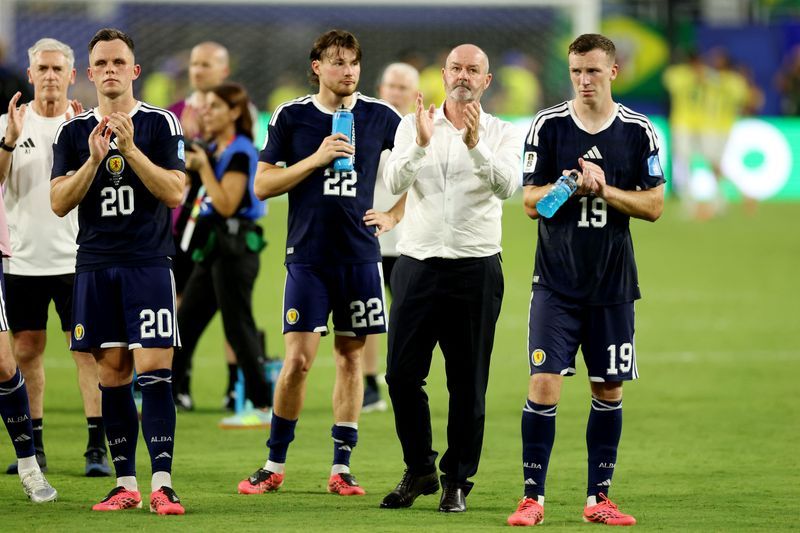
Scotland's long-awaited return to the World Cup stage appears set to end in disappointment after manager Steve Clarke acknowledged that his side gifted Brazil a one-sided victory in Miami on Wednesday. The 3-0 scoreline in their final Group C fixture has left the Scottish contingent facing an early exit from their first global tournament in 28 years, with Clarke expressing little optimism about salvaging qualification through the third-place route.
While the mathematics of the competition technically permit Scotland to advance as one of the tournament's best-performing third-placed teams, Clarke's assessment suggests the Scots will fall short once the remaining group matches conclude. With 20 matches still to be played across the 12 groups, Clarke expects at least two other third-placed finishers will accumulate better records than Scotland's current three-point tally. The coach's candid admission reflects both his analytical reading of the group stage dynamics and an implicit acceptance that his team has exhausted their realistic pathway to knockout football.
The manager proved remarkably forthright in his post-match analysis, attributing the defeat primarily to Scotland's own tactical shortcomings rather than Brazilian superiority alone. Clarke emphasised that Brazil's clinical finishing capitalised on opportunities his defence had carelessly surrendered, suggesting the match could have followed a different trajectory had Scotland maintained disciplinary standards in possession and transition phases. His observation that Scotland had "given them" at least two of the three goals underscored a frustration that stemmed not from being outplayed, but from self-sabotage at critical junctures.
Yet Clarke balanced his disappointment with acknowledgment of Brazil's formidable attacking prowess and Scotland's goalkeeper Angus Gunn's important contributions. The Brazilian side, widely regarded as one of the tournament favourites, demonstrated the ruthless conversion of half-chances that separates elite teams from those operating at Scotland's level. Gunn's saves prevented the margin from becoming even more humiliating, offering modest consolation in an otherwise depressing afternoon for the Tartan Army.
Despite the tactical disappointment, Clarke refrained from directing personal criticism toward his playing squad, instead channelling his frustration toward broader structural concerns within Scottish football. The manager recognised that his players had accomplished something remarkable in reaching the World Cup, overcoming a qualification campaign against difficult opponents to secure a berth after nearly three decades of absence. His reservations about their performance were tempered by respect for their achievement in delivering this tournament experience to the nation.
Clark's analysis pivoted toward the systemic development challenges facing Scottish football when confronted with the physical and technical demands of elite international competition. His observation that Morocco and Brazil's combination of power, athleticism, and skill exposed deficiencies in Scotland's player development pipeline struck at deeper institutional issues beyond the immediate tournament context. The coach suggested that Scottish football must fundamentally reshape its approach to cultivating young talent capable of competing at the highest level, implying that current production methods are insufficient for generating players equipped to grace the world stage alongside the tournament's elite nations.
The manager's comments regarding Scotland's supporter base, known collectively as the Tartan Army, reflected genuine appreciation for their contribution to the tournament atmosphere while subtly reminding fans of the complicated relationship between team performance and supporter experience. Clarke acknowledged that the fans would not have travelled to America without the players' qualification achievement, a reality that demands recognition even amid disappointment. His remarks carried an implicit message that pride in qualification and recognition of the players' accomplishment need not be overshadowed entirely by the Group C exit.
Clark's balanced perspective also served as a broader commentary on Scottish football culture, where long absences from major tournaments create unrealistic expectations when qualification is finally achieved. He appeared to caution supporters against the complacency that had historically preceded Scotland's qualification droughts, using this tournament experience as a platform for honest conversation about development and ambition. The manager's willingness to engage in this candid discussion suggests an intent to channel current disappointment into constructive programme evolution rather than accept the cyclical pattern of qualification followed by early elimination.
As Scotland prepares for what appears to be an imminent departure from Qatar, the team's campaign will be remembered as both a milestone achievement in reaching the tournament and a missed opportunity to translate qualification into sustained competitive performance. Clarke's honest assessment provides the foundation for post-tournament reflection and strategic planning, acknowledging both what Scotland achieved in getting to the World Cup and what must improve before the next tournament cycle. The manager's comments suggest that rather than resting on the accomplishment of qualification alone, Scottish football must embrace the harder challenge of building a programme capable of sustained tournament success.

