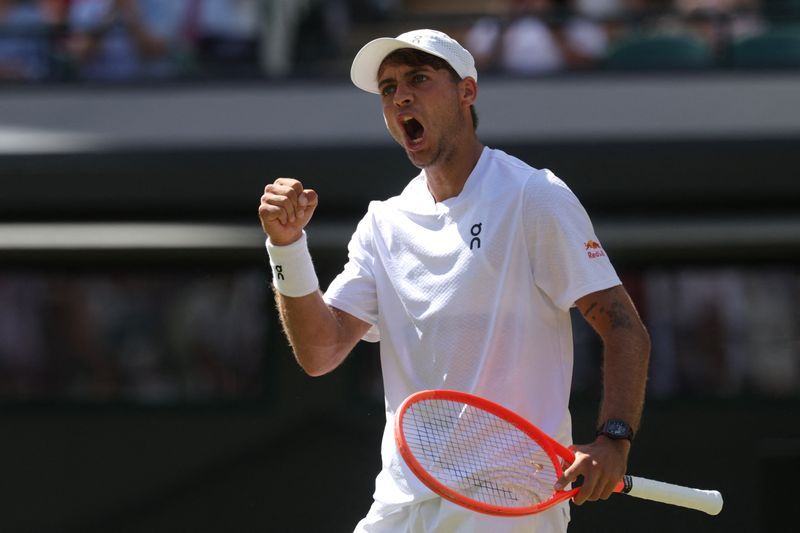
Flavio Cobolli extended his remarkable Grand Slam form on Monday afternoon at the All England Club, dismantling Australian fifth seed Alex de Minaur with a convincing 7-5 7-6(4) 6-3 victory to secure his place in the Wimbledon quarter-finals. The ninth-seeded Italian's progression marks a significant moment in his career trajectory, representing back-to-back quarter-final appearances at the sport's most prestigious grass court tournament and building momentum just weeks after reaching the final of the French Open, where he came agonisingly close to claiming his maiden Grand Slam title.
Playing on Court One under oppressive summer conditions that tested both competitors and spectators alike, Cobolli demonstrated the composure and tactical maturity that has defined his breakthrough season. He broke serve decisively in the eleventh game of the opening set, converting after forcing a backhand error from his opponent, and claimed the first frame in fifty minutes with controlled precision. The encounter itself represented the first meeting between top-ten ranked players in the men's singles draw this year, underscoring the calibre of opposition the 24-year-old Italian has been navigating through the tournament.
The sweltering London heat proved a complicating factor throughout the afternoon, with two separate stoppages in play required when spectators struggled with the extreme temperatures. During these breaks, Cobolli's characteristic professionalism shone through as he engaged respectfully with De Minaur, the Australian frankly warning him that such interruptions were likely given the conditions. This sportsmanship and equanimity under pressure has become a hallmark of Cobolli's play, endearing him to crowds while maintaining focus on the tactical battle unfolding on court.
The second set developed into a tighter affair, with Cobolli eventually prevailing through a tiebreak after clawing back from a 2-5 deficit. His powerful hitting during the critical moments at the end of this frame proved instrumental in breaking De Minaur's resistance, with the Italian reeling off three consecutive games to force the decider. Cobolli's tactical flexibility—mixing aggression with patience, varying pace and spin—neutralised De Minaur's renowned court coverage and defensive prowess, a testament to his growing maturity on the game's biggest stages.
The third set saw Cobolli reassert his dominance after De Minaur levelled at 2-2. The Italian's recovery from 0-2 down and subsequent break salvage in the sixth game demonstrated the mental resilience that has become central to his identity as a competitor. By the concluding stages, De Minaur's resistance had crumbled, and Cobolli closed out the match with the authority of a player whose confidence has been buoyed by successive deep Grand Slam runs.
Cobolli's next opponent awaits in the quarter-finals, with the winner of the fourth-round clash between British rising star Arthur Fery and Bulgarian veteran Grigor Dimitrov representing his likely pathway. Both players have enjoyed productive campaigns at the All England Club during the opening week, suggesting another stern test lies ahead for the Italian. However, given Cobolli's demonstrated ability to elevate his game against elite opposition, the prospect of a quarter-final encounter holds considerable appeal.
Reflecting on his performance, Cobolli acknowledged the physical toll of extended Grand Slam campaigns on modern professionals, expressing relief at dispatching De Minaur in straight sets while preserving energy reserves for upcoming rounds. The intensity of back-to-back Grand Slam deep runs, particularly over grass and clay surfaces with their distinct physical and technical demands, places significant strain on even the most conditioned athletes. His pragmatic approach to managing fatigue—prioritising recovery and rest between matches—reflects lessons learned through his recent elevated status on the professional circuit.
The Italian's approach to the coming days before his quarter-final appearance proved characteristically refreshing. When asked whether he would study footage of the Fery-Dimitrov encounter, Cobolli eschewed traditional preparation in favour of more restorative activities. He planned to combat the oppressive heat with ice cream, enjoy traditional Italian cuisine prepared by his father, and catch glimpses of international football featuring Spain and Portugal. This balanced approach to professional sport—maintaining intensity and focus while refusing to become consumed by relentless analysis—has become increasingly recognised as crucial to longevity and mental wellbeing in professional tennis.
Cobolli's journey to this juncture in his career represents a dramatic elevation in trajectory that has culminated in genuine Grand Slam contention. From relatively modest professional beginnings, the 24-year-old has rapidly ascended through the rankings, combining technical skill with the mental fortitude necessary to compete at the highest level. His French Open runner-up finish earlier this month served as validation of his potential, while his continued success on grass at Wimbledon suggests capacity to excel across the sport's varied surfaces.
For Malaysian and Southeast Asian tennis followers, Cobolli's breakthrough carries broader significance in demonstrating that emerging players from less traditionally dominant tennis nations can compete with—and defeat—established elite performers. His Italian background, combined with his relatively unconventional path to prominence, offers inspiring evidence that professional tennis's competitive landscape continues to evolve, with fresh talent regularly challenging the sport's established hierarchies. His performances this fortnight at the All England Club have reinforced expectations that Cobolli represents one of the next generation of genuine Grand Slam contenders, potentially reshaping the men's professional circuit over coming years.

