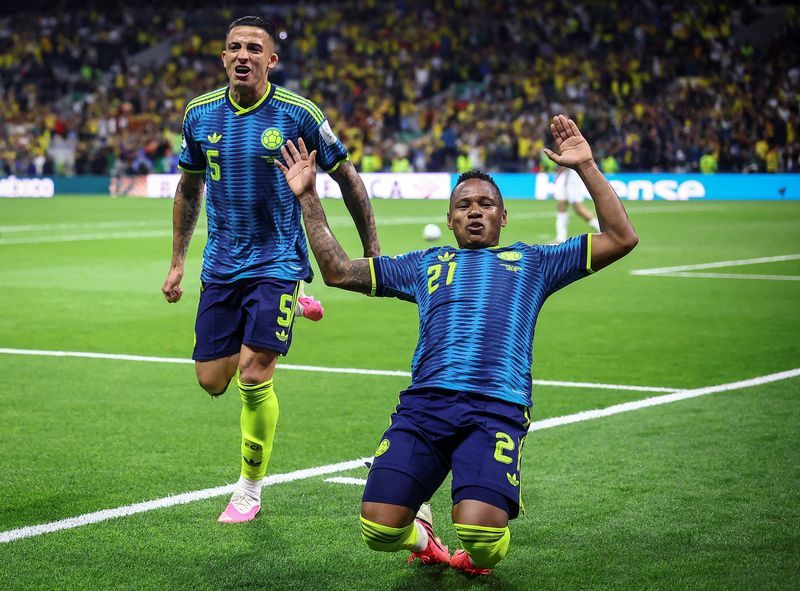
Colombia will attempt to extend their perfect record in Group K when they confront DR Congo on Tuesday, looking to consolidate their position at the top of the standings following an opening-day triumph. Coach Nestor Lorenzo's squad began their tournament campaign with a 3-1 demolition of Uzbekistan, though that scoreline belied a second-half period in which the Central Asians exposed defensive frailties that the South American outfit cannot afford to repeat against a more tactically sophisticated opponent.
A victory would virtually guarantee Colombia's passage to the knockout stage and could potentially cement first place in the group should results elsewhere go their way. The mathematical reality works in their favour, as a win combined with a Portuguese stumble against Uzbekistan would leave them in pole position heading into the final round of group fixtures. For Lorenzo's team, securing three points on Tuesday transforms the dynamics of their campaign and removes much of the pressure from their final group match.
The Colombian attack has found an early leader in Bayern Munich winger Luis Diaz, whose combination of pace, technical ability, and finishing proved decisive against Uzbekistan. Operating as a spearhead in attack, Diaz scored once and provided an assist while earning the official player of the match accolade. However, the team will require greater contributions from captain James Rodriguez, who played a peripheral role in the opening victory as Colombia often bypassed midfield construction in favour of direct transitions to their speedier attacking outlets.
Lorenzo's assessment of his team's first-half performance against Uzbekistan revealed a side capable of imposing their quality, yet the manager recognises that the second-half deterioration represents a significant concern heading into their matchup with opponents who have already demonstrated an ability to frustrate tournament heavyweights. The coach acknowledged that his team's dominance in possession created paradoxical problems, with excessive ball retention occasionally forcing them into lateral or backward movement rather than decisive forward play. This wastefulness in transition moments, he stressed, must be corrected against an opponent unlikely to afford them repeated opportunities.
DR Congo's first World Cup appearance in over half a century has exceeded most expectations, as Sebastien Desabre's squad produced a 1-1 draw against Portugal in their tournament opener. The Central African nation, competing as Zaire at their last World Cup appearance in 1974, impressed observers with their organised defensive structure and willingness to exploit rapid counter-attacking opportunities against one of the tournament's pre-tournament favourites. Yoane Wissa's goal marked DR Congo's return to World Cup football after 48 years away from the global stage, a moment of historical significance for a nation whose football has struggled for international prominence.
The tactical blueprint DR Congo employed against Portugal—a compact defensive shape supplemented by direct passing and swift breaks—represents the most likely approach when facing Colombia. Lorenzo explicitly cautioned his squad about the Congolese style of play, characterising their threat as fundamentally different from the possession-based approaches typical of European opponents. The Argentine manager noted that DR Congo's emphasis on transition football, long diagonal passes, and quick counter-movements would present distinct operational challenges, requiring Colombia to maintain defensive discipline whilst still orchestrating attacking moves.
Lorenzo's warnings about defensive vulnerability take on heightened significance given Colombia's second-half struggles against Uzbekistan. Defensive lapses that went largely unpunished against a team of inferior quality could prove catastrophic against opponents possessed of superior technical execution and already confident following their performance against Portugal. DR Congo's demonstrated ability to trouble elite opposition suggests they possess both the tactical maturity and individual quality to exploit Colombian defensive disorganisation, particularly during transitions when Lorenzo's side has historically been vulnerable.
Colombia's advantage extends beyond purely footballing considerations, as the team will benefit from substantial crowd support at Mexico City's Estadio Azteca. Thousands of Colombian expatriates and supporters travelled to the Mexican venue for the opening fixture, effectively transforming the stadium into a home ground advantage. With Colombia's tournament base located in Guadalajara, the Colombian delegation expects similar waves of supportive attendance, a factor that psychologically favours the South American side whilst potentially unsettling DR Congo's players despite their evident confidence.
The broader context of this Group K encounter hinges on DR Congo's unexpected competitiveness against traditional powerhouses. Rather than serving as convenient punching bags for more established footballing nations, Desabre's squad has demonstrated the capacity to compete with distinction and extract positive results through disciplined, organised play. For Colombia, this represents a formidable examination of their tournament credentials—a chance to prove they possess the defensive solidity and clinical attacking execution necessary to navigate the tournament's later stages. Victory would represent significant progress, yet the manner of that victory will prove equally telling for Lorenzo's hopes of extending Colombia's World Cup ambitions.
%22%2F%3E%3C%2Fpattern%3E%3C%2Fdefs%3E%3Crect%20width%3D%22100%25%22%20height%3D%22100%25%22%20fill%3D%22url(%23phxmxkg)%22%2F%3E%3Crect%20width%3D%22100%25%22%20height%3D%22100%25%22%20fill%3D%22url(%23phxmxkp)%22%2F%3E%3Ctext%20x%3D%2250%25%22%20y%3D%2250%25%22%20text-anchor%3D%22middle%22%20dominant-baseline%3D%22central%22%20fill%3D%22rgba(255%2C255%2C255%2C0.95)%22%20font-family%3D%22Georgia%2C%20'Times%20New%20Roman'%2C%20serif%22%20font-weight%3D%22700%22%20font-size%3D%22194%22%20letter-spacing%3D%22-0.02em%22%3ESarawak%3C%2Ftext%3E%3C%2Fsvg%3E)