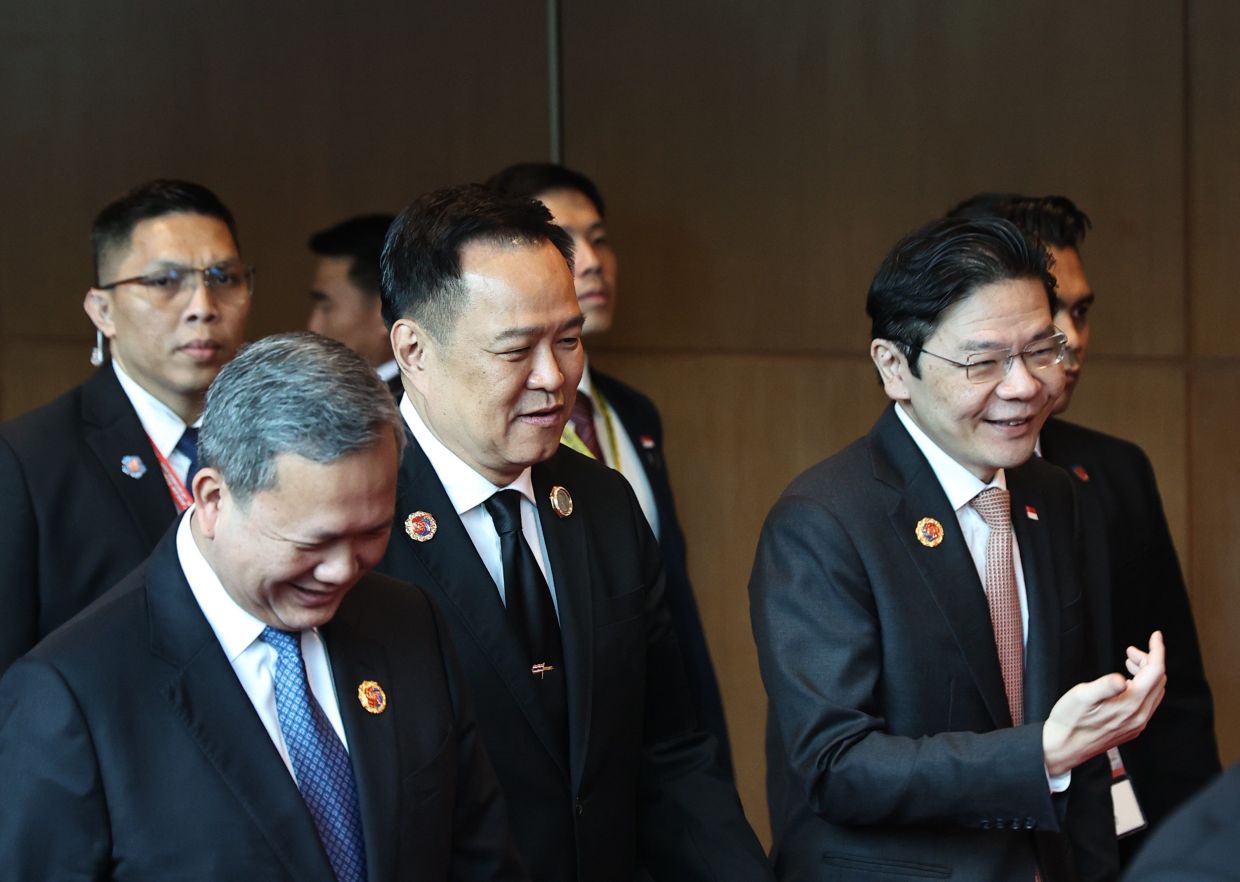
The prospect of China stepping into the Cambodia-Thailand border dispute has gained traction this week, with both Southeast Asian nations demonstrating diplomatic willingness to involve Beijing in resolving a territorial matter that has simmered since tensions escalated last year. The convergence of Cambodian Prime Minister Hun Manet and Thai Prime Minister Anutin Charnvirakul in Beijing, both attending the 2026 World Artificial Intelligence Conference, created an opportunity for separate but significant exchanges on the border question that hint at a changing diplomatic landscape in the region.
Hun Manet took the occasion of his July 16 meeting with Chinese Premier Li Qiang to provide a formal briefing on Cambodia's position regarding the ongoing frontier dispute. During their bilateral talks, the Cambodian leader reiterated Phnom Penh's commitment to peaceful resolution grounded in international legal frameworks and existing treaties between the two disputing parties. This move represented one of the most substantive presentations Cambodia has made to its closest strategic ally since the border tensions began, signalling that Phnom Penh views China as a crucial stakeholder in efforts to de-escalate the situation. Li responded by reaffirming China's traditional support for Cambodia, invoking the language of "ironclad friends" to underscore the depth of bilateral ties.
What proved particularly significant was Bangkok's simultaneous positioning on the possibility of Chinese involvement. Anutin, speaking to Thai media during his own Beijing visit, notably stated that Thailand was "not closing the door" to China assuming a mediatory role should Beijing wish to facilitate tension-reduction efforts. This careful diplomatic formulation avoided formally requesting Chinese mediation while preserving the option for future engagement, reflecting Thailand's preference for maintaining direct bilateral dialogue with Cambodia even as it acknowledges that external facilitation could prove valuable. The Thai leader's comments represented a notable shift in tone from previous positions, suggesting that both capitals may be reconsidering how external actors might assist in resolving what has become an increasingly complex territorial disagreement.
China's historical role in this context provides essential background for understanding current developments. During last year's Asean Foreign Ministers' Meeting, Chinese Foreign Minister Wang Yi publicly stated Beijing's willingness to maintain "an objective and fair position" and serve a "constructive role for the harmonious coexistence between Thailand and Cambodia." Though framed cautiously, Wang's remarks effectively kept the door open for deeper Chinese involvement while avoiding formal mediation overtures that might appear to contradict China's stated preference for regional actors to resolve their own disputes. Since that declaration, Beijing has gradually intensified its diplomatic activity, hosting trilateral discussions among senior officials from both Cambodia and Thailand while supporting implementation of the existing ceasefire framework.
For Malaysian observers and broader Southeast Asian readers, the possibility of Chinese mediation carries significant implications. The Cambodia-Thailand border issue has the potential to destabilise regional dynamics, particularly given both nations' membership in Asean and their respective strategic alignments. Should China formally assume a mediatory role, it would represent an expansion of Beijing's diplomatic influence in mainland Southeast Asia at a moment when regional powers are increasingly attentive to great power competition. Chinese facilitation of peace processes could position Beijing as an indispensable diplomatic player in matters affecting regional stability, potentially shifting the balance of influence in Asean affairs away from more traditional dialogue mechanisms.
Cambodia's broader diplomatic strategy appears focused on diversifying international engagement around the border question while maintaining alignment with Beijing. Phnom Penh has welcomed Asean observer missions and pursued legal mechanisms under international law, demonstrating a preference for multilayered diplomatic approaches rather than reliance on any single mediator. This hedging strategy reflects Cambodia's complex geopolitical position: maintaining its historically close relationship with China while signalling openness to broader regional and international oversight. Hun Manet's personal briefing of Li Qiang underscores how seriously Phnom Penh takes Beijing's involvement in the issue, even as it maintains that ultimate resolution must emerge through peaceful negotiation and respect for international conventions.
Thailand's posture similarly reflects strategic calculation. By explicitly stating it has not formally requested Chinese mediation while remaining receptive to such involvement, Bangkok preserves strategic flexibility while acknowledging reality: China possesses both the diplomatic leverage and the relationship capital to potentially facilitate conversations that direct bilateral negotiations have struggled to advance. Thailand's emphasis on preferring direct dialogue with Cambodia preserves the principle of bilateral dispute resolution even as it tacitly acknowledges that impasses may benefit from external facilitation. This nuanced positioning suggests Thai policymakers believe Chinese involvement, if calibrated carefully, could help both parties move beyond current stalemate without compromising either nation's fundamental interests.
The question of whether China will formalise a mediation role remains genuinely uncertain. Beijing has carefully avoided announcing any formal mediation initiative, and neither Cambodia nor Thailand has officially requested one. This cautious approach aligns with China's broader diplomatic doctrine, which emphasises respect for national sovereignty and preference for "win-win" solutions while expanding influence through pragmatic engagement rather than overt intervention. Chinese officials may calculate that maintaining the current posture—supportive but officially non-mediatory—allows Beijing to preserve relationships with both parties while positioning itself to intensify involvement should both sides formally request it.
For the region more broadly, the situation exemplifies how great power dynamics increasingly intersect with traditional regional dispute mechanisms. The presence of Cambodia and Thailand's leaders simultaneously in Beijing, combined with their respective messaging about Chinese involvement, suggests that both capitals view Beijing as an increasingly important diplomatic node. Whether this represents a healthy diversification of conflict-resolution mechanisms or a troubling concentration of influence on a single external actor depends partly on how such engagement is structured and whether it complements rather than supplants Asean-centred approaches.
The coming weeks will likely reveal whether the current diplomatic signals translate into concrete action. Both Hun Manet and Anutin's willingness to engage with the border question during Beijing visits, combined with their careful rhetoric about Chinese involvement, creates space for Beijing to step into a more formal role should circumstances and both parties' preferences align. However, the absence of formal requests or public mediation proposals suggests the process remains in preliminary stages. For Malaysia and other Asean members watching these developments, the Cambodia-Thailand border situation serves as a useful case study in how regional powers navigate great power involvement in their internal affairs—a question of growing relevance across Southeast Asia.

