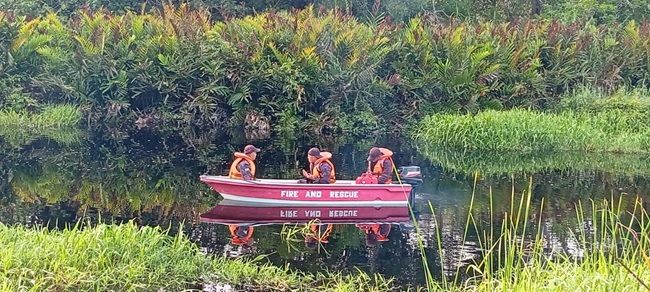
Authorities in Brunei have intensified their hunt for a missing man in Kampong Baru Sungai Bera following reports that he may have been attacked by a crocodile, with the coordinated search operation now well into its third day despite no signs of the victim emerging. The disappearance has prompted a significant mobilisation of resources from multiple government agencies, underscoring the gravity of the situation and the challenges posed by conducting rescue operations in a river environment known to harbour dangerous wildlife.
The Fire and Rescue Department (FRD) has deployed considerable assets in the search effort, deploying its own fleet of boats for continuous river patrols whilst simultaneously maintaining a visible presence along the riverbanks. The department has also leveraged modern technology, deploying unmanned aerial vehicles to conduct surveillance across the waterway and surrounding areas, expanding the search scope beyond what traditional ground and water-based methods alone could achieve. This multi-layered approach reflects standard protocols for missing-person cases in water environments where time and environmental factors are critical.
Supporting the FRD's efforts is a substantial police contingent led by the Royal Brunei Police Force (RBPF). Personnel have been drawn from Seria Police Station and the Royal Brunei Police Force Marine Police (POLMAR) unit, whose maritime expertise proves invaluable in river-based operations. The Wildlife Division has also joined the coordinated response, bringing specialised knowledge of crocodile behaviour and river ecology that could prove essential in locating the victim or identifying potential landing sites where an injured person might have sought refuge.
Operations are being directed by Senior Superintendent Amirul Hadi Junaidi, the Commanding Officer of the Operations Branch, who is overseeing the coordination between these multiple agencies. The establishment of a formal command structure for the operation reflects the complexity of managing rescue efforts across a major waterway with varying topography and challenging environmental conditions. Such multi-agency coordination, whilst essential, also highlights the scale of resources required to conduct thorough search operations in Brunei's river systems.
The incident began when the FRD received a distress call on Wednesday, June 24, from family members reporting that a male resident had gone missing during a fishing expedition in the river. An initial response team comprising two fire engines and nine personnel, led by Acting Station Officer Mohd Zulkifli Md Tahir, were dispatched to the scene. Upon arrival, investigators conducted interviews with the victim's family members who provided crucial details about the circumstances surrounding the disappearance.
According to information gathered from family members at the scene, the man had been engaged in fishing activities along the river when the suspected crocodile attack occurred. Whilst eyewitness accounts were unavailable, the sequence of events and the river environment strongly suggested a predatory animal encounter. This assessment prompted authorities to classify the incident as a potential crocodile attack rather than a simple drowning or accidental disappearance, fundamentally shaping the nature and scope of the rescue operation.
The FRD established a Tactical Command Post near the incident site to coordinate the expanding search effort. From this central hub, personnel have been able to orchestrate the deployment of firefighting assets, coordinate drone operations, and manage communications between the various teams conducting patrols and searches. The command post serves not only as a logistical centre but also as a focal point for evidence gathering and witness interviews as the investigation proceeds alongside the rescue operation.
The absence of any trace of the victim after three days presents a deeply troubling scenario. In river-based incidents involving large predators, the passage of time typically diminishes prospects for locating survivors, though recovery operations remain important for providing closure to families and for gathering information about the incident. The Sungai Bera environment, with its natural currents, vegetation, and wildlife, presents significant obstacles to visual identification and retrieval efforts.
For Malaysian and Southeast Asian readers, the incident serves as a sobering reminder of the wildlife hazards present in river systems throughout the region. Crocodile encounters, whilst statistically rare, occur periodically across Malaysia, Brunei, and Indonesia, where estuarine and freshwater crocodile populations coexist with human fishing and recreational activities. The incident at Sungai Bera underscores the importance of public awareness regarding safe practices near crocodile-inhabited waters, particularly during dawn and dusk when crocodiles are most active. Local authorities across the region have increasingly emphasised the need for public education campaigns warning residents and tourists against approaching crocodile-prone areas and against fishing in isolated sections of rivers without proper precautions or companion support.

