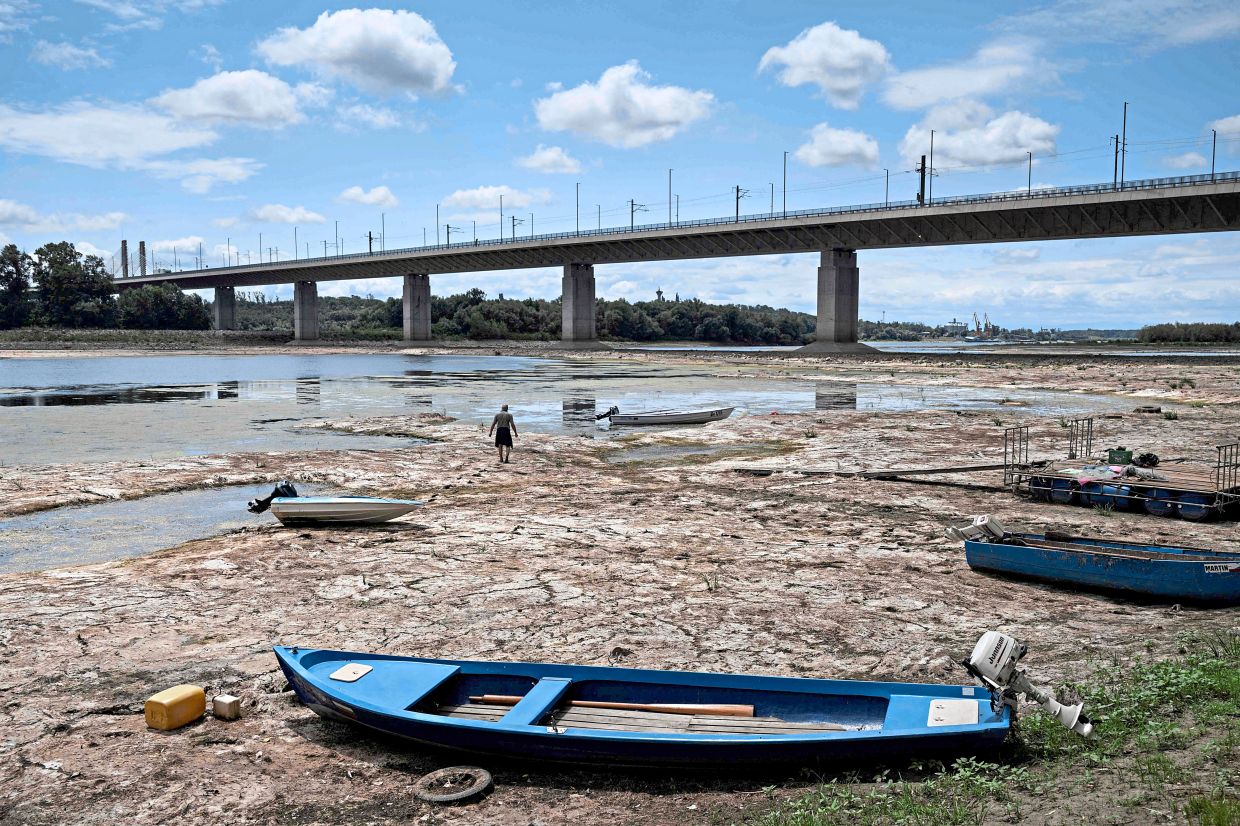
The Danube River, one of Europe's most vital waterways, has reached catastrophically low levels as a prolonged drought grips Central Europe, revealing the fragility of the continent's economic and energy systems in the face of intensifying climate stress. The river, which winds through ten countries from Germany to the Black Sea, now stands at historically unprecedented depths along much of its course, with Budapest recording water levels of just 23 centimetres in late July—well below the previous record low of 33 centimetres established in 2018. The combination of minimal rainfall and successive heat waves pushing temperatures above 38 degrees Celsius across the region has accelerated evaporation and drained water reserves that typically sustain one of Europe's most important commercial and recreational corridors.
For residents and observers along the Danube's path, the sight has become both scientifically stark and emotionally troubling. Photographer Gabor Kertesz documented the exposed base of Budapest's Margaret Bridge, where bare rocks and dry sandbars now replace the normally submerged landscape. The visible transformation serves as a tangible reminder of shifting environmental conditions, raising uncomfortable questions about the trajectory of the continent's climate. The Hungarian Meteorological Service has documented that precipitation across nearly the entire country remains 80 to 130 millimetres below historical averages over the past 90 days, signalling a systematic rainfall deficit rather than isolated drought conditions.
The economic consequences are mounting rapidly across the tourism sector, which depends heavily on Danube river cruises as a major draw for Central European destinations. Popular cruise operators have been forced to relocate departure points far upstream from their traditional Budapest docking stations, disrupting carefully planned itineraries and reducing the convenience that makes river tourism attractive to international visitors. Cargo shipping has virtually ceased operations along significant stretches of the river, according to Hungary's Ministry of Transport and Investment, as vessels cannot navigate the shallow waters. The disruption carries particular weight for the region's economy, as the Danube remains a critical artery for freight transport between Western and Eastern Europe.
The human cost of the crisis became starkly apparent when Bulgarian police evacuated 186 tourists from the Viking Ullur, a cruise ship that ran aground near Vidin in late July. The vessel, which had anticipated resupplying at the port city, found itself unable to reach shallow-water docking facilities after striking an underwater shoal. Passengers faced shortages of food and water while stranded, with the 52 crew members facing an uncertain timeline for refloating the ship depending on water conditions and technical refloating options. Similar scenes have unfolded across the region, with hundreds of small recreational boats and dozens of cargo ships marooned along dried riverbanks near Serbia's Novi Sad, where some operators report the water's edge has receded between 15 and 20 metres from its normal position.
The impact on individual livelihoods has been immediate and severe for those whose businesses depend on river navigation. Radovan Segrt, who operates river excursion services from his houseboat, has effectively abandoned his summer season operations, unable to offer the boat-riding experiences that comprise his primary income source. For workers and entrepreneurs dependent on Danube tourism and transport, the current crisis represents not merely a temporary setback but potential financial collapse if conditions persist into autumn and winter months.
Beyond tourism and shipping, the Danube's low water levels threaten the energy security of several Central European nations that rely on the river for nuclear reactor cooling. Romania's Cernavoda nuclear power plant has already shut down one reactor unit as a precautionary measure after observing Danube water flow rates drop to approximately 1,630 cubic metres per second—roughly one-third of typical July volumes. Authorities have announced plans for additional reactor shutdowns if conditions worsen. Hungary's Paks nuclear facility, which supplies nearly half of the country's entire electricity generation capacity, initiated an emergency power-down of one reactor on 29 July due to inadequate cooling-water supplies, following two successive power reductions across other reactors during the preceding two days. The cascading shutdowns raise troubling questions about Europe's ability to maintain energy production during climate stress events, particularly as demand for cooling increases with rising temperatures.
The exposed riverbed itself has created secondary hazards that authorities must actively manage. Budapest's Margaret Bridge was temporarily closed after receding waters exposed a World War II-era bomb, underscoring how extreme drought can destabilise entire infrastructure networks by revealing buried ordnance and creating unexpected safety risks. The phenomenon reflects the Danube's lengthy military history and the presence of unexploded munitions scattered across Central European waterways from decades of conflict.
While most residents and policymakers view the drought as catastrophic, the exposed riverbed has created unusual opportunities for treasure hunters and history enthusiasts. Metal detector hobbyist Zsolt Horvath has taken advantage of the low water conditions to recover wartime artefacts, unearthing items such as radio amplifiers and bullet casings using powerful magnets. Horvath's candid acknowledgement that the extreme conditions represent both blessing and curse encapsulates the paradoxical nature of environmental crises—while individual curiosities emerge, the broader implications signal genuine systemic dysfunction.
For Malaysia and Southeast Asia, the Danube crisis offers an instructive case study in how climate change can rapidly destabilise critical infrastructure systems that governments assume to be resilient. The region's own major rivers—the Mekong, the Irrawaddy, and others—similarly sustain enormous populations and support extensive hydroelectric and irrigation networks. If prolonged droughts can render Central Europe's most famous waterway nearly impassable within months, comparable scenarios could unfold in Southeast Asia with far more severe consequences given the region's greater population density and dependence on monsoon precipitation patterns. The Danube situation demonstrates that even wealthy, technologically advanced nations struggle to manage sudden environmental shocks, raising urgent questions about readiness in less-developed regions where adaptive capacity remains limited and economic vulnerability runs higher.

