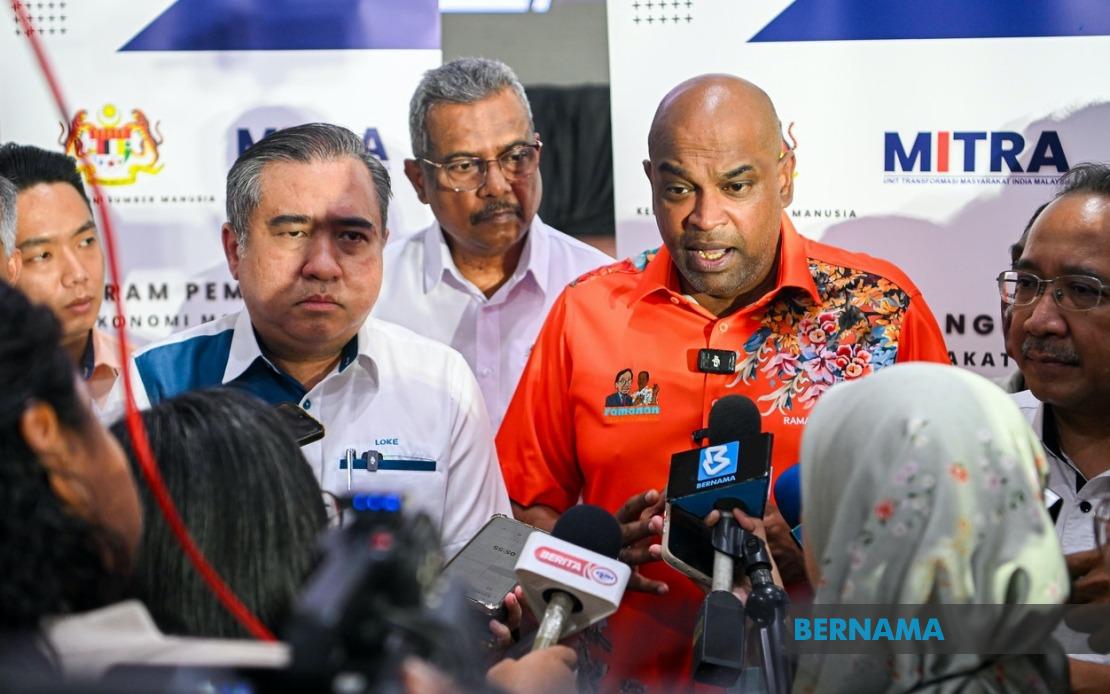
Transport Minister Anthony Loke has pushed back firmly against recurring criticism that the Democratic Action Party (DAP) wields disproportionate influence over Malaysia's government, characterizing the accusations as a worn rhetorical device designed to undermine the Pakatan Harapan (PH) administration. Speaking in Seremban on July 7, the DAP secretary-general contended that policy decisions at both federal and state levels emerge from collaborative deliberation rather than from directives issued by any individual party within the coalition.
Loke's remarks represent the latest attempt by coalition leadership to address a persistent political narrative that has animated opposition discourse and generated concerns among certain voter demographics. The allegation that DAP—Malaysia's largest Chinese-majority party—effectively steers the government has become a standard talking point in attacks on PH, particularly among quarters seeking to mobilize Malay-Muslim voters around themes of cultural anxiety. By directly confronting this characterization as repetitive and lacking substantive basis, Loke signaled that the coalition intends to actively counter such framings rather than allow them to circulate unchallenged.
The Transport Minister elaborated on the internal governance mechanisms through which PH reaches major decisions, describing a process in which all constituent parties—including DAP, UMNO, and PKR—participate meaningfully before Prime Minister Datuk Seri Anwar Ibrahim renders final determinations. This procedural framework, Loke maintained, ensures that no single faction monopolizes influence, while preserving the prerogative of the Premier to adjudicate competing interests and settle contested matters. His statement underscores the coalition's efforts to project an image of inclusive, consensus-driven administration as a counterweight to opposition claims of DAP hegemony.
Loke posed a rhetorical question that reflects the coalition's apparent frustration with the durability of these accusations: whether critics possess any substantive alternative argument beyond attributing government actions to DAP manipulation. This phrasing suggests that PH strategists view the DAP-dominance narrative less as a legitimate policy critique and more as a default rhetorical weapon deployed when opponents lack specific, factual objections to particular initiatives. The question implicitly invites observers to evaluate whether such broad-brush assertions warrant credence absent concrete evidence of party overreach in specific instances.
The minister emphasized that within a coalition framework inherently characterized by multiple parties, each component naturally advocates for its policy preferences and constituents' interests. According to his account, UMNO tables its positions, PKR advances its agenda, and DAP articulates its perspective—a normal feature of multi-party governance rather than an indication of improper influence by any particular member. This framing normalizes intra-coalition contestation as a healthy manifestation of democratic pluralism within the governing structure rather than as evidence of structural imbalance or hidden power concentration.
Loke drew an explicit parallel between federal governance practices and the administration in Negeri Sembilan, where Menteri Besar Datuk Seri Aminuddin Harun similarly solicits input from all coalition partners before implementing significant decisions. This symmetry, he suggested, illustrates a consistent institutional pattern across different levels of government rather than ad-hoc or inconsistent practice, thereby reinforcing the credibility of his portrayal of coalition decision-making as systematic and balanced.
Beyond procedural governance, Loke addressed another allegation frequently intertwined with DAP-dominance claims: that Malay-Muslim interests face systematic threat under PH administration in Negeri Sembilan. He dismissed this assertion as recycled political rhetoric devoid of concrete substantiation. The Transport Minister directed attention to material evidence that might contradict such alarmism: the state remains administered by a Malay Menteri Besar, a position he presented as emblematic of Malay representation at the highest executive tier. Moreover, he contended that government policies and programmes in the state have maintained protective frameworks for all communities, including the Malay majority, since PH assumed control of state administration in 2018.
This defensive maneuver reveals how accusations of DAP overreach have become entangled with broader anxieties about Malay-Muslim political standing and communal security—concerns that transcend straightforward questions about bureaucratic decision-making authority. By addressing both dimensions of opposition criticism simultaneously, Loke attempted to inoculate the coalition against attacks operating on multiple registers: the procedural-institutional argument targets those who view power concentration as undemocratic, while the communal-security argument targets voters mobilized by perceived demographic or political threat.
The minister's repeated invocation of the Malay Menteri Besar as evidence against discrimination claims underscores a strategic emphasis within coalition messaging: the formal inclusion of UMNO—historically the party most responsive to Malay-Muslim constituencies—in the PH government itself serves as evidence that the coalition has not marginalized such interests. This argument implicitly contests the premise that DAP influence necessarily produces policies disadvantageous to Malays, by pointing to UMNO's ongoing participation in and influence over coalition decisions.
Loke's comments occur within a broader political context in which control of coalition-government narratives has become increasingly significant to electoral viability. As PH seeks re-election, the ability to establish credible counter-narratives to opposition messaging will determine whether government-composition questions distract voters from economic performance, infrastructure development, or other outcome-based evaluations of administrative competence. His forceful rejection of DAP-dominance accusations represents an effort to shift conversational terrain away from structural anxiety and toward substantive policy accomplishments or contested matters of principle.
The Transport Minister's defense also reflects internal coalition dynamics, as UMNO's participation in PH creates potential vulnerabilities if the Malay-Muslim party appears subordinate to or manipulated by DAP partners. By publicly reinforcing that UMNO exercises genuine agency within coalition decision-making, Loke sought to reassure UMNO constituencies and leadership that partnership arrangements remain equitable and reciprocal rather than hierarchical or exploitative. Such reaffirmation becomes particularly important as the coalition approaches electoral contests in which defections from constituent-party voter bases could prove electorally decisive.
The persistence and potency of DAP-dominance allegations despite repeated coalition denials suggest that opposition messaging has achieved substantial penetration among portions of the electorate disposed to suspect that plural coalition arrangements inherently produce disadvantage for particular communities. Whether Loke's latest intervention effectively alters such perceptions or merely rehearses arguments already dismissed by skeptical audiences remains an open question. The coalition's ability to shift this political narrative may ultimately depend less on procedural clarifications than on whether voters perceive government outcomes as benefiting their communities and interests.

