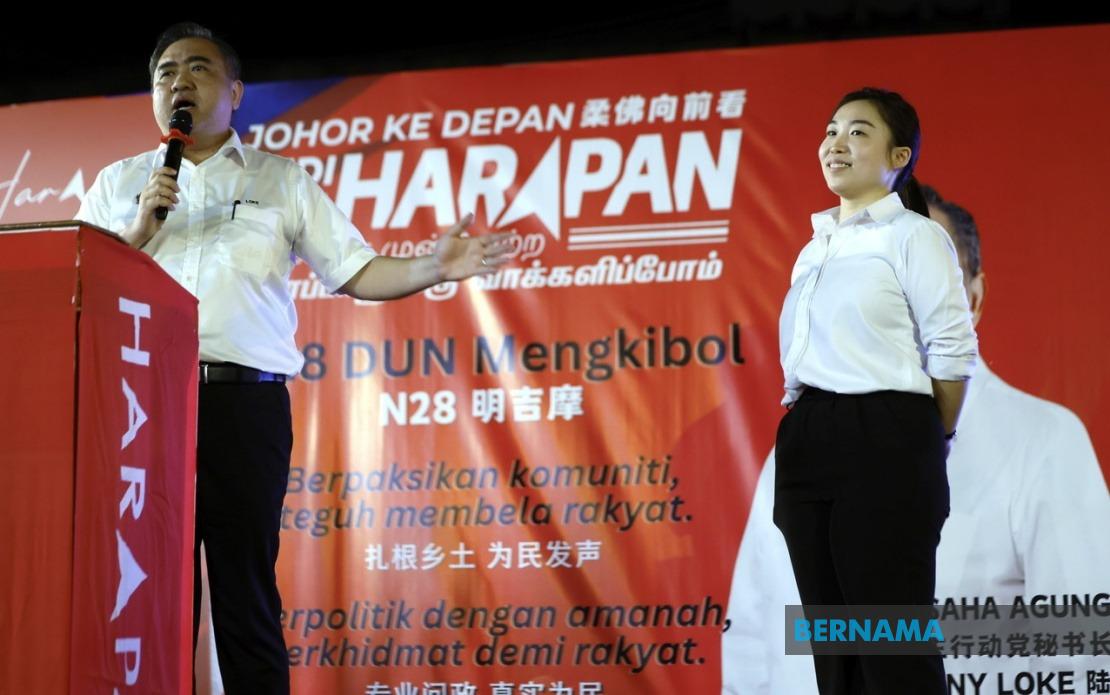
The Democratic Action Party has unveiled its first candidate for the upcoming Johor state election, selecting 33-year-old lawyer Chu Poh Yee to contest the Mengkibol state assembly seat. The party made the announcement at a candidate declaration ceremony in Kluang on Tuesday evening, marking the beginning of what promises to be a significant reshuffling of political representation in the southern state.
Chew Chong Sin, the incumbent assemblyman who has represented the constituency across two consecutive terms, will step aside to make room for the new nominee. Rather than leaving politics altogether, Chew is being repositioned for a higher tier of electoral competition. Party secretary-general Anthony Loke confirmed that the party leadership has identified Chew as a suitable candidate for the Labis parliamentary seat in the next national election, a move that opens the door for fresh candidates at the state level.
The shift comes as the current Labis Member of Parliament, Pang Hok Liong, has signalled his intention to retire from parliamentary politics. This creates a natural succession opportunity within the party's strategic planning. Loke's explanation revealed a deliberate pipeline approach to candidate management, where strong state representatives are elevated to federal positions while simultaneously nurturing new talent for state contests.
Chu's nomination reflects the Democratic Action Party's stated commitment to expanding opportunities for women in electoral politics. Loke emphasised that the party leadership had reached unanimous consensus on her selection, a procedural point suggesting the decision carried substantial organisational backing. The party secretary-general highlighted Chu's educational qualifications and linguistic capabilities, noting her proficiency across multiple languages—a particularly valuable asset in Malaysia's ethnically diverse electorate.
Beyond formal credentials, Loke pointed to Chu's practical experience working alongside elected representatives in the constituency on legal aid matters. This grassroots engagement demonstrates familiarity with constituent concerns and hands-on problem-solving rather than purely theoretical political credentials. Her deep community connections within Mengkibol appear central to the party's confidence in her viability as a candidate, suggesting the selection process weighed local knowledge alongside professional standing.
The Mengkibol nomination forms part of a broader electoral strategy now taking shape for Johor's state election. The Democratic Action Party has finalised its complete candidate slate for all 17 state seats it intends to contest, comprising a mix of sitting members, seats the party lost previously and hopes to reclaim, plus entirely new battlegrounds. This composition reveals a strategy balancing defence of existing strongholds with territorial expansion.
The staggered announcement schedule indicates coordinated planning across the Pakatan Harapan coalition. Four additional candidates—for the seats of Tiram, Johor Jaya, Senai, and Bukit Permai—will be revealed this Saturday, while the remaining nominees will be unveiled together with other coalition partners' selections at a unified announcement led by the Prime Minister on Monday. This sequenced approach maximises media coverage and demonstrates coalition unity while building anticipation for the complete picture.
For Malaysia's broader political landscape, the emphasis on female candidates signals a normative shift within opposition parties towards greater gender representation in electoral competition. The Democratic Action Party's willingness to retire a two-term incumbent to create space for women candidates suggests this commitment extends beyond tokenism to substantive reallocation of candidacies. This pattern, if replicated across coalition partners, could meaningfully alter the gender composition of state legislatures.
The Johor state election represents significant political testing ground before the next national election. The southern state's importance as an economic hub and its status as a traditionally competitive battleground means that coalition performance here carries implications beyond state governance. Chu's nomination to Mengkibol exemplifies how local candidate selection decisions connect to regional political dynamics and national trajectory.
For Johor voters, the turnover in representation brings both continuity and change. Chew's repositioning to parliamentary politics suggests the Democratic Action Party perceives him as a stronger federal-level candidate, whether through heightened prominence or specific policy focus suited to national legislature work. Meanwhile, Chu's selection implies the party assesses her as better positioned than the incumbent to retain the state seat—a calculation resting on her ground-level community presence despite less formal political experience.
The broader context of staggered announcements also reflects electoral strategy calibration. By spacing candidate revelations, parties sustain political momentum and maintain media engagement across multiple cycles rather than concentrating attention in a single news cycle. This approach recognises that candidate announcements function as campaign narrative building blocks rather than mere administrative matters.
As Johor's political contest begins to crystallise, the emergence of candidates like Chu Poh Yee will shape how different demographic groups perceive coalition offerings. The explicit emphasis on her legal expertise and language capabilities positions professional competence as central to the campaign narrative, potentially resonating with urban, educated constituencies increasingly important to electoral mathematics in modernising Malaysia.

%22%2F%3E%3C%2Fpattern%3E%3C%2Fdefs%3E%3Crect%20width%3D%22100%25%22%20height%3D%22100%25%22%20fill%3D%22url(%23ph1fu7wg)%22%2F%3E%3Crect%20width%3D%22100%25%22%20height%3D%22100%25%22%20fill%3D%22url(%23ph1fu7wp)%22%2F%3E%3Ctext%20x%3D%2250%25%22%20y%3D%2250%25%22%20text-anchor%3D%22middle%22%20dominant-baseline%3D%22central%22%20fill%3D%22rgba(255%2C255%2C255%2C0.95)%22%20font-family%3D%22Georgia%2C%20'Times%20New%20Roman'%2C%20serif%22%20font-weight%3D%22700%22%20font-size%3D%22170%22%20letter-spacing%3D%22-0.02em%22%3EGabungan%3C%2Ftext%3E%3C%2Fsvg%3E)