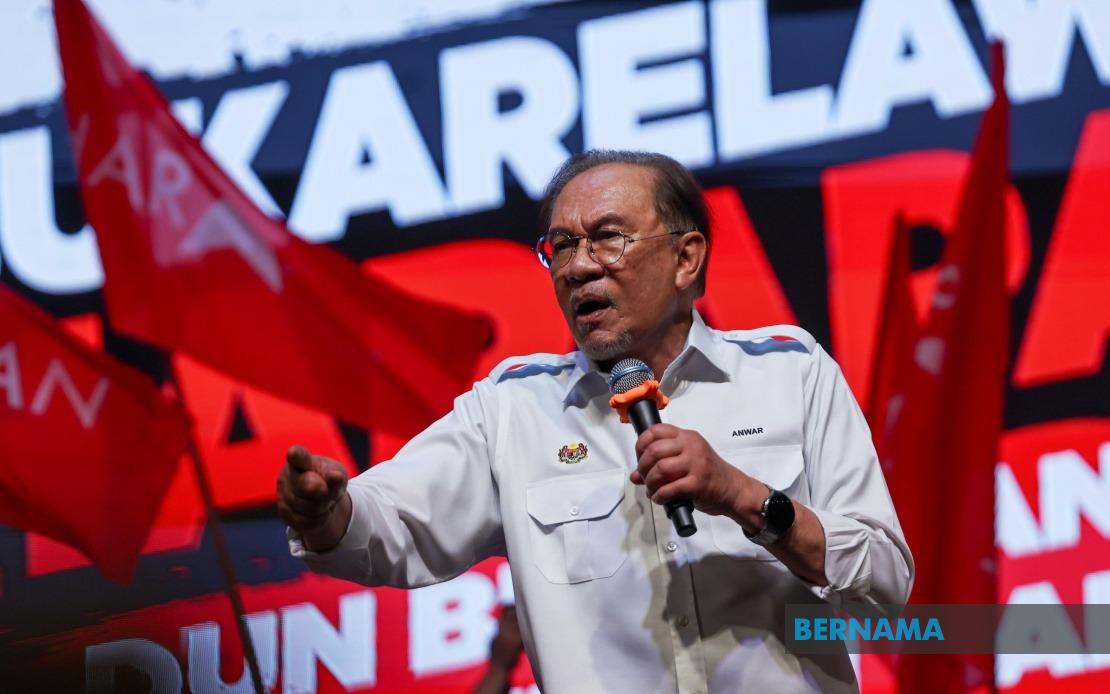
Prime Minister Datuk Seri Anwar Ibrahim moved to counter persistent accusations of racial bias against the Democratic Action Party during remarks in Muar this week, emphasizing that DAP has consistently respected constitutional protections for Malays and Bumiputeras. Speaking as chairman of Pakatan Harapan at a public engagement, Anwar rejected efforts to portray the opposition-turned-coalition partner as promoting anti-Malay sentiment, pointing instead to the party's acceptance of government initiatives without objection or delay.
The prime minister cited the gazettal of 20.23 hectares of land in Bandar Malaysia as Malay Reserve Land as concrete evidence of DAP's willingness to uphold constitutional obligations toward the Malay-Muslim majority. This specific example carries symbolic weight beyond its acreage, as Bandar Malaysia sits within the heart of the capital and represents one of the nation's most high-profile development projects. By emphasizing DAP's non-opposition to this designation, Anwar sought to demonstrate that the party does not challenge foundational provisions of the Federal Constitution regarding Bumiputera status and reserved lands.
As leader of the Unity Government—a broad coalition spanning historically opposed political forces—Anwar framed his governing philosophy around the principle of impartial treatment across Malaysia's multiethnic society. He acknowledged that his administration implements targeted programmes benefiting the Malay community and other Bumiputera groups, including enhanced allocations to Perbadanan Usahawan Nasional Berhad (PUNB), the national entrepreneur development body. The absence of DAP resistance to these initiatives, he argued, demonstrates internal coalition consensus on supporting communal economic advancement where constitutionally sanctioned.
Yet Anwar's remarks also revealed the core tension within Malaysia's present political arrangement. While defending DAP against accusations of undermining Malay privilege, he simultaneously defended the government's obligation to extend poverty relief and development programmes to economically marginalised Chinese and Indian communities. This apparent balancing act reflects the fundamental challenge of governing a multiethnic nation where historical constitutional protections for one group coexist with democratic principles of equal citizenship for all. Anwar's formulation—that honouring Malay-Bumiputera provisions need not exclude assistance to other poor populations—represents an attempt to reconcile competing constitutional and moral claims.
The prime minister's emphasis on equitable economic distribution takes on heightened significance given Malaysia's current growth trajectory. Rather than treating expansion as an opportunity for concentrated gains among political elites or privileged factions, Anwar presented economic development as a social contract requiring broad-based benefit distribution. His vision envisions improved housing accessibility, enhanced small business infrastructure, strengthened education systems, and upgraded basic amenities reaching across income levels and ethnic lines. This framing suggests frustration with previous governmental patterns where economic gains accrued narrowly while structural poverty persisted across multiple communities.
Anwar's remarks about the nature of political power itself carry implications for the Unity Government's internal dynamics and broader governance direction. By stating that power constitutes a trust rather than a vehicle for personal enrichment, and that political service must supersede personal interest, he implicitly critiqued patterns of political patronage and rent-seeking that have characterised Malaysian politics. This moral dimension to his argument addresses concerns among voters from all backgrounds who have witnessed political leaders leveraging public office for private accumulation. For a coalition government comprising ideologically distinct parties, such ethical framing may serve as a unifying principle even when specific policy preferences diverge.
The timing of these comments during campaigning for the Johor state election reflects their electoral significance. With 172 candidates competing across 56 state assembly constituencies, and polling scheduled for 11 July, Anwar's defence of DAP addresses a persistent vulnerability within Pakatan Harapan's political coalition. Johor traditionally represents stronghold territory for Malay-based parties, making accusations of DAP anti-Malayism particularly resonant among voters the coalition needs to attract or retain. By explicitly detailing DAP's acceptance of Bumiputera provisions and development programmes, Anwar sought to insulate the party against last-minute fear campaigns that have historically proved effective in the state.
The Johor state election carries particular weight within Malaysian politics given the state's size, economic importance, and historical role as a Barisan Nasional bastion. Victory or strong showing would significantly strengthen the Unity Government's parliamentary position and internal cohesion. Conversely, substantial losses would embolden parties within the coalition to demand policy shifts or repositioning. Anwar's emphasis on inclusive governance directly addresses voter concerns about whether DAP participation in the coalition might translate into reduced support for Malay-Muslim institutions or interests—a concern repeatedly deployed by opposition parties despite DAP's constitutional acceptance and policy compliance.
Anwar's inclusive development vision, if operationalized effectively, could address one of Malaysia's most persistent structural challenges: the coexistence of significant poverty within multiple communities despite overall economic growth. The prime minister's articulation suggests recognition that poverty concentrated within Malay-Muslim communities cannot be adequately addressed through policies that simultaneously exclude other impoverished populations from development assistance. This approach potentially broadens the political base for antipoverty initiatives while avoiding the zero-sum framing that has historically fractured coalition governments. Whether the Unity Government can translate this rhetoric into coherent policy implementation across contentious issues like subsidy targeting, education resource allocation, and employment quotas remains the substantive challenge ahead.
The broader context of Anwar's remarks involves recalibrating public expectations about what multiethnic coalitional governance entails. Malaysia's constitutional architecture enshrines specific protections and privileges for Bumiputeras, yet democratic participation requires responding to the needs and aspirations of all citizens regardless of ethnic classification. Anwar's insistence that honouring constitutional Bumiputera provisions and extending inclusive development constitute complementary rather than contradictory objectives represents an argument that such apparent tensions can be managed through transparent priority-setting and equitable resource distribution rather than through winner-take-all political competition.
As the Johor election unfolds and Malaysia moves toward subsequent electoral contests, Anwar's framing of DAP and the Unity Government's commitment to constitutional pluralism will face renewed testing. Whether voters accept his reconciliation of Bumiputera protections with multiethnic inclusivity, or whether opposition parties successfully amplify concerns about DAP's long-term intentions, will substantially shape the political landscape for the remainder of this government's term and influence the formation of subsequent governing coalitions.

