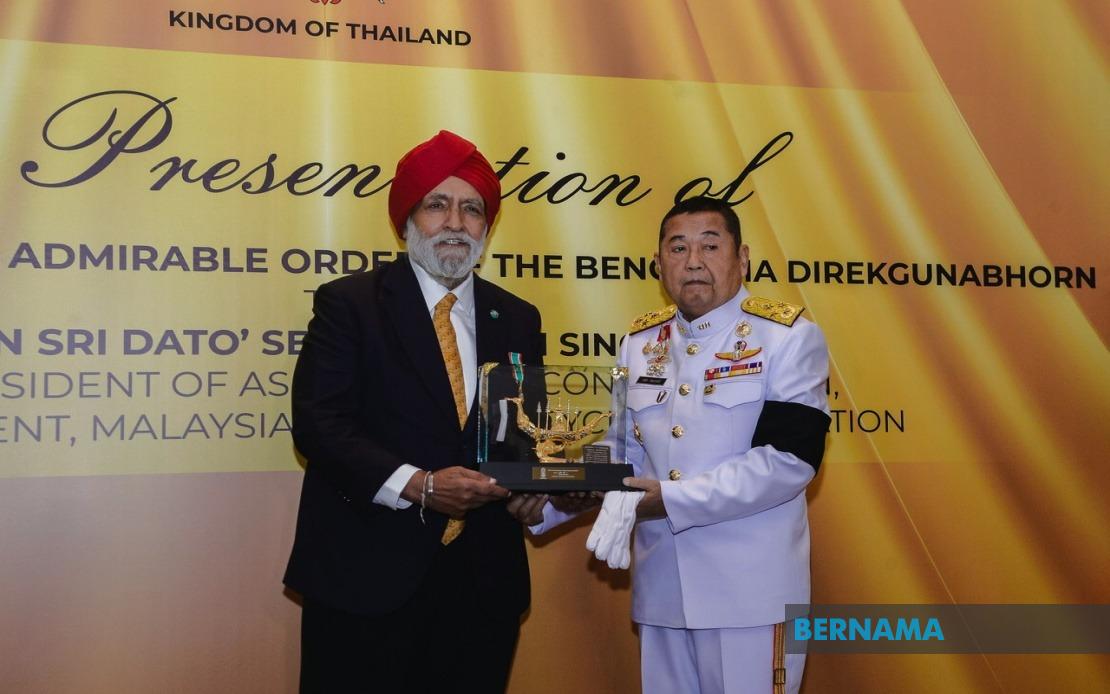
Tan Sri Darshan Singh Gill, who shaped cycling governance across Malaysia and Asia over three decades, has been bestowed one of Thailand's highest honours in a ceremony held in Kuala Lumpur. The "Most Admirable Order of the Direkgunabhorn (Fifth Class – Benjama Direkgunabhorn)" was presented by ACC senior vice-president General Decha Hemkasri under the royal patronage of Thailand's monarchy, acknowledging Gill's profound impact on developing the sport regionally and beyond.
The decoration, originally decreed by the late King Bhumibol Adulyadej The Great, Rama IX, underscores the esteem in which cycling leaders are held across Southeast Asia's institutional frameworks. Such recognition from a fellow ASEAN nation demonstrates how sports governance transcends national borders and reflects deeper regional cooperation mechanisms. For Malaysia, the honour carries particular significance as it validates the country's trajectory from a regional cycling backwater to a competitive force on the global stage.
Gill's tenure as Malaysian National Cycling Federation president between 1988 and 1990 coincided with transformative years for domestic cycling administration. His subsequent leadership of the Asian Cycling Confederation from 1996 to 2005 positioned him at the forefront of continental cycling development during a period of rapid modernisation and professionalisation across the sport. During these formative years, he established governance frameworks that would eventually enable Malaysian cyclists to compete at elite international levels.
The award's timing resonates with Malaysia's recent ascent in competitive cycling. Datuk Mohd Azizulhasni Awang, widely regarded as a generational talent, recently claimed Commonwealth Games gold in the men's keirin event at Glasgow's Sir Chris Hoy Velodrome, ending a 16-year championship drought for Malaysian track cycling. This breakthrough follows years of investment and administration refined under leaders like Gill, demonstrating how institutional excellence translates into athletic performance.
Equally significant is Malaysia's emergence as an administrative powerhouse within international cycling structures. Datuk Amarjit Singh Gill, current MNCF president, achieved a historic milestone by becoming the first Malaysian elected as International Cycling Union vice-president for the 2025-2029 term. This election, secured during the 194th UCI Congress in Kigali, Rwanda, represents a fundamental shift in how Asian and Malaysian voices influence global cycling policy. Such representation at world body level would have been unimaginable during the era when Malaysia's cycling infrastructure was nascent.
Gill's reflections on this progression highlighted how Malaysia's cycling narrative has evolved from the achievements of athletes like M. Kumaresan and Rosman Alwi to contemporary champions like Azizulhasni. This generational comparison illustrates not merely individual excellence but systemic development. The presence of Malaysian administrators and athletes simultaneously excelling at global forums suggests a mature sporting ecosystem supported by sound governance and institutional capacity.
The conferment of a Thai royal insignia also reflects broader ASEAN solidarity in sports development. Thailand, as a fellow regional cycling nation with its own track cycling traditions, acknowledges Malaysia's contributions to Asian cycling advancement. Such reciprocal recognition strengthens regional sporting ties and encourages knowledge-sharing among Southeast Asian cycling federations navigating similar development challenges.
For Malaysian sports administrators, Gill's honour serves as validation that long-term institutional building yields tangible results. The establishment of governance structures, the nurturing of technical expertise, and the cultivation of competitive pathways—often unglamorous administrative work—ultimately determine whether a nation produces world-class athletes and administrators. Gill's career exemplified this principle, prioritising systemic development over short-term visibility.
The award also underscores how former administrators remain influential in shaping sporting narratives. Gill's presence and contributions continue to be referenced in discussions about Malaysian cycling's future direction. His mentorship and institutional legacy provide continuity as younger administrators like Amarjit navigate increasingly complex international sporting politics. This transmission of expertise across generations strengthens Malaysia's institutional memory within global cycling governance.
Moreover, the recognition highlights Malaysia's potential as a regional sports administration centre. With both competitive athletes and world-level administrators emerging from the Malaysian system, the country could position itself as a thought leader in Asian cycling development. This requires continued investment in technical training, athlete development pathways, and governance capacity-building—areas where Gill's legacy remains instructive.
The Thai honour also carries symbolic weight in regional diplomacy. Sports recognitions between ASEAN members reinforce political and cultural ties beyond formal government channels. Thailand's acknowledgement of a Malaysian cycling leader's contributions demonstrates how sporting bodies can serve as unofficial ambassadors, promoting regional understanding and cooperation.
Gill's award represents a culmination of decades devoted to institution-building when Malaysian cycling lacked international prominence. His willingness to develop systems rather than merely celebrate occasional successes established foundations upon which contemporary Malaysian cyclists and administrators now flourish. As Malaysia continues pursuing greater international sporting recognition, administrators like Gill—who invested in unglamorous groundwork—merit remembrance as architects of national sporting capability.

