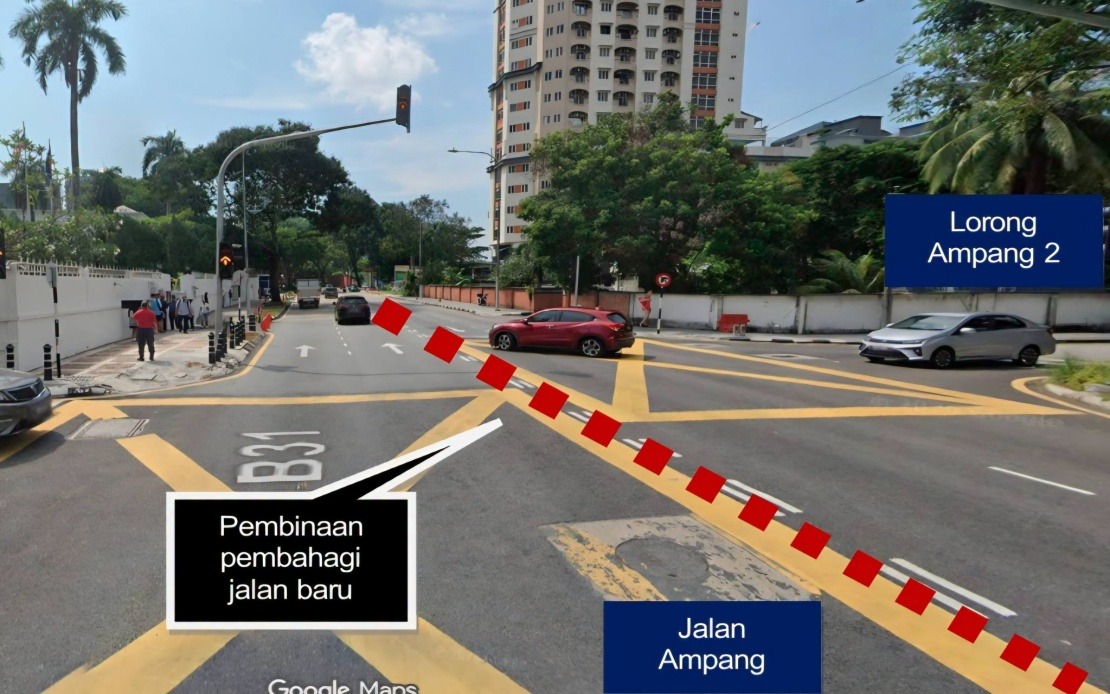
Kuala Lumpur City Hall (DBKL) has initiated the permanent closure of two traffic light intersections on Jalan Ampang, effective immediately, in connection with an extensive road modernisation scheme designed to reshape one of the city's key traffic corridors. The affected intersections—one in front of the Royal Thai Embassy and another at Lorong Ampang 2—have been taken offline to accommodate infrastructure improvements along the 3.2-kilometre stretch of Jalan Ampang, which extends from the Jalan Tun Razak junction through to Middle Ring Road 2 (MRR2).
The upgrade initiative represents a significant infrastructure commitment by the municipal authority to address longstanding traffic management challenges in the area. By removing the traffic light-controlled intersections and introducing structural modifications such as road dividers and reconfigured lane layouts, DBKL aims to fundamentally alter how vehicles navigate this busy urban corridor. The underlying premise is that eliminating certain intersection control points will paradoxically improve overall traffic flow by reducing the complex vehicle-weaving patterns that typically occur at signalised junctions, where drivers must negotiate multiple directional movements within confined spaces.
The comprehensive nature of the project extends well beyond simple closure of traffic signals. DBKL's infrastructure blueprint calls for the construction of permanent road dividers that will segregate opposing traffic streams, reducing head-on collision risks and unauthorised crossing manoeuvres. The roadway itself will be reconfigured into a two-way, four-lane configuration—a design choice that suggests the authority believes the corridor requires expanded capacity despite the intersection closures. This apparent contradiction reflects modern traffic engineering philosophy, which prioritises uninterrupted flow on main arterial roads over accommodating local turning movements at mid-block locations.
Pedestrian safety and accessibility have been integrated into the project scope, with DBKL committing to enhanced pedestrian walkways that meet contemporary comfort and safety standards. Street lighting infrastructure will also receive systematic upgrades, addressing visibility concerns that have historically plagued the corridor during evening hours. These complementary improvements suggest the authority recognises that effective road networks serve multiple user categories—not merely vehicles but also pedestrians, cyclists, and vulnerable road users who depend on well-maintained public infrastructure.
For motorists accustomed to the existing intersection configuration, navigation will require behavioural adjustment. DBKL has designated alternative routing options to facilitate traffic redistribution during the transition period. Drivers heading towards Ampang may execute U-turns at Jalan Tun Razak, effectively bypassing the closed intersections via a slightly longer route. Those travelling cityward from the eastern suburbs can perform similar manoeuvres at Jalan Ampang Hilir. These alternatives suggest DBKL has conducted traffic modelling to identify suitable divergence points that can absorb displaced traffic without creating bottlenecks elsewhere in the network.
The closure represents a calculated trade-off between short-term inconvenience and long-term operational efficiency. Traffic engineers contend that intersection closures, when strategically applied to reduce weaving conflicts and eliminate complex signal coordination challenges, can substantially decrease travel times along corridor sections. The Jalan Ampang project appears based on this principle—by sacrificing flexibility for turning movements at two points, the authority believes overall throughput will improve for the majority of through-traffic using the main roadway.
Implementing such infrastructure modifications in an established urban environment demands careful public communication and compliance with traffic management protocols. DBKL has issued guidance emphasising strict adherence to newly installed traffic signage and road markings. The authority clearly recognises that successful project execution depends not merely on physical construction but on motorist cooperation and understanding of revised traffic patterns. Inadequate public communication about route changes frequently generates congestion and confusion during major intersection closures in Malaysian cities.
From a broader urban development perspective, the Jalan Ampang upgrade sits within Kuala Lumpur's ongoing efforts to systematise its road network and address congestion on major corridors. The city's traffic challenges stem partly from historical patterns of uncoordinated intersection development, where traffic signals evolved organically rather than being integrated into coherent arterial management systems. Projects like this represent attempts to retrofit modern traffic engineering standards onto legacy street networks, a process complicated by existing property boundaries, established development patterns, and the need to maintain at least minimal traffic flow during construction.
The project's implications extend beyond Jalan Ampang itself. Traffic displaced from the upgraded corridor may distribute across parallel routes including Jalan Ampang Hilir and secondary roads serving the Ampang area. Residents and businesses along these alternative routes should anticipate temporary volume increases as drivers adapt to the new Jalan Ampang configuration. Similarly, the success or difficulties experienced during this project will likely inform future DBKL decisions regarding intersection closures and corridor-wide modernisation initiatives elsewhere in the city.
For business establishments along Jalan Ampang, particularly those relying on customer accessibility from certain directions, the intersection closures warrant contingency planning. While DBKL has provided alternative routes, the modified access patterns may temporarily affect foot and vehicle traffic to affected premises. However, improved long-term traffic flow and enhanced pedestrian infrastructure could ultimately benefit businesses by creating a more attractive streetscape and reducing travel times for customers.
The timing of this infrastructure work also merits consideration. Implementing major traffic changes during periods of elevated urban mobility demand amplifies disruption potential. DBKL's decision to commence the project immediately suggests either confidence in the alternative route capacity or acceptance of short-term congestion as a necessary cost of long-term improvement. Motorists and residents should monitor official traffic advisories and plan journeys strategically during the implementation phase.
Ultimately, the Jalan Ampang upgrade exemplifies evolving approaches to managing traffic within Malaysian cities. Rather than simply expanding capacity through widening or new construction, modern projects increasingly emphasise systematic redesign of existing corridors to improve efficiency, safety, and user experience across multiple transportation modes. Success will depend on the quality of engineering design, thoroughness of public communication, and ultimately, whether the projected traffic flow improvements materialise under real-world conditions.

