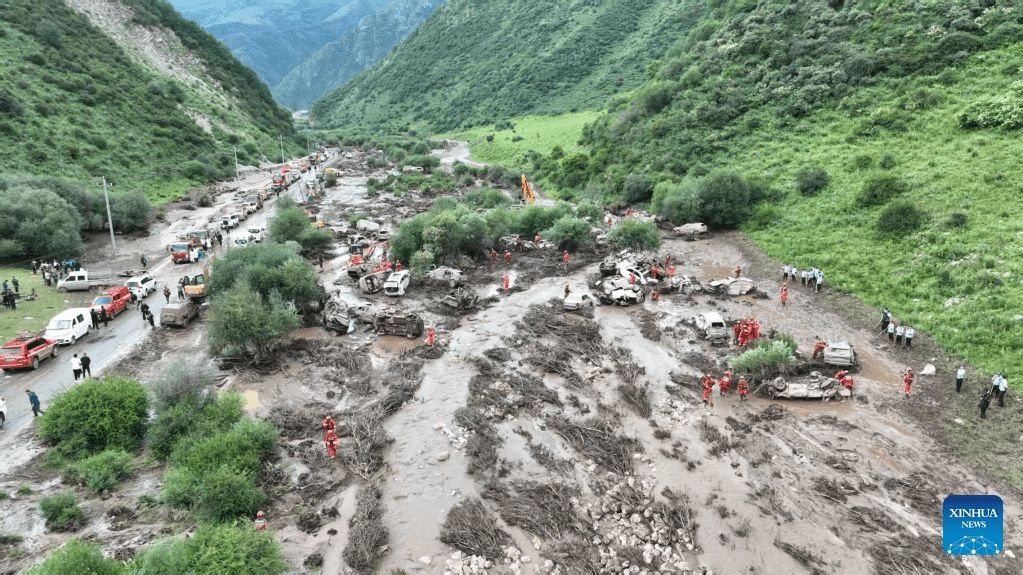
A catastrophic flash flood has struck a scenic recreation area in Weiyuan County, Dingxi City, in Gansu Province, claiming at least 10 lives and leaving 23 people injured as the region grapples with the aftermath of torrential rainfall. The disaster unfolded on Sunday afternoon when unexpected cloudbursts overwhelmed the area, trapping numerous tourists who had been camping at the site. Emergency response teams from local public security and fire-and-rescue departments have mobilised search-and-rescue operations at the scene, working against time to locate any remaining missing persons.
The catastrophe arrives at a moment when China's weather authorities are dealing with an exceptionally severe atmospheric system. Typhoon Noul, the nation's third major tropical cyclone to strike this month and the 12th of the year, made landfall in Huidong county in Guangdong Province on Sunday morning at approximately 3:50 am local time. The storm's name, derived from a Korean word meaning the glow of sunrise or sunset, belies the destruction it has wrought across the Pearl River Delta region and beyond. The typhoon represents the strongest tropical cyclone to impact China during the current calendar year, underscoring the intensity of seasonal weather patterns affecting East Asia.
The convergence of Noul's powerful circulation with prevailing atmospheric patterns has created ideal conditions for extreme precipitation across southern and central China. The Ministry of Water Resources and the China Meteorological Administration jointly issued a red-level alert for flash floods on Sunday evening, the highest warning tier in China's meteorological hierarchy. The warning encompasses a vast geographical area, spanning Jiangxi, Hunan, Guangdong, Sichuan, Shaanxi, Gansu, and parts of southeastern Xinjiang. Authorities have projected that this exceptional flooding threat will persist from Sunday evening through Monday evening, with the potential for additional rainfall extending through Tuesday.
The geographical scope of the hazard reflects the typhoon's broad influence on regional weather systems. Officials have cautioned that some areas, particularly Fujian Province, face the prospect of extremely heavy precipitation levels. The storm's inland trajectory will continue to generate strong winds and heavy rainfall as Noul weakens gradually while moving further into the Chinese interior. State broadcaster CCTV has advised that persistent rainfall patterns will characterise the weather across affected regions during this extended period, necessitating heightened vigilance from residents and emergency management personnel.
The disaster has forced Chinese authorities to undertake one of the largest civilian relocations witnessed in recent months. More than 700,000 people in Guangdong Province have been relocated to safer locations away from flood-prone zones and areas vulnerable to typhoon-force winds. This massive displacement operation reflects the serious threat assessment that government officials have made regarding Noul's potential impact on populated regions. The evacuation efforts represent a coordinated response involving multiple provincial and municipal governments working to prioritise human safety over other considerations.
Hong Kong, the region's major financial and transportation hub, experienced the typhoon's periphery effects, with the storm passing within 80 kilometres of the territory. The Hong Kong Observatory recorded southwesterly gale-force winds battering the Asian city-state, prompting the issuance of typhoon warning signals that lasted through much of Sunday before being cancelled as the system moved westward. Hong Kong's international airport, which suspended operations for more than 12 hours due to hazardous conditions, began gradually resuming flight operations on Sunday afternoon as wind speeds subsided to manageable levels.
The flash flood disaster in Gansu Province carries particular significance for Southeast Asian nations and Malaysia in particular, as it demonstrates the unpredictable nature of extreme weather events in the broader East Asian region. The interaction between tropical cyclone systems and orographic features can generate localised precipitation that conventional forecasting models sometimes underestimate, a phenomenon that meteorologists continue to study with increasing intensity. For Malaysian observers, the Gansu tragedy offers sobering reminders about the potential for rapid-onset flooding in mountainous and scenic areas where tourists congregate, particularly during seasons when tropical cyclone activity is elevated.
Emergency management authorities across affected Chinese provinces have implemented comprehensive preventative measures to mitigate flooding risks. Officials have instructed local governments to intensify monitoring of historically flood-prone locations, including mountain ranges, river valleys, construction sites, and bridge infrastructure. These vulnerable locations frequently experience accelerated runoff during extreme precipitation events, transforming seemingly minor watercourses into destructive torrents. The emphasis on real-time monitoring, early warning dissemination, and coordinated evacuation procedures reflects lessons learned from previous major flooding disasters across China.
The response to Typhoon Noul demonstrates the critical importance of early warning systems and coordinated disaster management protocols in densely populated regions vulnerable to tropical cyclone impacts. China's meteorological and hydrological authorities have demonstrated their capacity to issue timely alerts across multiple provinces, enabling large-scale preemptive evacuations and the positioning of rescue assets. However, the Gansu casualties underscore the reality that even with advanced warning systems, sudden localised phenomena can overwhelm emergency response capacity. For Malaysian policymakers and disaster management officials, this case study highlights the continued necessity for investment in community-level awareness and preparedness, particularly in tourism-dependent regions where concentrated populations of visitors may lack familiarity with local hazard characteristics.
The convergence of the Gansu flooding tragedy with Typhoon Noul's broader ramifications has prompted widespread discussion within Chinese emergency management circles regarding the adequacy of current early warning systems for sudden-onset hydrological hazards. While meteorological agencies excel at predicting large-scale atmospheric phenomena, the translation of those predictions into actionable local guidance for mountainous scenic areas remains an ongoing challenge. The incident may catalyse additional investment in real-time hydrological monitoring networks and improved communication protocols between weather agencies and tourism operators, particularly in remote locations where response times are naturally constrained by geographical factors.

