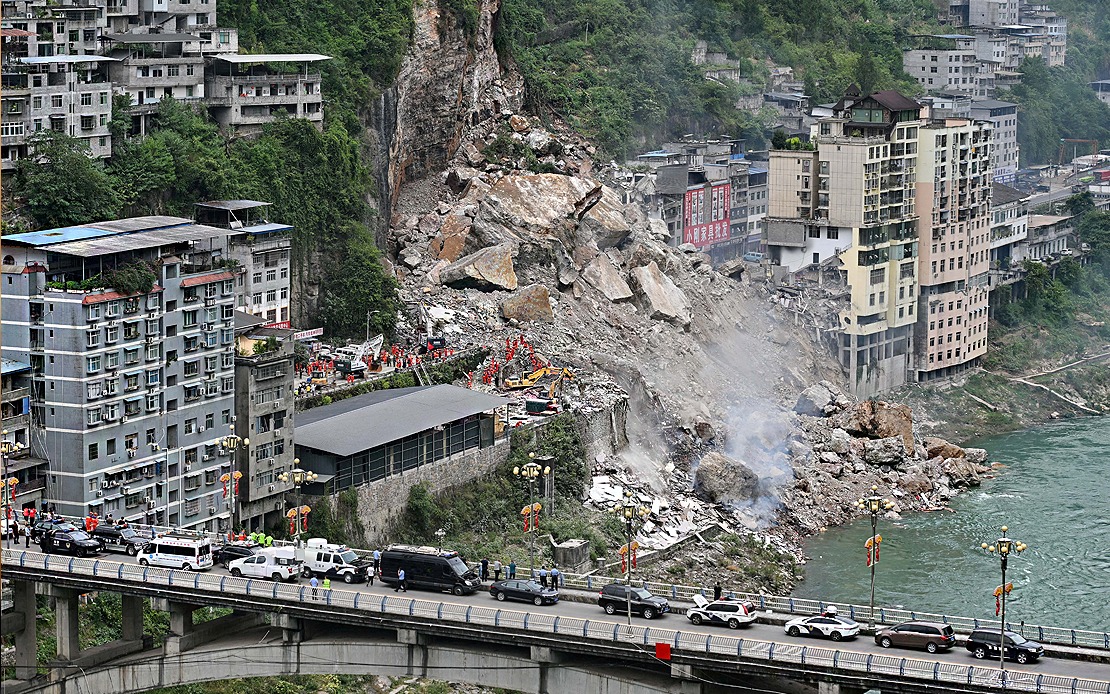
A devastating mountain collapse in southwest China's Chongqing Municipality has resulted in at least 51 confirmed deaths, with a further ten individuals still unaccounted for as of Thursday, according to statements released by local officials and reported through Xinhua. The disaster, which struck the Hanjia sub-district of Pengshui Miao and Tujia Autonomous County on the morning of July 17, has become one of the region's most significant natural disasters in recent times, prompting an extensive and ongoing rescue operation involving multiple government agencies and emergency services.
The catastrophic event unfolded at 9:08 am when the mountainside gave way along a section of the Wujiang River, a major waterway in the region. The collapse buried more than ten residential buildings beneath tonnes of rock and soil, leaving dozens of families displaced and countless others searching for missing relatives. The sheer magnitude of the structural damage has made recovery efforts extraordinarily challenging, requiring specialized equipment and expertise to carefully sift through the massive debris field that now covers the affected area.
In response to the immediate humanitarian crisis, local authorities initiated a sweeping evacuation protocol that successfully moved more than 1,100 residents away from the danger zone and potential secondary collapses. This large-scale evacuation underscores both the scale of the original disaster and the government's concern about the structural integrity of surrounding terrain in the aftermath. The rapid mobilization of evacuation resources demonstrates the established emergency response mechanisms that regional authorities have developed for such geological emergencies.
Rescue teams have managed to retrieve ten individuals alive from the rubble, with three of these survivors having already been discharged from hospital facilities following medical assessment and treatment. The remaining rescue survivors continue to receive specialized care for injuries sustained during the collapse and subsequent rescue operations. Medical personnel have been preparing facilities to handle additional survivors as search operations continue, though the passage of time since the initial collapse has reduced expectations for finding further living victims among the missing.
Search operations on land have now been completed, marking a significant transition in the rescue strategy. However, authorities have shifted focus to underwater searches and comprehensive river cleanup operations, as the proximity of the collapse site to the Wujiang River means that debris and potentially missing persons may have been carried downstream by the current. Specialized diving teams and river recovery equipment have been deployed to systematically search the riverbed and banks, extending the operation beyond the initial collapse zone into areas several kilometers downriver.
The disaster occurred against the backdrop of heavy rainfall that characterizes the summer monsoon season across southwestern China. Geological and meteorological experts have long identified the region's steep terrain and wet climate as contributing factors to landslide and collapse risks, particularly in areas with previous geological instability. The July rainfall that precipitated this particular collapse represents a recurring seasonal hazard that authorities in Chongqing and neighboring provinces have attempted to mitigate through improved monitoring systems and early warning protocols.
For Malaysian readers, this incident illustrates challenges that resonate across the broader Southeast Asian region. Malaysia itself faces similar geological and climatic risks, particularly in areas with steep terrain and during the monsoon seasons. The collapse demonstrates the importance of robust building codes, geological surveys before residential development, and early warning systems for natural disasters. The displacement of over a thousand residents also highlights the humanitarian dimensions of such events and the critical role of coordinated government response in minimizing casualties and supporting affected communities.
The restoration efforts currently underway encompass not merely physical reconstruction but also the profound work of helping displaced communities rebuild their lives. Local authorities have established support mechanisms for affected families, including temporary shelter, food assistance, and psychological support services. The process of restoring normal life to the affected district will likely extend for months, requiring sustained commitment from provincial and local government bodies as well as community organizations.
International disaster management experts often point to events like the Chongqing collapse as important case studies for understanding how geological hazards intersect with urban development. The presence of over ten residential buildings in a zone ultimately proven vulnerable to collapse raises questions about pre-construction geological assessments and zoning decisions made in previous decades. As climate change potentially intensifies extreme weather events, regions across Asia may need to reassess their understanding of which areas are truly safe for human habitation.
The ongoing nature of the search and recovery operation reflects the thorough and methodical approach Chinese authorities are taking toward accounting for every missing person. The commitment to underwater searches, despite the passage of time since the initial disaster, demonstrates a determination to provide closure to grieving families and ensure that no victim is overlooked. This comprehensive approach, while resource-intensive, sets a standard for disaster response that prioritizes human dignity alongside the eventual restoration of physical infrastructure and normalcy.

