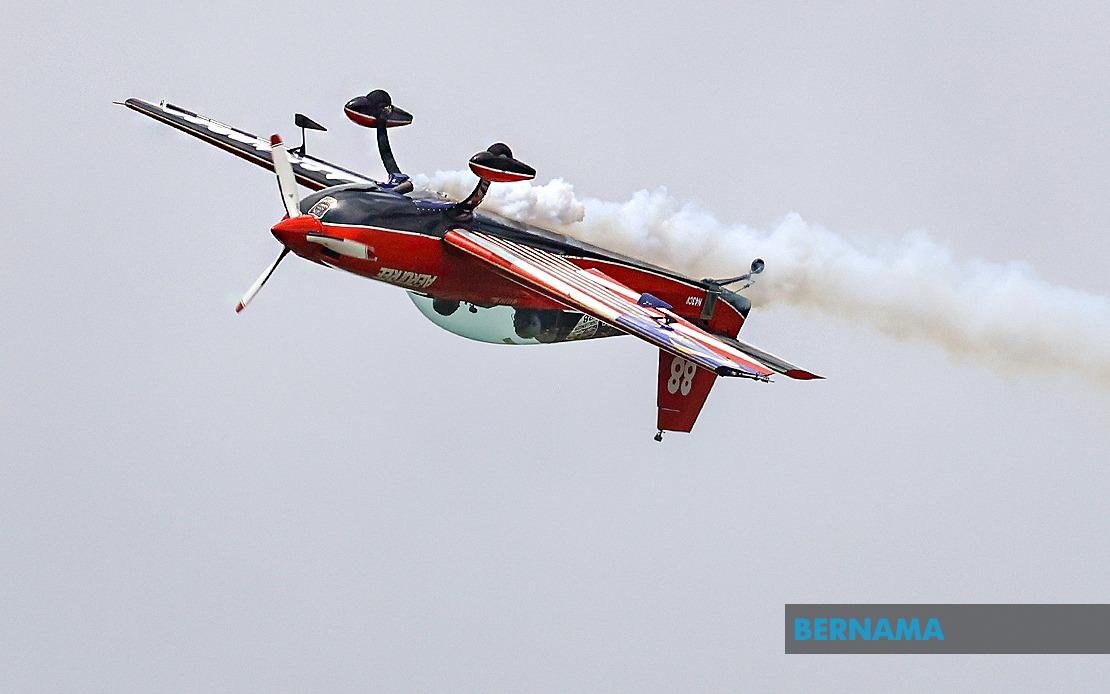
A retired Royal Malaysian Air Force fighter pilot with four decades of aviation expertise took centre stage in Putrajaya on National Day, piloting a solo twilight aerobatic performance that blended precision flying with pyrotechnics against the setting sun. Major (Rtd) Datuk Halim Othman, 60, led the inaugural 'Merdeka Sunset Show: Melukis Senja' air display during the 69th National Day celebrations, marking a significant moment in Malaysia's contemporary aviation heritage. The 7 pm performance represented not merely a spectacle of aerial acrobatics but a carefully choreographed demonstration of the technical mastery, discipline and courage demanded by high-performance fighter aviation.
Halim's trajectory through Malaysia's aviation sector reflects a career trajectory uncommon in Southeast Asia. Beginning his service as an RMAF fighter pilot in 1985, he earned the coveted 'Top Gun' designation before transitioning into the rarefied world of competitive aerobatic flying and international air racing. His most significant distinction came as Malaysia's first qualifier for the Red Bull Air Race World Championship, an achievement that saw him competing against predominantly non-Malaysian and non-Asian pilots in one of aviation's most demanding competitive formats. This background positioned him uniquely to contribute expertise at the highest levels of aerial performance and to mentor emerging Malaysian aviation talent.
The Merdeka Sunset Show concept itself drew inspiration from earlier successful demonstrations. Halim had previously pioneered this innovative performance model at Chenang during the Langkawi International Maritime and Aerospace Exhibition (LIMA) the preceding year, establishing a template that merged artistic sunset backdrops with complex aerobatic manoeuvres and visual pyrotechnics. The format proved sufficiently compelling to warrant adaptation for the national celebrations, reflecting growing recognition in Malaysia that aviation spectacles can serve both entertainment and aspirational purposes for younger generations considering careers in aerospace fields.
In discussing his approach to aerobatic flying, Halim emphasised that the discipline extends far beyond executing dramatic turns and rolls. Rather, successful aerobatic performance demands comprehensive understanding of aircraft systems, precise calculation of performance envelopes, rigorous physical conditioning, and countless hours of deliberate practice. The margin between spectacular performance and catastrophic failure in aerobatic flying remains razor-thin, necessitating the absolute precision and unwavering focus that characterises top-tier military aviators. This emphasis on the technical and mental rigour underlying apparent effortlessness reflects professional attitudes prevalent among elite pilots globally.
Halim's international racing experience had exposed him to competitive environments where Malaysian pilots remained largely absent. During his Red Bull Air Race campaign, he encountered predominantly non-Malaysian competitors, facing the psychological and competitive challenge of proving Malaysian capability against established international practitioners. He subsequently reflected on these experiences as motivation for his current work, framing his aerobatic displays and mentoring activities as deliberate efforts to inspire Malaysian youth and demonstrate that the nation could produce pilots capable of competing successfully at the world's highest competitive levels. This explicit commitment to national representation through personal excellence reflects a broader pattern among Malaysian sports and performance achievers who view individual accomplishment as vehicles for national aspiration.
Throughout his military and post-military career, Halim accumulated experience across an impressive spectrum of aircraft. His fighter pilot background encompassed the MiG-29N, F/A-18D Hornet, A-4 Skyhawk, and F-5E Tiger, providing exposure to diverse aircraft systems and performance characteristics. Beyond military platforms, he developed proficiency in civilian corporate aircraft including the Learjet 35A and King Air 350i, broadening his expertise beyond purely combat aviation. This diversity of experience enabled him to bring nuanced understanding to aerobatic flying with the Extra 300L, an aircraft specifically designed for high-performance aerobatic competition.
Beyond individual performance, Halim has contributed substantially to developing Malaysia's institutional capacity in aerobatic aviation. He founded and serves as president of Aerotree Defence and Services Sdn Bhd, and played a central role in establishing Krisakti, Malaysia's first official aerobatic display team, which debuted at LIMA 2011. These institutional developments represented meaningful steps toward establishing permanent Malaysian presence in specialised aviation domains historically dominated by Western and European practitioners. The creation of dedicated aerobatic teams with professional standards aligned Malaysia's aviation sector more closely with international norms while simultaneously building domestic expertise and capability.
Looking forward, Halim articulated ambitions to expand Malaysia's aerobatic aviation programme substantially. He announced plans to develop a new aerobatic team comprising six aircraft equipped with coloured smoke systems for deployment at future National Day celebrations and LIMA exhibitions. This expansion would represent significant investment in specialised aviation infrastructure and pilot training, establishing more permanent platforms for demonstrating Malaysian aviation capabilities. The scale of this proposed initiative suggests confidence in sustained institutional and financial support for aerobatic aviation activities within Malaysia.
Halim positioned these aerobatic displays as corporate social responsibility initiatives through Aerotree, framing them explicitly as mechanisms for inspiring local youth and cultivating interest in aerospace careers among younger Malaysians. This framing reflects international trends whereby aviation organisations increasingly emphasise their roles in developing future aerospace workforces and expanding the talent pipeline within their respective nations. By connecting spectacular aerial performances directly to youth inspiration and career development objectives, Halim aligned individual achievement with broader human capital development goals relevant to Malaysia's longer-term aerospace sector ambitions.
For Malaysian readers, Halim's career trajectory and current initiatives carry several implications. First, they demonstrate that Malaysian pilots can achieve world-class proficiency in highly specialised aviation domains when provided adequate opportunity and support. Second, his commitment to establishing institutional frameworks for aerobatic aviation suggests growing maturity in how Malaysia approaches aviation excellence, moving beyond occasional individual achievements toward sustainable systemic capability. Third, the planned expansion of aerobatic teams indicates that aviation spectacles increasingly feature in national celebrations alongside traditional military parades, reflecting evolving cultural attitudes toward technological display and national pride.
Within the Southeast Asian context, Malaysia's development of aerobatic aviation capabilities and international-standard display teams positions the nation distinctly within the region. While other Southeast Asian nations possess greater absolute air force resources, few have emphasised development of civilian aerobatic expertise or integrated such capabilities into national ceremonial frameworks as deliberately as Malaysia has done under Halim's leadership. This specialisation could eventually establish Malaysia as a regional hub for aerobatic training and competition, potentially attracting participants from neighbouring nations and generating regional recognition in this niche aviation domain.
The Merdeka Sunset Show ultimately represented more than ceremonial spectacle. It showcased decades of individual expertise, demonstrated institutional commitment to aviation excellence, and projected aspirational messaging to younger Malaysians regarding what national aviation achievements might encompass. Halim's performance at sunset served as both celebration of past accomplishment and announcement of future ambitions, suggesting that Malaysian aviation's contemporary trajectory extends well beyond military operations into specialised domains where technical excellence, precise execution, and sustained commitment combine to produce performances capable of inspiring both national pride and individual career aspiration among viewers.

