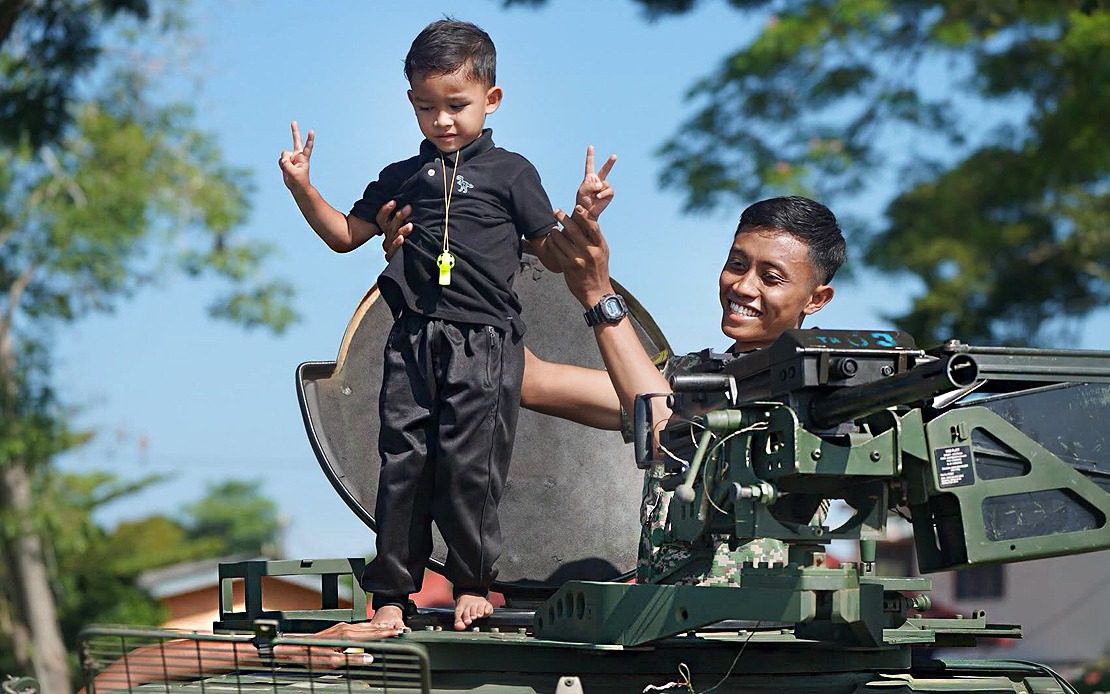
The Ministry of Defence has intensified its community outreach in the Alor Gajah district through the rollout of Program Jiwa Murni MADANI, a civil-military cooperation initiative designed to deepen bonds between the armed forces and ordinary Malaysians. Held at Padang Awam Kampung Gadek, the programme represents a strategic pivot toward building grassroots support for national defence objectives while simultaneously addressing tangible community needs through a blend of health, economic, and infrastructure interventions.
Program Jiwa Murni MADANI functions as both a social platform and a governance mechanism, enabling the Ministry of Defence and the Malaysian Armed Forces to maintain meaningful dialogue with residents across diverse demographic backgrounds. Rather than projecting military authority in isolation, the initiative embeds armed forces personnel within community spaces where civilians can access practical services. This approach reflects a broader understanding that national defence resilience depends not merely on hardware and personnel numbers, but on public confidence in state institutions and the military's responsiveness to civilian welfare.
The Alor Gajah intervention encompassed a diverse menu of services and activities intended to reach multiple segments of the population simultaneously. Free medical screening sessions provided residents with preventive health information and early diagnosis opportunities. Career and volunteering exhibitions created pathways for younger community members to explore employment or civic participation through the armed forces. Entrepreneurship seminars supported small business development, while RAHMAH Sales—a government-backed initiative to offer discounted essential goods—brought affordable commodities directly to residents. Sports competitions fostered community cohesion and recreational opportunity, and mobile government service counters reduced bureaucratic barriers by bringing administrative functions to the district itself.
Infrastructure reconstruction work undertaken by the 9th Squadron of the Royal Engineers Regiment demonstrated the armed forces' capacity for productive civilian engagement beyond security operations. Five distinct projects collectively valued at RM179,200 addressed infrastructure deficits across the district. These included rehabilitation of the Multi-Purpose Hall playground in Kampung Baru, Pondok Batang; fence repairs at Sekolah Jenis Kebangsaan (Tamil) Durian Tunggal; resurfacing of the futsal court in Taman Seri Kelemak, Rembia; roof restoration work on the Madrasah Seri Kemuning in Kampung Kemuning; and structural maintenance at the Surau Madrasah Khairiah in Kampung Paya Datuk Hilir. By channelling military engineering expertise toward civilian infrastructure, the armed forces become embedded in the lived experience of community improvement.
Deputy Defence Minister Adly Zahari's presentation of a RM133,000 cheque allocated through the Service Centre Initiative represented direct financial support for religious and educational institutions across the district. Eight recipients benefited from this allocation, including the Board of Surau Kampung Ulu Batang Melaka, Surau Al Mubarakah in Taman Dimensi, and the Chee Sen Ting Temple Association in Machap Baru. Additional recipients encompassed the Board of Surau As Syakirin at Taman Sri Sutera, Surau Al Ittihadiyah in Taman MAIM Rumbia, the Kuan Yen Shrine Association at Batang Pondok, and the Kariah Surau Committee in Kampung Gubah, Nyalas. Schools also received backing, with Sekolah Jenis Kebangsaan Batang Melaka obtaining support for developing a GreenLab facility. This sectoral distribution across Muslim and non-Muslim institutions underscores a commitment to religious pluralism within the defence ministry's community engagement framework.
The distribution of 500 RAHMAH baskets to Malaysian Armed Forces veterans and local residents reinforced the government's stated commitment to inclusive welfare provision. By explicitly targeting veterans—individuals with direct historical ties to the military—alongside general residents, the initiative acknowledged the armed forces' special obligation to those who have served while simultaneously normalising military personnel as part of the broader civil community. The symbolic significance of this dual distribution extends beyond material provision to signal that military service represents a form of citizenship deserving reciprocal social investment.
Parallel programming through the Religious Corps of the Malaysian Armed Forces further embedded spiritual and moral dimensions into the civil-military engagement strategy. The Program Ilmu dan Muafakat MADANI conducted at Masjid Kelemak the preceding day combined congregational prayer, religious lectures, charitable contributions, and direct dialogue between armed forces religious personnel and mosque congregations. This integration of faith-based programming acknowledges the importance of spiritual legitimacy and moral authority in shaping public perception of military institutions. Rather than relegating religion to private life, the Ministry of Defence leveraged Islamic institutions and practices as legitimate channels for deepening institutional relationships.
The Ministry's dual programming through both Program Jiwa Murni MADANI and Program Ilmu dan Muafakat MADANI demonstrates a comprehensive approach that intersects welfare provision, spiritual engagement, and community involvement within a unified strategic framework. This integration reflects recognition that modern civil-military relations demand multifaceted engagement strategies addressing economic, religious, social, and material dimensions of community life simultaneously. A purely transactional approach offering services without spiritual or developmental components risks superficial acceptance rather than deeper institutional legitimacy.
These initiatives align with Core 4 of the National Defence Strategic Plan 2026-2030, which emphasises strengthened civil-military cooperation as a foundational element of national defence architecture. Rather than viewing military strength exclusively through military-technical parameters, the strategic plan positions social cohesion, institutional trust, and community buy-in as central to national defence sustainability. When defence institutions become embedded in community welfare provision, emergency response, and social development, their legitimacy and public support naturally strengthen, creating a virtuous cycle where defence capacity and social welfare reinforce each other.
For Malaysian and Southeast Asian stakeholders, the Alor Gajah model offers insights into how defence ministries can maintain and build public support during periods of fiscal constraint and competing national priorities. By deploying existing military engineering capacity, medical personnel, and organisational infrastructure toward civilian benefit rather than allowing such assets to operate in isolation, defence institutions can demonstrate concrete value to taxpayers while avoiding the perception that military budgets represent resources diverted from social welfare. In a region where public scepticism toward military institutions historically remains significant, such programmes represent strategic investments in institutional legitimacy rather than mere charity.
The inclusivity of the initiative—extending support across religious communities, educational institutions of different types, and both urban and rural areas—signals an attempt to ensure that defence ministry engagement transcends ethnic or religious boundaries. This approach matters particularly in Malaysia's pluralistic context, where military institutions must maintain legitimacy across diverse communities. By ensuring that Muslim prayer spaces, Hindu temples, and secular schools all received tangible support, the defence ministry demonstrates institutional impartiality and commitment to national cohesion beyond the armed forces themselves.

