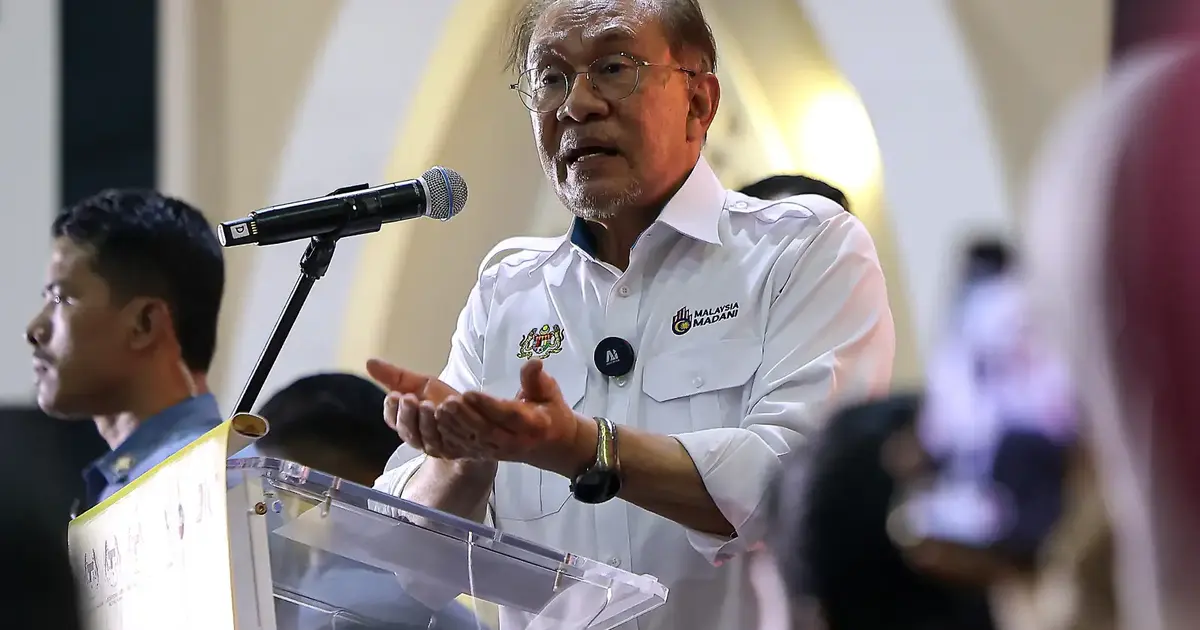
Prime Minister Anwar Ibrahim has moved to address longstanding anxieties within Malaysia's Malay-Muslim majority by arguing that advancing the rights of Chinese and Indian citizens does not represent a retreat from constitutional protections enshrined for the Bumiputera community. His comments reflect an attempt to navigate the delicate balance between fostering national cohesion and maintaining the constitutional framework that has underpinned Malaysian governance since independence.
Anwar's assertion comes amid periodic tensions over how Malaysia can reconcile its commitments to both minority rights and constitutionally-guaranteed Malay-Muslim privileges. The Article 153 framework, established during the Federation's founding, grants specific protections to Malays and indigenous peoples, including preferential treatment in land ownership, public sector appointments, and educational opportunities. For many in the majority community, discussions about expanding protections for other groups have occasionally been perceived as threatening these foundational arrangements.
The Prime Minister's intervention suggests an effort to reframe the national conversation around inclusive governance. By emphasising that protecting minorities does not require dismantling existing constitutional safeguards, Anwar appears to be offering reassurance to constituencies concerned about dilution of traditional arrangements while simultaneously signalling the government's commitment to pluralism and equal citizenship. This rhetorical positioning reflects the political complexity of leading a multiethnic democracy where competing communities harbour different interpretations of the social contract.
Malaysia's experience over seven decades demonstrates that the relationship between majority protections and minority rights need not be zero-sum. The country has sustained relative stability by maintaining both the constitutional position of Malays and Islam while allowing space for other communities to participate in economic and political life. Yet perceptions matter as much as constitutional text, and anxieties periodically resurface when policy debates touch on sensitive areas such as religious freedom, vernacular education, or economic opportunity.
Anwar's comments also carry implications for how his administration governs moving forward. Having inherited a coalition that includes parties with diverse constituencies—from Islamist organisations to secular and minority-focused formations—the Prime Minister must continuously calibrate messaging to maintain support across these groups. His insistence that minority protection strengthens rather than weakens the nation suggests an effort to create space for progressive policies while managing conservative concerns about cultural and religious change.
For Chinese and Indian Malaysians, historically concerned about the extent to which constitutional provisions limit their opportunities, Anwar's framing offers a degree of legitimacy to their continued advocacy for equitable treatment. Whether in employment, education, or business opportunities, these communities have long argued that genuine meritocracy and equal treatment would not necessarily diminish Bumiputera benefits but rather optimise national development by drawing talent from all segments of society. The Prime Minister's remarks implicitly endorse this logic.
The Malaysian context differs significantly from Western debates about multiculturalism. Rather than abstract principles of diversity, the conversation here involves navigating a constitutionally-entrenched system explicitly designed to protect one community while developing a functioning polity that accommodates others. This structural reality requires political leadership capable of articulating how both objectives can be pursued simultaneously, which is precisely what Anwar attempts to do in framing minority protection as compatible with existing arrangements.
Regionally, Malaysia's approach to managing ethnic and religious diversity continues to attract attention. In Southeast Asia, where rapid social change and international pressure for human rights compliance create tensions in other multiethnic states, Malaysia's constitutional settlement remains distinctive. By defending both minority rights and majority protections, Anwar positions the country as pursuing a middle path distinct from either assimilationist models or systems that prioritise one group entirely.
The effectiveness of Anwar's message ultimately depends on whether policy implementation matches rhetoric. Public perceptions of fairness in government contracts, university admissions, and civil service recruitment carry weight beyond formal constitutional language. If constituencies perceive that inclusive statements are not matched by substantive shifts in resource distribution or opportunity access, the credibility of such framing will erode. Conversely, demonstrating that minorities can advance without triggering majority disadvantage reinforces the narrative that protection and inclusion are mutually reinforcing rather than antagonistic.
Looking ahead, Anwar's intervention establishes a baseline position from which his government can operate. By explicitly rejecting the premise that defending minorities requires abandoning constitutional protections, he creates rhetorical space to pursue policies benefiting all communities while defending against accusations of betraying constitutional principles. Whether this rhetorical framework translates into durable political consensus or represents temporary positioning remains to be seen as concrete policy decisions emerge.

