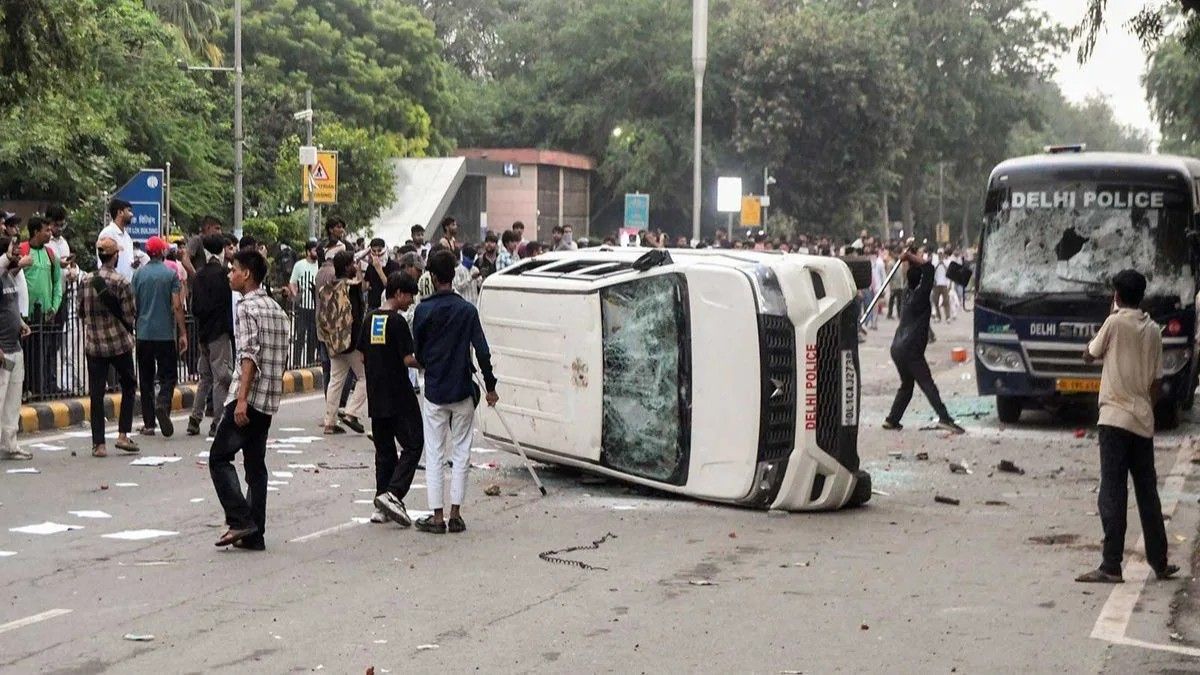
New Delhi authorities have lodged ten separate First Information Reports stemming from disturbances and incidents during the Cockroach Janta Party's "Sansad Chalo" march, as law enforcement pushes back against claims circulating through social media platforms that depicted fresh violence at a central protest venue on Tuesday. The action underscores intensifying tensions between demonstrators demanding political accountability and security forces managing ongoing demonstrations in India's capital.
The Deputy Commissioner of Police for the New Delhi district addressed the misinformation campaign through a statement on social media, asserting that footage purporting to document stone-throwing or police intervention at Jantar Mantar on the specified date were "false and misleading". Authorities explicitly cautioned citizens to disregard unverified claims and depend exclusively on government communications for reliable reporting, highlighting the role of digital platforms in amplifying unconfirmed narratives during politically charged moments.
The formal charges distributed across multiple police stations within New Delhi reflect the scale of the Monday confrontation. Four cases were initiated at Parliament Street station, three at Connaught Place station, and individual cases at Mandir Marg, Barakhamba Road, and Kartavya Path stations. The geographical spread of these filings indicates that the disturbances extended across several districts of the capital, with security forces responding at multiple locations simultaneously.
Criminal allegations encompass a broad spectrum of conduct deemed unlawful by investigators. One case specifically addresses an alleged assault causing grievous risk to a Rapid Action Force officer during the Monday demonstration. A separate charge concerns unauthorised aerial reconnaissance using a drone over the New Delhi district during parliamentary proceedings, suggesting potential coordination and logistical sophistication in the protest operation. Additional complaints allege pre-meditation of violence, hindrance to state functions, violence directed at law enforcement, and destruction of infrastructure, with prosecutions pursued under the Bharatiya Nyaya Sanhita, firearms legislation, and public property protection statutes.
Security officials characterised the Monday action as typified by demonstrators behaving in a "disorderly, aggressive and violent manner" despite repeated cautions and the enforcement of restrictions prohibiting assemblies. Investigators have begun sifting through more than 250 video recordings to identify participants and establish whether the violence reflected spontaneous eruption or carefully orchestrated strategy. This digital archaeology represents a critical component of contemporary protest investigation, permitting authorities to construct timelines, trace accountability, and establish patterns of behaviour that might substantiate conspiracy allegations.
The underlying catalyst for the Cockroach Janta Party's mobilisation centres on demands for the resignation of the Union Education Minister Dharmendra Pradhan, whom the party accuses of permitting irregularities in national examinations. This dimension carries particular weight for Malaysian and broader South Asian audiences, as examination integrity touches fundamental questions about meritocracy, fairness in access to higher education, and institutional trustworthiness. The willingness of Indian civil society to mobilise over educational governance signals how deeply these concerns penetrate the consciousness of engaged citizens across the region.
Following Monday's clashes, protest organisers regrouped at Jantar Mantar on Tuesday after security personnel dismantled encampments and demonstration infrastructure overnight. A substantial police presence, encompassing conventional constabulary and specialised paramilitary units, remained stationed at the site. The Cockroach Janta Party's spokesperson Ashutosh Ranka announced the intention to sustain agitation until ministerial resignation materialises, demonstrating the protest movement's commitment to protracted engagement despite security escalation.
Allegations from the protest movement include assertions that demonstrators—encompassing students and civic volunteers—sustained injuries during the Monday confrontations. Particularly significant claims emerged regarding the treatment of female protesters, including Geetanjali J. Angmo, spouse of prominent activist Sonam Wangchuk, who reportedly experienced mistreatment by security forces. These allegations, if substantiated, would raise questions about proportionality in police responses and gender-specific vulnerabilities during mass demonstrations, issues resonating across South and Southeast Asian contexts where police conduct during protests remains contentious.
Delhi Police footage released during the immediate aftermath depicted stone-pelting in the Connaught Place vicinity, providing visual evidence of violent conduct that prosecutors will likely deploy in prosecution narratives. The department simultaneously appealed for cooperation from demonstrators and requested public vigilance against the circulation of unverified digital content. This dual messaging—documentary evidence coupled with requests for civility—reflects the contemporary paradox wherein modern policing simultaneously captures and contests the narrative authority of visual documentation.
For Malaysian observers, the Delhi unrest illuminates patterns of protest, state response, and institutional contestation increasingly evident across South and Southeast Asia. The deployment of expansive video analysis, the invocation of conspiracy provisions, and the rapid lodging of multiple charges exemplify strategies that governments employ to neutralise organised dissent. Simultaneously, the persistence of demonstrators despite infrastructure removal and heavy security presence demonstrates the resilience of civil society mobilisation around substantive policy grievances.
The registration of charges under the Bharatiya Nyaya Sanhita, India's recently updated criminal code, signals authorities' application of contemporary legal frameworks to protest conduct. This modernisation of prosecutorial tools reflects broader regional trends wherein governments calibrate legal architecture to address evolving forms of collective action and digital coordination. Understanding these regulatory developments matters for regional practitioners of law, journalism, and governance.
As investigations advance and the protest trajectory remains uncertain, the incident exemplifies the friction between institutional demand for order and civil society assertion of accountability. The allegations of misinformation, combined with documentary evidence and eyewitness claims of excessive security response, position this episode within a recognisable global pattern wherein protests generate competing narratives about legitimacy, proportionality, and the appropriate exercise of state authority.

