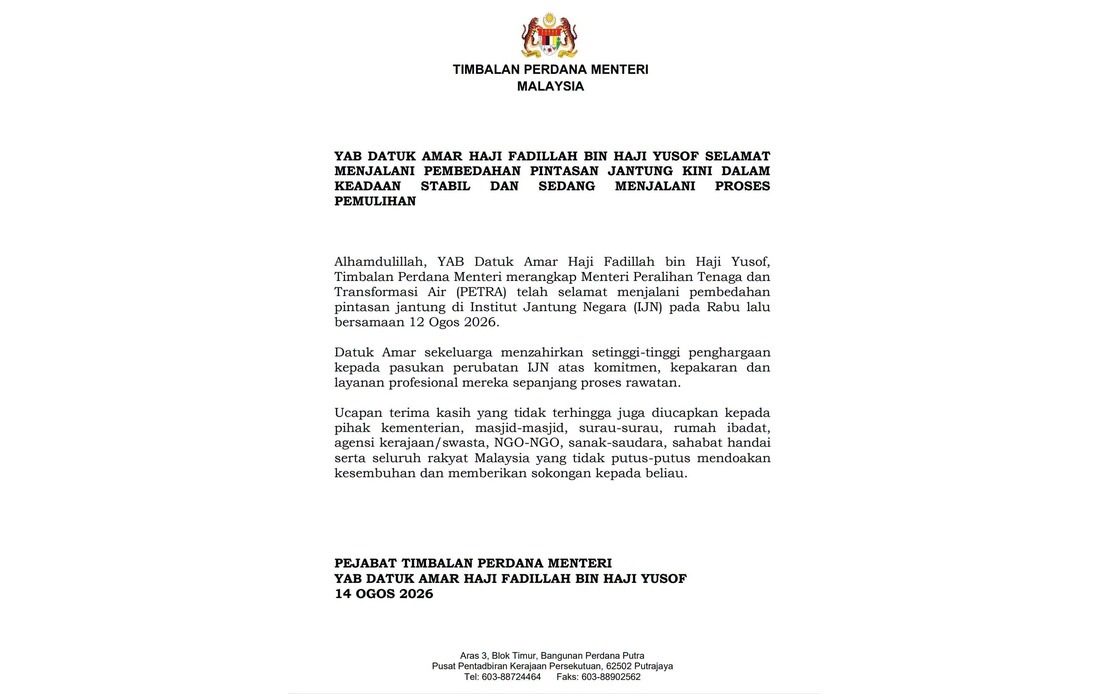
Deputy Prime Minister Datuk Seri Fadillah Yusof, who also holds the portfolio of Energy Transition and Water Transformation Minister (PETRA), is progressing positively in his recovery after undergoing double coronary artery bypass surgery at the National Heart Institute (IJN) on August 12. The surgical procedure, which addressed blockages in two coronary arteries, was completed successfully, with the medical team reporting that the patient's condition continues to improve in line with expectations for this type of cardiac intervention.
Fadillah's family conveyed their gratitude to the IJN medical team in a statement released through the Deputy Prime Minister's office, acknowledging the institution's commitment to his care and the professional expertise displayed throughout his treatment course. The family also extended thanks to the broader Malaysian community, including religious institutions, government agencies, non-governmental organisations, and private sector entities, for their prayers and well-wishes during this period. This public acknowledgement reflects the significant concern across Malaysian society regarding the health of senior government figures.
The timeline of Fadillah's treatment began when he was admitted to IJN on July 28, following which a coronary angiogram was conducted on July 29. This diagnostic procedure revealed significant blockages that necessitated surgical intervention rather than less invasive treatment options. The multidisciplinary medical team at IJN subsequently determined that coronary artery bypass grafting represented the most suitable therapeutic approach for addressing his condition.
The surgical team performing the procedure comprised two senior cardiothoracic surgeons at IJN: Prof Datuk Seri Dr Mohamed Ezani Md Taib and Prof Datuk Seri Dr Mond Azhan Yakub, supported by Clinical Fellow Cardiothoracic and Vascular Surgery Dr Ahmad Mahir Shamsuddin. The operation employed IJN's Enhanced Recovery After Surgery (ERAS) protocol, a comprehensive framework that coordinates multiple medical disciplines to facilitate early mobilisation, reduce post-operative complications, and expedite the recovery trajectory. This modern approach represents contemporary best practices in cardiac surgery, emphasising patient engagement and activity rather than prolonged bed rest.
One measure of Fadillah's swift recovery became evident in his early mobilisation programme commenced just one day after surgery. On August 13, he successfully completed 2.8 kilometres of cycling exercise under direct supervision of IJN's clinical team, demonstrating substantial physical capacity and cardiovascular stability at an early post-operative stage. Such active engagement so soon after open-heart surgery underscores both the effectiveness of modern surgical techniques and the patient's underlying health status.
Following his successful cycling session, Fadillah was transferred from the Intensive Care Unit to the general ward, indicating the medical team's confidence in his stabilisation and reducing need for the most intensive level of monitoring. His movement to a general ward also suggests he has passed critical post-operative thresholds and can continue his recovery in a less acute care environment. He continues participation in post-CABG cardiac rehabilitation programmes designed to strengthen his cardiovascular system and restore functional capacity.
The National Heart Institute's chief executive officer, Prof Datuk Seri Dr Mohamed Ezani Md Taib, publicly confirmed satisfaction with the Deputy Prime Minister's progress, noting that treatment and recovery have proceeded according to plan. His statement underscores that the surgical outcome met pre-operative expectations and that Fadillah's condition is tracking within normal parameters for a patient of his clinical presentation undergoing bypass surgery.
This medical incident highlights the importance of early detection and appropriate management of coronary artery disease in Malaysian society. Fadillah's case demonstrates that even high-ranking government officials require timely intervention when significant blockages are identified, and that modern cardiac surgery facilities in Malaysia—particularly institutions like IJN—possess the capability to manage complex cases successfully. The positive outcome also reflects Malaysia's capability in advanced medical care, positioning the country as a centre for cardiac treatment excellence within Southeast Asia.
For the broader Malaysian public and healthcare system, Fadillah's recovery underscores the critical role of comprehensive cardiac rehabilitation protocols in achieving optimal outcomes after bypass surgery. The ERAS approach employed in his treatment represents international best practices, and his rapid mobilisation demonstrates the effectiveness of coordinated multidisciplinary care. His case may also raise awareness among older Malaysians regarding the importance of regular cardiac screening, particularly among those with risk factors for coronary artery disease.

