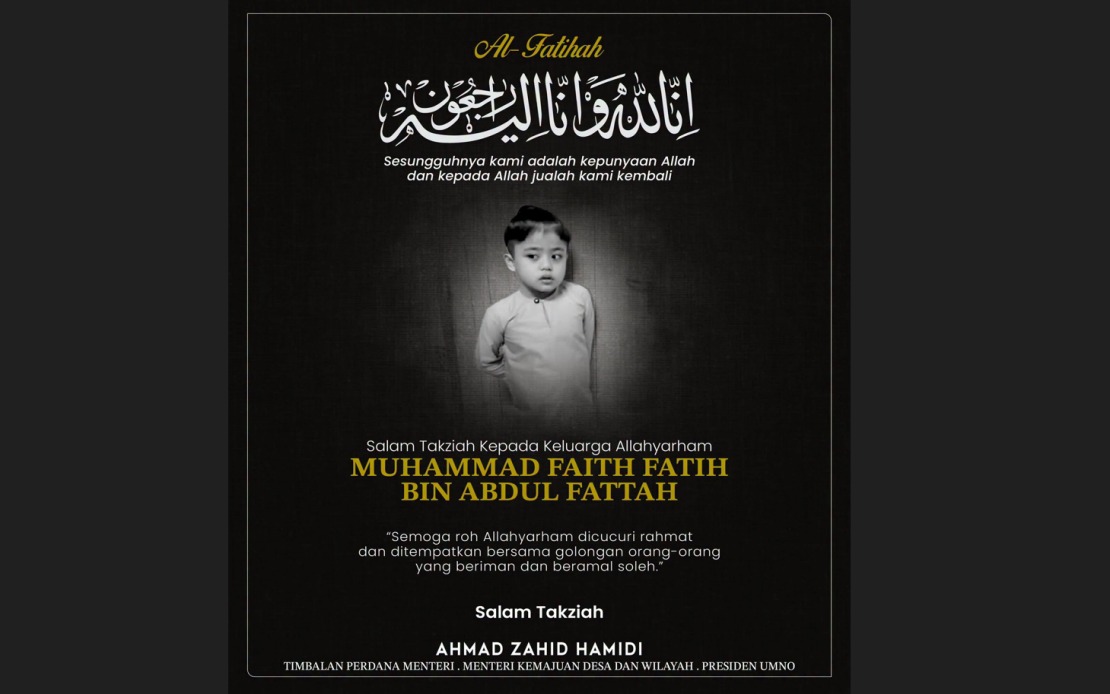
Deputy Prime Minister Datuk Seri Dr Ahmad Zahid Hamidi has conveyed his deepest sympathies to the family of Muhammad Faith Fatih Abdullah Fattah, a six-year-old boy with autism, whose body was recovered from an oil palm plantation in the Kampung Baru vicinity near Sungai Sumun, Hutan Melintang, on the evening of June 30. The discovery of the child's remains in a drain within the plantation marked the tragic conclusion of a search and rescue operation that had begun after the youngster disappeared from his home.
Through a statement posted on social media, Ahmad Zahid, who serves as the Member of Parliament for Bagan Datuk, characterised the incident as deeply distressing, particularly given the child's vulnerability as a young person with special needs. He acknowledged the unimaginable pain that only a parent who has lost a child can comprehend, recognising that no challenge in life compares to the loss of a beloved offspring. His remarks reflected the emotional weight of the tragedy and sought to recognise the magnitude of grief the family was enduring during such a difficult period.
The Bagan Datuk Member of Parliament extended formal condolences to all family members, with particular emphasis on the parents who face an extraordinarily difficult journey ahead. In his statement, he invoked Islamic principles of compassion and faith, calling upon family and the broader community to recite Al-Fatihah, a chapter from the Quran traditionally recited for the deceased, and to pray that divine mercy would be bestowed upon the child's soul. This spiritual approach sought to offer not only emotional support but also a framework through which the grieving family and their community could process the loss.
According to information provided by Bagan Datuk police chief Supt Mohammad Ali Mohd Jali, the police received their initial report of the missing child at approximately 4.54 pm on June 30. Family members indicated that Muhammad Faith Fatih Abdullah Fattah had last been observed in the living room of the family residence before he disappeared without trace. The circumstances surrounding how a six-year-old child with autism managed to venture into a remote oil palm plantation area raise significant questions about supervision and safeguarding that will likely form part of any subsequent investigation.
The search and rescue operation proceeded through the evening hours, with authorities systematically combing through the plantation area. The child's body was eventually discovered at 10.08 pm in a drainage channel running through the oil palm estate. The location of the discovery—in a drain rather than on open ground—suggests the youngster may have fallen into the waterway, though the exact circumstances surrounding his death remain unclear and would be subject to police investigation and a post-mortem examination.
This tragedy underscores persistent challenges surrounding child safety and the protection of vulnerable populations in Malaysia. Children with autism spectrum disorder often face heightened risks in unsupervised settings, as their cognitive differences may affect their ability to recognise danger, respond to calls for help, or navigate away from hazardous situations. The case highlights the critical importance of robust safeguarding measures tailored to the specific needs of children with developmental and neurological conditions, as well as community awareness regarding these vulnerabilities.
The incident also raises broader questions about land safety and environmental hazards in agricultural areas. Oil palm plantations, while economically significant to Malaysia and the broader Southeast Asian region, contain numerous potential dangers including drainage systems, machinery, pesticides, and terrain that presents risks to unwary visitors, particularly small children. The discovery of the child in a drain emphasises how even relatively commonplace agricultural features can pose fatal risks when combined with supervision lapses.
For policymakers and child welfare advocates, the tragedy serves as a reminder of the necessity for comprehensive support systems for families caring for children with special needs. Parents managing the additional demands of raising an autistic child often face profound stress, and they require access to adequate resources, respite care services, and community support networks. The incident may prompt renewed discussions about how government and non-governmental organisations can better support families with disabled children across Malaysia.
The expression of sympathy from the Deputy Prime Minister reflects the importance that senior political leadership places on acknowledging such tragedies and recognising the broader implications for Malaysian society. While official condolences offer limited comfort to a grieving family, they serve to validate the community's recognition of the loss and affirm collective values regarding the protection and dignity of vulnerable individuals, particularly children.

