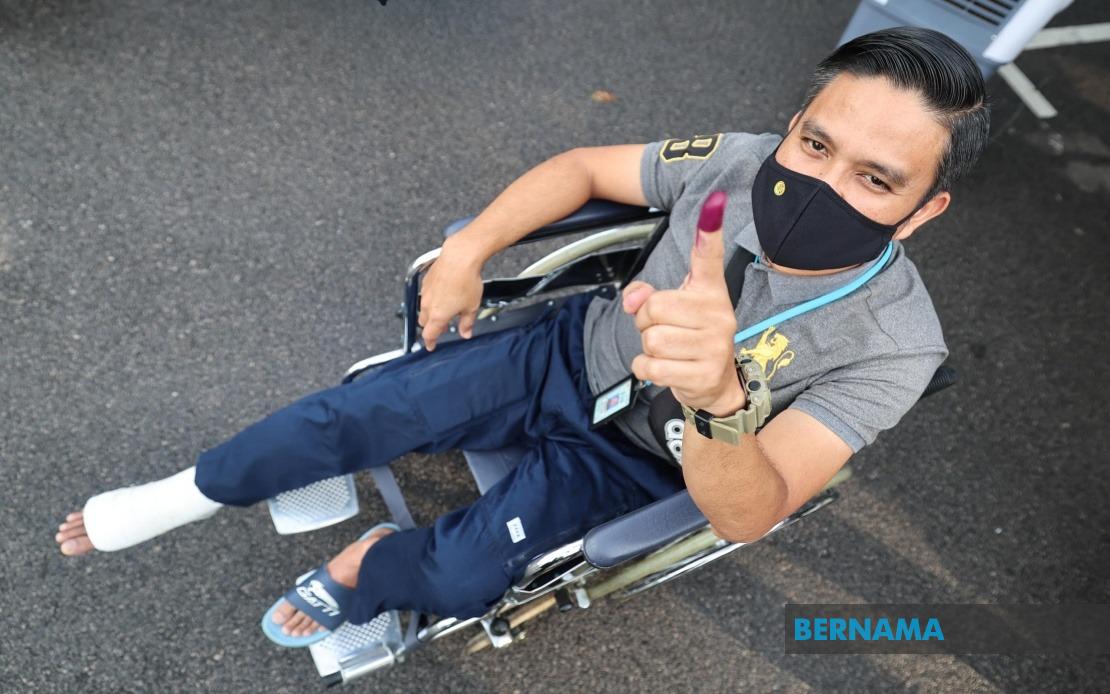
Sergeant Syahrizal Musa's determination to fulfil his civic responsibility transcended physical pain when he arrived at the Johor Police Contingent Headquarters early voting centre on July 7, confined to a wheelchair yet resolute in his purpose. The 40-year-old officer, attached to the Internal Security and Public Order Department at Johor IPK, had sustained a minor Achilles tendon tear while playing sepak takraw the previous week—an injury severe enough to warrant medical leave extending through mid-July. Yet nothing could dissuade him from making the journey from his residence in Tampoi with a friend to cast his ballot in the 16th Johor state election, demonstrating a dedication to democratic participation that resonates beyond the polling booth.
Syahrizal's commitment to voting reflects a deeper philosophy about the responsibilities accompanying Malaysian citizenship. In a candid conversation with reporters, the Seri Iskandar native, who hails from Perak, articulated his conviction that injury presents no legitimate excuse for abandoning one's electoral obligation. Over more than two decades serving with the Royal Malaysia Police, he has maintained a perfect record of participation, never missing an election opportunity regardless of circumstances. This particular instance marked his first time casting a ballot while wheelchair-bound, yet he approached the task with the same gravity and purpose he has demonstrated throughout his tenure with the force.
The sergeant's background as an accomplished sepak takraw player added context to his injury narrative. An athletic enthusiast since youth, Syahrizal had previously represented the police contingent across multiple tournaments, embodying the multifaceted identity of a public servant balancing professional duties with personal pursuits. The accident that sidelined him was thus doubly frustrating—not only did it restrict his mobility, but it also temporarily ended his participation in a sport that had defined much of his recreational life. Medical professionals confirmed that the injury, though classified as minor in severity, required sufficient rest to necessitate official medical leave until July 16.
Having joined the Johor IPK in 2014 after spending nine years at the Muar branch, Syahrizal had established himself as a dedicated law enforcement professional with deep roots in Johor's policing infrastructure. His decision to prioritize voting despite his physical condition speaks to the values he has cultivated throughout his career—an emphasis on duty, responsibility, and participation in the democratic process that underpins Malaysian governance. The personal sacrifice involved in navigating from Tampoi to the voting centre, complicated by his temporary mobility limitations, underscores the significance he attaches to this fundamental right.
The early voting exercise on July 7 accommodated a substantial portion of the electorate, with 64 polling centres operating across the state to facilitate military and security personnel who would be unavailable on the main polling day. The 24,751 early voters comprised 12,041 Malaysian Armed Forces personnel and their spouses, alongside 12,710 Royal Malaysia Police and General Operations Force personnel with their spouses. This arrangement acknowledges the operational realities of security forces, whose duties often conflict with standard election schedules, thereby ensuring their participation in shaping their state's political direction.
The broader context of the Johor election demonstrates the state's significance within Malaysia's political landscape. The 16th state election featured 172 candidates competing for 56 seats, representing a competitive contest that would substantially influence Johor's governance trajectory. The primary polling day, scheduled for Saturday following the early voting period, would see approximately 2.7 million ordinary voters making their selections. For a state as populous and economically significant as Johor, voter participation rates carry implications extending beyond state politics, often resonating through national political dynamics given Johor's historical influence within Malaysian federalism.
Syahrizal's narrative carries particular resonance for Malaysian voters and residents contemplating their own participation in electoral processes. His invocation of voting as a responsibility rather than merely a privilege reflects civic virtues that, while fundamental to democratic theory, require active embodiment through individual choice and sacrifice. By consciously choosing to vote despite genuine physical impediment, he illustrated that electoral participation demands nothing less than genuine commitment from those who wish to influence their community's future.
The sergeant's final reflection to reporters transcended his personal circumstances, addressing the broader Malaysian electorate directly. He expressed hope that more citizens would recognize and exercise their democratic rights, understanding that individual votes collectively determine not only state leadership but also the trajectory of the nation itself. This sentiment, delivered from someone literally embodying the costs of civic engagement, carries substantial moral weight and serves as an implicit challenge to those who might rationalize non-participation based on minor inconveniences.
The image of Syahrizal proceeding to cast his ballot from a wheelchair encapsulates broader themes about democratic participation and civic duty that extend throughout Malaysian society. His willingness to overcome physical adversity for this fundamental right demonstrates that citizenship involves active participation rather than passive privilege. For Malaysian voters and potential voters encountering their own barriers—whether logistical, circumstantial, or psychological—Syahrizal's example provides both inspiration and quiet rebuke, suggesting that meaningful democracies require citizens willing to invest personal effort in their electoral responsibilities.

