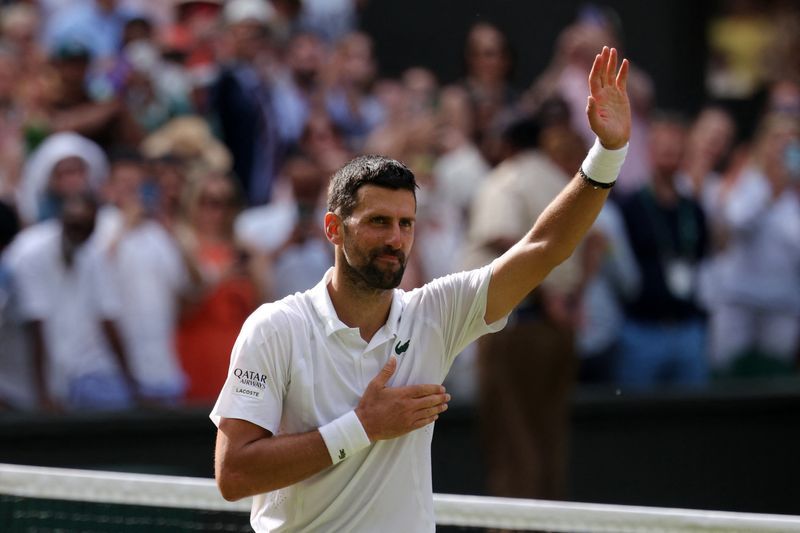
The Wimbledon Championships reached its decisive stages on Tuesday with several compelling narratives unfolding at the All England Club. Among the standout encounters was the clash between 24-time Grand Slam champion Novak Djokovic and third-seeded Canadian Felix Auger-Aliassime, while Japanese 14th seed Naomi Osaka sought to extend her unexpected resurgence against Czech tenth seed Karolina Muchova in an eagerly anticipated women's quarter-final.
Djokovic's path to the quarter-finals demonstrated both his enduring quality and the physical toll of modern professional tennis. The Serbian champion, who recently etched his name into Wimbledon folklore by claiming his 106th victory at the venue, surpassed the previous record during a demanding round-of-16 confrontation against qualifier Roman Safiullin. That three-and-a-half-hour battle, stretching across four sets, underscored the Serbian's willingness to absorb punishment and grind through adversity. At 39 years old, the prospect of reaching a record 25th Grand Slam title remained within touching distance, though not without considerable obstacles ahead.
The nature of Djokovic's recent performances revealed a tennis icon operating at diminished explosiveness yet compensating through tactical sophistication and mental fortitude. Having been drawn into extended four-set contests in consecutive rounds, he acknowledged the demanding nature of his progression, yet framed such struggles as intrinsic to championship tennis. "I enjoy the battle. I enjoy the suffering in a sense, to some extent, even though I don't want it, I don't invite it," Djokovic reflected after defeating Safiullin. His philosophy centred on acceptance and adaptation—when the ideal script fails to materialise, the experienced campaigner pivots toward grinding out results through sheer determination and tactical flexibility.
Auger-Aliassime represented a formidable yet surmountable challenge, having split their two prior encounters in 2022. The 25-year-old Canadian possessed the physical attributes to trouble Djokovic—powerful serving and aggressive baseline play—yet acknowledged the magnitude of facing a player whose longevity and consistency had redefined sports longevity. "I hope that I can show that I've improved as a player," Auger-Aliassime stated, his words revealing both measured confidence and the profound respect elite competitors harbour for Djokovic's legacy. The Canadian's reflection on the Serbian's "load of work over the years" captured something essential about how younger players view Djokovic: not merely as a current rival but as a standard against which their own careers would be measured.
On the women's side, Osaka's quarter-final appearance represented something considerably more momentous than her seeding suggested. The 28-year-old Japanese star, who last won a Grand Slam title in 2021, produced an unexpected masterclass against world number one Aryna Sabalenka in the round of 16. Her performance transcended the scoreline, representing a glimpse of the dominant player who had previously conquered multiple Grand Slam tournaments. Osaka's dominance with her serve and the devastating precision of her forehand dismantled Sabalenka, who had won their three earlier encounters in 2024. The victory carried particular resonance given that psychological mountain Sabalenka's previous successes represented.
Osaka approached her breakthrough moment with refreshing candour and humility, reframing her victory as merely "a practice match" despite the roaring crowd and high stakes. Her journey to the quarter-finals marked the first occasion she had reached this stage at Wimbledon, a fact that underscored how injuries and personal circumstances had interrupted her trajectory. The Japanese player had garnered considerable attention for her distinctive fashion choices at the Championships, her style resonating beyond the court and into broader cultural conversations about identity and self-expression in professional sport.
Her opponent, Muchova, brought substantial pedigree of her own, having reached three previous Wimbledon quarter-finals without progressing beyond that juncture. The Czech player had strategically prepared by competing in two warm-up tournaments prior to the Championships, accumulating grass-court exposure that translated into tactical sharpness. Muchova had recently defeated former Wimbledon champion Barbora Krejcikova—her compatriot and seeded player—in a statement victory that demonstrated her capacity to elevate performance against elevated competition. Their previous grass-court encounter at Bad Homburg earlier that month had favoured Muchova, though their broader head-to-head record remained evenly balanced at three victories each across six meetings.
Elsewhere on the quarter-final card, defending champion Jannik Sinner faced German Jan-Lennard Struff in a matchup between contrasting circumstances. The Italian world number one and four-time Grand Slam winner brought the weight of defending his title against a player attempting something extraordinary. Struff, at 36 years old, became the oldest man in the Open Era to reach a Grand Slam quarter-final for the first time, an achievement realised when his opponent Hubert Hurkacz retired from their round-of-16 encounter whilst Struff led the fifth set 4-2. Despite having never advanced beyond a Grand Slam quarter-final despite decades competing at the professional level, Struff's achievement resonated powerfully, demonstrating that breakthrough moments transcend age and prior accumulated experience.
Sinner approached his encounter with Struff conscious of their prior meetings, having won all three previous confrontations. Yet the Italian recognised that quarter-final tennis at Grand Slam events carried different emotional and physical texture. "Quarter-final of a Grand Slam, the feelings are different. There is definitely more tension. In the same time, I'm very happy where I am at the moment," Sinner observed, his comments reflecting the heightened stakes and psychological intensity that characterise the latter stages of major championships. He acknowledged the need for continued adaptation and problem-solving as opponents adjusted to his patterns.
The quarter-final proceedings also featured an all-American clash between fourth-seed Jessica Pegula and seventh-seed Coco Gauff, adding additional intrigue to a tournament that had produced several upset results and compelling storylines. The concentration of elite players across the draw illustrated the competitive parity within modern tennis, where previous champions and emerging talents competed on increasingly level ground. For Malaysian and Southeast Asian enthusiasts, these quarter-finals represented the type of high-quality tennis that captivated global audiences—seasoned champions defending their positions against ambitious challengers, each match carrying implications for the tournament's trajectory and the broader tennis hierarchy.
The quarter-final stage transformed Wimbledon from a broad tournament into a concentrated battle among tennis's elite, where physical conditioning, mental resilience, and tactical sophistication determined progression. For Djokovic, the pursuit of a record 25th Grand Slam continued; for Osaka, the possibility of rehabilitation and renewed relevance seemed increasingly tangible; and for players like Struff, the achievement of reaching this stage transcended any particular tournament, representing career-defining moments that validated decades of professional commitment.

