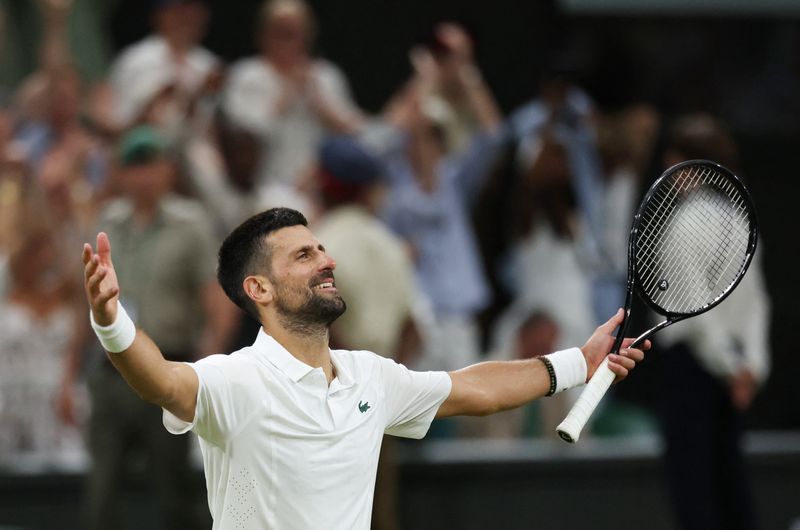
Novak Djokovic's remarkable longevity at the All England Club continues unabated. The 39-year-old Serbian champion outlasted Canadian Felix Auger-Aliassime in the longest quarter-final in Wimbledon history on Tuesday, a gruelling five-hour-and-fifteen-minute encounter that ended 7-6(10) 3-6 6-3 6-7(4) 7-6(10-4). The victory propels him into an eighth consecutive semi-final at the tournament and sets up a highly anticipated clash with reigning champion Jannik Sinner—a matchup that promises to be among the defining contests of this year's championship.
Djokovic's march through the draw has shattered historical records with almost routine precision. His triumph in the previous round brought his total match victories at the All England Club to 106, surpassing the legendary Roger Federer's tally. Now, by reaching the semi-finals for the eighth straight year, he has become the first man in tennis history to achieve this particular distinction. These milestones underscore not merely his talent but his capacity to sustain elite performance across multiple seasons when most athletes of his age have long since retired from professional competition.
The quarter-final itself was a masterclass in grinding resilience rather than dominant tennis. Auger-Aliassime proved a formidable adversary, pushing his higher-seeded opponent to the absolute limit in nearly every set. The Canadian's youthful power and athleticism kept him competitive throughout, though crucial moments continually slipped from his grasp. The opening set exemplified this pattern—a lengthy tiebreak saw Auger-Aliassime squander opportunities before a costly volley long handed Djokovic the opening statement.
The momentum swung dramatically in the second set when Auger-Aliassime broke Djokovic at 5-3, the seventh seed's double fault proving costly. The Canadian's composed serving kept the set within reach, and when the Centre Court roof closed around 7:40 p.m. local time, the match reset with the score level. Djokovic, however, used the environmental change to recalibrate his approach. His ball-striking became noticeably crisper in the third set, allowing him to fashion a break in the sixth game and construct meaningful separation from his opponent.
The fourth set witnessed mounting frustration from Auger-Aliassime, who lost his opening service game and subsequently vented his disappointment by striking his chair with his racket. Yet the Canadian refused to capitulate, demonstrating the temperament of a player who recognises he belongs among tennis's elite. He clawed his way back to level the set through the tiebreak, forcing Djokovic into a fifth-set decider where a match tiebreak would decide proceedings. For neutral observers, this extended warfare provided precisely the kind of compelling theatre that makes Wimbledon the sport's premier event.
The fifth set exemplified the drama that elevates professional tennis beyond mere athletics. The pair remained deadlocked through twelve games before Djokovic's experience and nerve finally prevailed in the match tiebreak. His shot-making under pressure—accumulated across three decades of tournament tennis—proved the decisive factor when the margins are measured in millimetres and psychological fortitude. The Centre Court crowd erupted in recognition of both champions who had delivered a contest worthy of the tournament's grandeur and history.
Djokovic's post-match assessment revealed the immense strain he had endured. "I won with a racket and a lot of heart," he told reporters, acknowledging that the victory extended beyond technical proficiency into the realm of emotional and physical resilience. He spoke candidly about managing the "extreme tension" inherent in such contests, where the scoreline remained level throughout and momentum shifted repeatedly. The tension was so consuming that he joked about ordering his children to sleep after the fourth set—advice they wisely ignored to witness one of the most compelling contests staged at the venue in recent memory.
The Serbian champion's path to an eighth Wimbledon title—which would match Federer's record—now runs through Sinner, currently the world's highest-ranked player and the defending champion. This meeting represents far more than a routine semi-final; it carries implications for Djokovic's legacy at a venue where he has claimed four titles previously. At 39, Djokovic faces questions about whether his body can sustain the demands of multiple matches at this intensity. Yet his victory over Auger-Aliassime suggests that heart, experience, and competitive will can compensate for the physical toll of advancing years.
For Malaysian and Southeast Asian tennis enthusiasts, Djokovic's continued presence at Wimbledon's business end provides compelling viewing and a reminder of his enduring dominance. His quest for a record 25th Grand Slam title—one more than Australian Margaret Court's standing record—remains very much alive. The match against Sinner will determine whether his improbable run at age 39 reaches the final, where he might claim his eighth crown and draw level with Federer. The fact that such possibilities remain realistic for a player of his age speaks to the extraordinary physical and mental preparation that has defined his professional career.
The Sinner showdown also represents a fascinating generational battle. Sinner, at 22 years old, represents the new guard of men's tennis—powerful, complete, and already a major champion. Djokovic embodies continuity with tennis's recent past, a player for whom retirement seems to be an increasingly vague concept. Their semi-final encounter will pit experience against youth, accumulated wisdom against explosive athleticism. For Djokovic, recovery will prove as important as preparation, with his body requiring careful management following the five-hour quarter-final. The intensity he displayed against Auger-Aliassime, channelling nerves and physical exhaustion into crucial moments, will need to be summoned once more if he is to overcome Sinner and reach the final. Whether he can do so remains the tournament's most compelling storyline.

