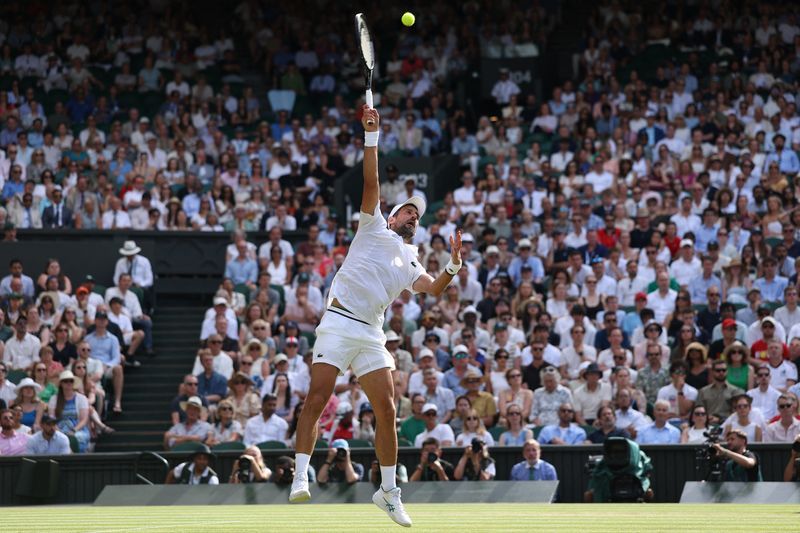
Novak Djokovic has etched his name deeper into tennis history by overtaking Roger Federer's benchmark for most match victories at Wimbledon. The seventh-seeded Serbian champion dispatched Russian qualifier Roman Safiullin 7-6(6) 6-3 3-6 6-3 on Centre Court on Sunday, advancing to the quarter-finals while simultaneously reaching his 106th win at the All England Club. This milestone represents another testament to Djokovic's sustained excellence at a venue where he has routinely challenged the sport's greatest competitors and accumulated an extraordinary championship portfolio.
The path to this record, however, proved unexpectedly arduous for the 39-year-old Djokovic, who is simultaneously pursuing his eighth Wimbledon title—matching Federer's record haul—and his 25th Grand Slam crown. Under intense midday conditions on the manicured lawns of southwest London, Safiullin exhibited the kind of spirited resistance that occasionally derails tournament favourites. The world number 132 had emerged from months of rehabilitation following a hip injury, bringing both hunger and rustiness to the court in equal measure, creating an encounter far closer than seedings suggested.
The opening set encapsulated the broader challenge Djokovic faced throughout the afternoon. Despite his pedigree and experience, the defending champion found himself unsettled by Safiullin's aggressive baseline play and unyielding commitment to extending rallies. Djokovic surrendered his serve twice through unforced errors—lapses that seemed out of character for a player normally defined by consistency and precision. More critically, he found himself staring at set point disadvantage while down 2-5, forced to dig deep and save those points before ultimately prevailing 7-6 in the tiebreak through sheer force of will.
Djokovic's tactical adjustment became evident in the second set, where he abandoned the baseline exchanges that had proved uncomfortable and instead orchestrated points through the net, employing serve-and-volley combinations with considerable flair and effectiveness. Once he obtained a commanding 4-2 lead, the momentum shifted irreversibly in his favour. Safiullin's forehand, which had troubled Djokovic throughout the opening set, began misfiring at crucial junctures, with the Russian's backhand proving particularly vulnerable under pressure. Djokovic seized this opening ruthlessly, doubling his set advantage with crisp stroke play that showcased why he has dominated professional tennis for over a decade.
The third set represented a temporary regression for the Serbian titan. Perhaps overconfident following the second set's convincing display, Djokovic's concentration wavered as Safiullin summoned another impressive performance, breaking serve and capturing the set 6-3 to extend the encounter into a fourth set. This moment underscored an emerging pattern in Djokovic's early Wimbledon campaign—he has surrendered sets in three of his first four matches, suggesting that either his preparation requires refinement or the challenge of returning to competition at the highest level demands physical and mental recalibration.
Djokovic's response in the fourth set vindicated his championship pedigree and demonstrated why he remains formidable even when aesthetics of his performance appear compromised. Having made tactical adjustments in the second set, he now refined his service delivery, deploying his first serve with greater accuracy and generating the conditions necessary to dominate rallies on his terms. The wind that had tormented him throughout the contest—particularly at one end of Centre Court—suddenly seemed less consequential as Djokovic elevated his concentration and executed his game plan with increasing precision. He consolidated an early hold and then accelerated decisively, closing out the match to secure passage to the last eight.
The victory carries implications extending beyond mere statistical achievements, though Djokovic's 106 Wimbledon match wins represent an extraordinary commentary on durability and excellence. At 39 years old, in an era where younger players possess physical attributes that should theoretically overshadow their seniors, Djokovic continues redefining what athletic longevity at the professional tennis level means. Federer's retirement has left Djokovic and Rafael Nadal as the final sentries of an era that transformed professional tennis, making these records increasingly poignant as they represent not just individual achievement but the closure of a generational epoch.
Djokovic himself acknowledged the unpolished nature of his progression through the opening week, employing the phrase "survive to thrive" to characterise his philosophy. This perspective proves particularly relevant for Malaysian and Southeast Asian audiences following tennis, as it illustrates how even champions at the absolute summit of their sport must navigate periods of uncertainty and adjustment. The willingness to acknowledge discomfort while maintaining competitive composure offers a broader lesson about resilience and adaptation that transcends the sporting domain.
Looking ahead, Djokovic will face either third seed Felix Auger-Aliassime or Spaniard Alejandro Davidovich Fokina in the quarter-finals, with both representing substantially different challenges. Auger-Aliassime offers pace and power from both wings, requiring Djokovic to dictate points through movement and court positioning. Davidovich Fokina, conversely, relies on ball-striking accuracy and clay-court instincts that have translated occasionally to grass, potentially offering Djokovic another contest characterised by baseline engagement. Either opponent would represent a significant step up in competition compared to Safiullin, potentially revealing whether Djokovic's current form trajectory suggests a genuine threat to Federer's eight-title Wimbledon record or merely another chapter in the gradual transition toward eventual retirement.

