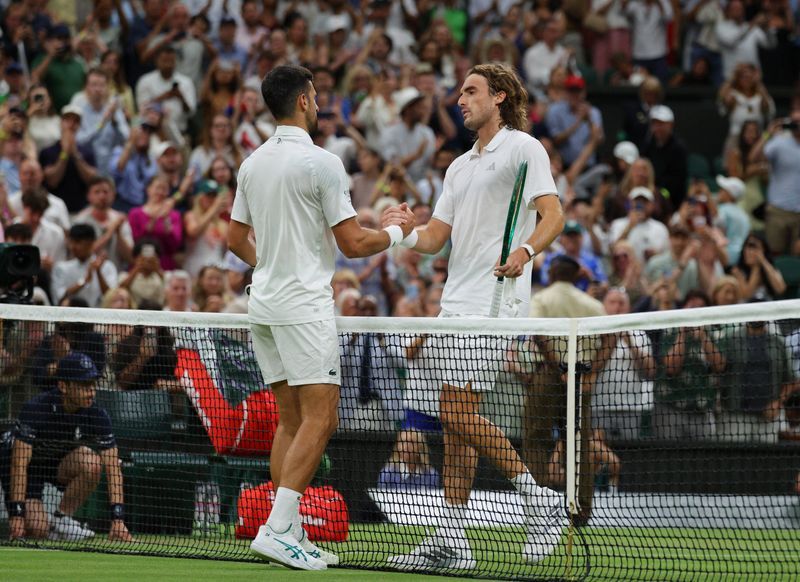
Novak Djokovic's supremacy over Stefanos Tsitsipas showed no signs of waning on Wednesday at the All England Club, as the Serbian tennis titan overwhelmed his Greek opponent with a methodical 6-3 6-4 6-2 victory on Centre Court. The dominant performance not only secured Djokovic's passage to the third round but also delivered a sobering reminder of the vast gulf that still exists between established grand slam champions and those aspiring to join their ranks, regardless of age or generational shifts in the sport.
What appeared on paper as a heavyweight encounter between a legendary veteran and a player once destined for multiple slam titles evolved instead into a clinical exhibition of Djokovic's enduring craftsmanship. The 39-year-old Serbian demonstrated that at this stage of his career, experience and mental fortitude remain formidable weapons against raw talent and physical capability. The ease with which he navigated the match—particularly his capacity to turn pressure situations to his advantage—underscored why he remains a force to be reckoned with at tennis's biggest stages.
A pivotal moment arrived at 4-4 in the second set when Tsitsipas faced a break point opportunity. Rather than capitalizing on the moment, the Greek player squandered two overhead opportunities that should have been straightforward winners. These lapses in execution proved costly; Djokovic seized the break immediately afterwards, fundamentally shifting the match's trajectory. The Serb's ability to capitalize on such miscues reflects not merely superior court positioning but also psychological dominance—the capacity to remain patient when opponents self-destruct.
Following that critical juncture, Djokovic demonstrated why he has won more matches at Wimbledon than any man in history. He claimed eight of the final ten games, methodically dismantling Tsitsipas's already faltering resistance and extending his head-to-head record against the Greek player to a staggering 12 consecutive victories. For Tsitsipas, the defeat represented far more than a simple loss; it embodied the cumulative weight of circumstances conspiring against his Grand Slam aspirations.
Tsitsipas arrived at SW19 carrying considerable baggage beyond his ranking slide to world number 87. The 27-year-old had parted ways with his coaching team mere days before the tournament commenced, a separation made more complicated by the fact that his coach was simultaneously his father, Apostolos. This organizational turmoil, combined with persistent physical setbacks that had forced him to retire during his opening match at last year's championships, created a fraught mental landscape for a player attempting to rediscover his Grand Slam-winning form.
The younger player's Grand Slam record against Djokovic tells a story of consistent frustration at the sport's highest level. Tsitsipas had contested two slam finals against the Serbian, losing at Roland Garros in 2021 and the Australian Open in 2023. Both defeats likely weighed heavily on his psyche as he took the court on Wednesday, establishing a psychological asymmetry that even the most mentally resilient young athletes struggle to overcome.
Despite the lopsided scoreline, Tsitsipas's journey to Wimbledon represented an attempt at professional rehabilitation following the career-threatening back issues that had threatened to truncate his trajectory. The chronic pain that forced his mid-match retirement last year had genuinely raised questions about whether he could sustain the physical demands required at the highest competitive level. Wednesday's loss, while disappointing, at least confirmed that his physical condition had sufficiently recovered to compete at tennis's premier venue, even if the mental and emotional dimensions of his comeback remain works in progress.
Djokovic's victory margin proved decisive yet hardly surprising given the head-to-head dynamic between these two competitors. The Serb sealed progression in under two hours, dispensing with Tsitsipas as he has done so many times before. This efficiency matters considerably for Djokovic's broader tournament aims: he remains just one victory away from equalling Roger Federer's extraordinary record of 105 match-wins at Wimbledon, a benchmark that speaks to decades of sustained excellence on grass.
Looking ahead, Djokovic will contest the third round against 25th-seeded Frenchman Arthur Rinderknech as he pursues an eighth Wimbledon crown and a record 25th Grand Slam title overall. Each tournament represents increasingly precious opportunity for the veteran champion, whose age makes every remaining opportunity at sport's biggest stages inherently significant. His display against Tsitsipas provided convincing evidence that Father Time remains a competitor Djokovic can outmaneuver through tactical brilliance and undiminished competitive hunger.
Post-match, Djokovic articulated his satisfaction with his own performance and expressed gratitude for the privilege of competing at Wimbledon during his fourth decade as a professional athlete. The Serb's philosophical approach to his longevity—his insistence that age functions more as mere numerical abstraction than limiting factor—reflects not arrogance but rather evidence accumulated through his extraordinary record across multiple surfaces and throughout multiple generations of rivals. His cream-coloured blazer and composed demeanor suggested a player entirely comfortable with his position in tennis's contemporary landscape, regardless of shifting generational tides.
For Malaysian and Southeast Asian tennis enthusiasts, Djokovic's continued dominance at Wimbledon reinforces an uncomfortable truth: the era of Serbian tennis supremacy shows no imminent signs of conclusion. While younger players like Tsitsipas represent the future, they continue encountering a present inhabited by a champion whose mental architecture and technical mastery have proven stubbornly resistant to the inevitable march of time and the emergence of new challengers.

