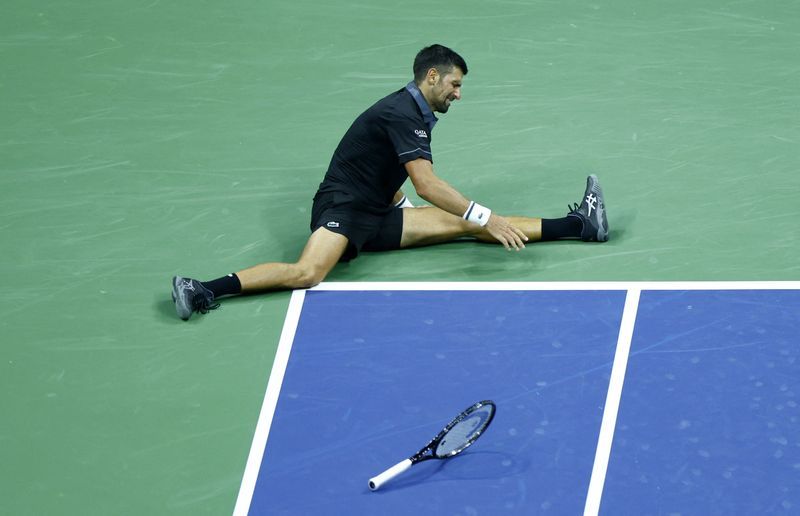
Novak Djokovic's championship ambitions at the US Open crumbled spectacularly on Sunday as the 39-year-old Serbian legend crashed out in the opening round to unseeded Argentine Mariano Navone in a gruelling five-set marathon. The 7-6(5) 5-7 4-6 6-2 6-1 defeat represented not merely a tournament upset, but a watershed moment for one of tennis's greatest competitors—his earliest first-round exit at any Grand Slam in nearly two decades, a stark departure from the consistency that has defined his career.
Djokovic arrived at Flushing Meadows burdened by persistent physical struggles and recent form doubts, having suffered defeat to Thiago Agustin Tirante just two weeks earlier in Cincinnati. The fourth seed initially appeared poised for a straightforward passage through his 20th appearance at this major, establishing a commanding 3-0 lead in the opening set under humid New York conditions. Yet as play continued, the match evolved into a test of endurance rather than technical dominance, with Navone, ranked 49th in the world, gradually clawing back into contention as the Serbian champion showed mounting discomfort throughout.
The turning point arrived when the match roof closed due to rain at Flushing Meadows, a technical interruption that seemed to disrupt Djokovic's rhythm irreparably. Navone capitalized on the delay to level at 4-4, then forced a tiebreak which the Argentine claimed with growing confidence, drawing roars from the crowd as he claimed the opening set. The spectacle of an unseeded player taking the first set from a four-time US Open champion signalled that this encounter would not follow the conventional script tennis observers anticipated.
Djokovic summoned reserves of competitive fire to claim the second set, suggesting a potential comeback was taking shape. However, during the third set, the Serbian champion's physical troubles manifested unmistakably when he vomited into a courtside bin—a visible manifestation of the chronic gastrointestinal issues that he later disclosed had plagued him throughout the year. Despite this disturbing episode, Djokovic recovered sufficiently to break Navone at 5-4 and secure the third set, offering tantalizing glimpses that his experience and tactical acumen might yet overcome the younger challenger's surging momentum.
The match's decisive turning point arrived in the fourth set, when Djokovic's physical condition deteriorated beyond recovery. A persistent back complaint severely compromised his serving capacity—traditionally a cornerstone of his defensive and offensive arsenal—while simultaneous shoulder troubles compounded his difficulties. Navone, displaying remarkable composure and tactical intelligence for a player on the brink of career-defining achievement, seized the fourth set as Djokovic's serve performance deteriorated visibly. The Argentine's clinical execution in the fifth set, accomplished in four hours and thirty-six minutes of intense competition, clinched the most significant victory of his professional career.
In the aftermath, Djokovic struggled visibly with the magnitude of his defeat. Speaking through evident emotion and tears, he articulated the extraordinary physical burden he has carried this season: chronic vomiting episodes that cascade into whole-body cramping and pain, compounded by structural issues in his back and shoulder that fundamentally undermine his capacity to execute the aggressive serving patterns that have sustained his dominance for two decades. He acknowledged possessing a break-up opportunity in the fourth set but proved unable to capitalize, illustrating how thoroughly his physical reserves had been depleted by the relentless nature of competition.
Djokovic's emotional vulnerability post-match revealed the psychological toll of competing while battling persistent bodily dysfunction. When asked whether quitting the match had crossed his mind, he responded with characteristic determination tempered by resignation: he simply wanted to finish what he had started, even though victory had become impossible. This stubborn refusal to withdraw, despite physical suffering, underscores both the competitive mentality that forged his legendary status and the cruel reality that physical limitations eventually constrain even the greatest talents.
Navone, by contrast, remained overwhelmed by the magnitude of his accomplishment. The 25-year-old Argentine, competing against the player he considers the greatest tennis competitor of all time, could scarcely comprehend that he had defeated Djokovic in a full five-set encounter. His immediate post-match comments reflected genuine astonishment: he acknowledged the adrenaline would require considerable time to subside, and he mentioned his phone ringing incessantly as news of his extraordinary achievement reverberated across Argentina and the global tennis community. The victory represented not merely a tournament milestone but a transformative moment that would fundamentally alter perceptions of his potential within the sport.
For Malaysian and Southeast Asian tennis enthusiasts, Djokovic's departure carries particular significance. The Serbian champion has historically commanded massive viewership across the region, where his technical brilliance and mental fortitude have inspired generations of young players. His unexpected vulnerability at a major championship challenges the narrative of invincibility that has surrounded him, demonstrating that even icons face moments when physical deterioration overwhelms competitive will. The contrast between Djokovic's struggle and Navone's breakthrough illuminates how Grand Slam tennis, despite appearing to reward established hierarchies, remains fundamentally unpredictable when players confront the convergence of physical limitation, form fluctuation, and determined opposition.
Djokovic's pursuit of a record 25th Grand Slam title—which would have extended his already unprecedented major championship haul—has been deferred indefinitely. His last Grand Slam victory occurred at the French Open in 2023, suggesting that even before this US Open collapse, questions surrounded his continued capacity to challenge for tennis's supreme prizes. The Flushing Meadows disaster, transpiring in his earliest tournament exit at this level since the 2006 Australian Open, raises urgent questions about whether age, accumulated physical injuries, and recurring illness will progressively diminish his capacity to compete at championship level. Whether this represents a temporary setback within a potentially continuing career or a watershed indicating permanent decline remains the consuming question for the tennis world heading forward.

