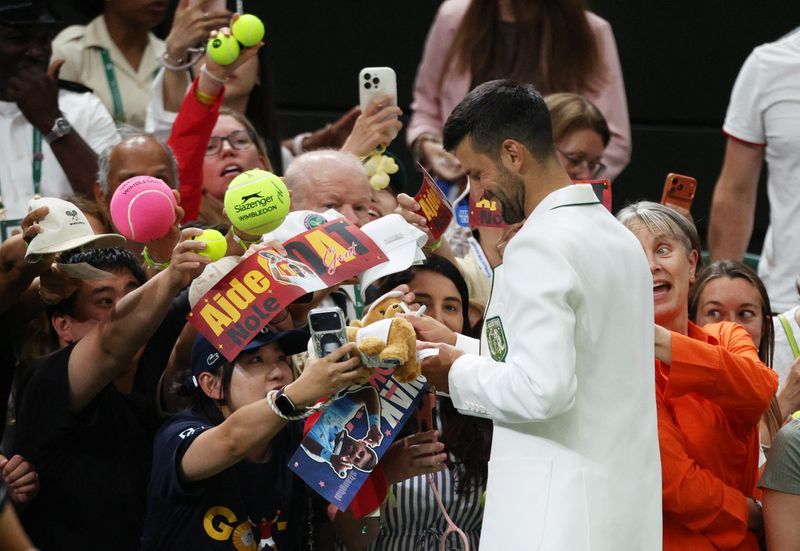
Novak Djokovic's demolition of Stefanos Tsitsipas at Wimbledon on Wednesday revealed a champion so thoroughly in control that he had the luxury of entertaining himself between points. The Serbian tennis great, already leading by two sets to love, remained composed enough to engage in light-hearted banter with court officials and spectators, a demeanor that starkly contrasts with the intensity required to maintain his dominance over one of the sport's most talented younger players. His 6-3 6-4 6-2 victory underscored not merely superior skill but a psychological edge that allowed him to relax even as he methodically dismantled his opponent.
During the match, Djokovic's playfulness extended to a prank targeting one of the match officials. When instructing a ball girl to trim some black tape from his right shoulder using scissors, the 24-time Grand Slam champion deliberately cried out in apparent agony as she made the cut. The unsuspecting court attendant, believing she had inadvertently injured one of the sport's greatest athletes in front of millions of viewers globally, recoiled in shock and alarm, clutching her chest as panic visibly washed over her. For an instant, the gravity of the situation seemed to overwhelm her composure.
Djokovic's reaction came within a heartbeat of her distress. He burst into laughter, his amusement at the successful prank immediately dissolving the tension he had created. The ball girl, realizing she had been the target of a good-natured joke, quickly joined him in laughter, the moment becoming one of genuine connection between player and court staff. Later, when discussing the incident during his post-match interview, Djokovic acknowledged the prank with characteristic self-awareness, noting that such lightheartedness typically emerges when a player holds a commanding lead rather than struggling from behind. He expressed genuine contrition for startling the young official, though he credited the moment with helping him maintain his relaxed state on court.
The context of Djokovic's playfulness deserves consideration within broader patterns of professional tennis. When players achieve such decisive leads in major tournaments, their psychological burden lightens considerably, freeing mental resources previously devoted to maintaining focus and managing pressure. This explains why pranks and humor surface during dominant performances rather than tightly contested matches where concentration remains paramount. For Djokovic, already possessing an intimidating record against most opponents, the ability to remain composed and even entertained while dismantling ranked competition speaks to his exceptional mental fortitude.
Djokovic's good humor extended beyond the court staff to include a notable spectator in the Royal Box. He spotted Rory McIlroy, the accomplished Northern Irish golfer and twice Masters champion, seated prominently in the viewing area. McIlroy had dressed for the occasion in his Green Jacket, the iconic prize that comes with winning the Masters Tournament at Augusta National Golf Club. The presence of the jacket, one of golf's most recognizable symbols, caught Djokovic's attention immediately.
During his on-court interview following the Tsitsipas victory, Djokovic made a point of addressing McIlroy directly, complimenting the appearance of the Green Jacket with obvious admiration. He had himself changed into a personalized cream blazer that he has been wearing throughout the current Wimbledon championships, a striking garment that serves as his own statement of style during the tournament. The contrast between his tailored cream jacket and McIlroy's iconic green one seemed to inspire Djokovic's next move.
Djokovic then posed a question to McIlroy, asking whether the jacket was indeed the Masters Jacket won by defeating the field at one of golf's most prestigious and demanding tournaments. McIlroy, evidently enjoying the interaction, confirmed with a nod that Djokovic had correctly identified his prize. This acknowledgment opened the door for Djokovic to propose an unusual wager that entertained the assembled crowd at Centre Court.
With characteristic wit, Djokovic suggested a jacket-for-jacket exchange arranged through an unconventional competition. He proposed that they play tennis against each other, with the stakes being his cream blazer against McIlroy's Green Jacket. Djokovic emphasized the condition that any match between them would involve tennis rather than golf, an obvious jest given that McIlroy is a professional golfer competing at the highest level of his sport while Djokovic, conversely, would be extraordinarily outmatched on a golf course. The proposal drew roaring approval from the spectators present at Wimbledon, who appreciated both the humor and the underlying sporting rivalry between two champions from different disciplines.
This exchange between Djokovic and McIlroy exemplifies how major sporting events serve as gathering places for champions across different disciplines. McIlroy's attendance at Wimbledon, adorned in his Masters achievement, creates opportunities for cross-sport banter that delights audiences and reminds the public of the interconnectedness of elite athletic competition. For Malaysian and regional Southeast Asian sports enthusiasts, such moments highlight how the greatest athletes command respect across sporting boundaries and maintain the humility to engage in friendly competition regardless of their dominance within their own fields.
The significance of Djokovic's performance and demeanor at Wimbledon extends beyond mere entertainment value. His ability to maintain such psychological equilibrium while systematically defeating world-class opposition reinforces why he has accumulated a record-equaling 24 Grand Slam titles. The mental resilience to stay relaxed, to engage with the moment, and to remain focused simultaneously demonstrates the multifaceted excellence required of modern elite athletes. For younger players and emerging competitors watching from around the world, including those developing their games throughout Southeast Asia, Djokovic's performance provides a masterclass in how champions conduct themselves when the pressure intensifies most severely.

