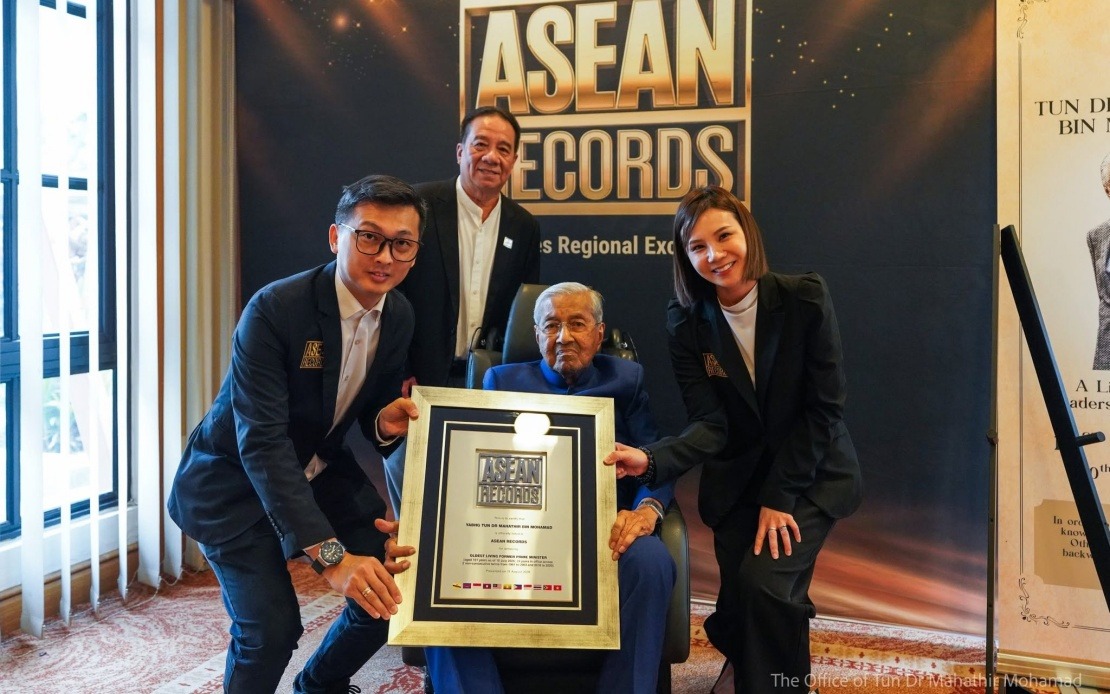
Tun Dr Mahathir Mohamad and Tun Dr Siti Hasmah Mohd Ali have etched their names into record books as a centenarian couple, receiving three separate recognitions that underscore their remarkable longevity and joint achievements. The former Prime Minister, now aged 101, and his wife, who recently turned 100, were honoured at a ceremony held at the Perdana Leadership Foundation in Kuala Lumpur yesterday, marking a constellation of significant milestones that have defined the past month for Malaysia's most prominent elder statesman and his spouse.
The accolades came from two major records organisations. ASEAN Records formally recognised Dr Mahathir as the Oldest Living Former Prime Minister in the ASEAN region, a distinction that reflects both his longevity and his historical significance as a leader who shaped Malaysia's trajectory for over two decades. In tandem, the same body conferred upon Dr Siti Hasmah the title of Oldest Living Spouse of a Former Prime Minister, acknowledging her own remarkable journey alongside one of Southeast Asia's most influential political figures. The couple jointly received recognition from ASIA Records as the First Former Head of Government and Spouse to Both Become Living Centenarians—a distinction that required verification across the broader Asian landscape to confirm its uniqueness.
The timing of these records carries particular resonance given the sequence of personal celebrations the couple has enjoyed. Dr Mahathir marked his entry into his 102nd year on July 10, followed just two days later by Dr Siti Hasmah's transition to her second century of life on July 12. These back-to-back milestone birthdays were followed by another significant moment in their shared history: on August 5, they commemorated seven decades of marriage, a golden anniversary that few couples reach and fewer still with such public prominence and continuing engagement in national affairs.
The verification process undertaken by the records organisations underscores the legitimacy of these achievements. The adjudication teams, led by ASEAN Records Advisory Board chairman Tan Sri Danny Ooi and chief adjudicators Gillian Ooi and Eldrick Koh—who serve as directors for both ASEAN and ASIA Records—conducted thorough research to confirm that no comparable achievement has been publicly documented anywhere across the ASEAN region or the broader Asian markets. This comprehensive vetting means the couple's accomplishments are not merely noteworthy locally but hold continental significance.
Dr Mahathir himself announced the records through social media, demonstrating the digital fluency that has characterised his engagement with Malaysian society even into his tenth decade. His willingness to share personal milestones publicly reflects a pattern of remaining connected to national conversation, a role he has sustained through frequent commentaries on contemporary political and economic issues. The announcement method underlines how modern technology has enabled figures of his generation to maintain direct communication channels with citizens.
The centenarian achievement holds particular symbolic weight in the Malaysian context. Dr Mahathir's tenure as Prime Minister from 1981 to 2003 fundamentally reshaped Malaysia's economy, infrastructure, and international standing. His vision of rapid industrialisation, the Multimedia Super Corridor, and initiatives like the Petronas Twin Towers defined an era of ambitious nation-building. That he has lived to see the fruits and challenges of those long-term projects, and continues to engage thoughtfully with Malaysia's ongoing development, adds historical depth to these records.
Dr Siti Hasmah's centenarian milestone carries its own significance within Malaysian society. As the wife of a long-serving Prime Minister and active public figure in her own right, she has been a steadying presence through multiple decades of political transformation. Her longevity alongside Dr Mahathir's demonstrates the couple's shared commitment to health, stability, and purpose—factors that gerontologists often identify as crucial to extended healthy living. Their 70-year marriage, spanning from 1954 through to 2024, encompasses Malaysia's entire post-independence history, offering a unique personal perspective on the nation's evolution.
The records arrive at a moment when Malaysia and Southeast Asia more broadly face questions about leadership succession and the transition of power between generations. Dr Mahathir's continued prominence as a commentator on national affairs, even in advanced age, raises broader questions about the role of elder statesmen in democratic societies. His outspokenness on contemporary issues demonstrates that age alone need not diminish the capacity for meaningful participation in public discourse, a lesson potentially relevant for how societies structure intergenerational dialogue.
The recognition by ASEAN Records and ASIA Records also reflects growing institutional attention to documenting and celebrating human achievement across borders. These organisations serve a function beyond mere novelty-seeking, creating official records that anchor historical narratives and allow societies to recognise exceptional longevity and contribution. For Malaysia, having its former leader and his spouse recognised at this continental level enhances national prestige and draws attention to factors that enable healthy ageing.
For Malaysian readers, the accomplishment carries personal dimensions beyond the political sphere. The couple's ability to maintain active engagement—whether through social media, public appearances, or continued involvement with the Perdana Leadership Foundation—offers a model of purposeful ageing. In a Southeast Asian region where rapid modernisation often creates tension between traditional respect for elders and contemporary social dynamics, Dr Mahathir and Dr Siti Hasmah's continued relevance demonstrates ways that older citizens can remain integral to national conversation.
Looking forward, these records likely mark the beginning rather than the culmination of the couple's documented achievements. With Dr Mahathir aged 101 and Dr Siti Hasmah at 100, and both reportedly in reasonable health, the possibility exists for further milestones—whether demographic or experiential—to be recorded. Their journey continues to unfold in the public eye, providing ongoing documentation of what extended life in the modern era can encompass for individuals of prominence and purpose.

