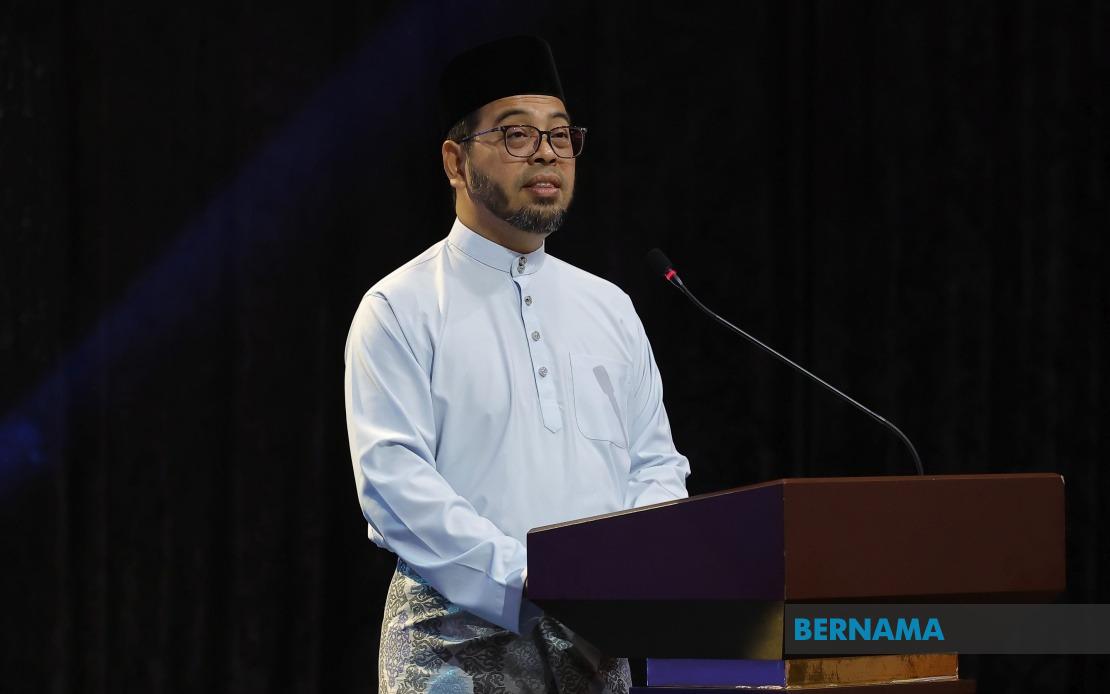
Religious Affairs Minister Dr Zulkifli Hasan has appealed for Malaysian Muslims to transcend internal disputes and channel collective energy towards building a more unified community capable of withstanding mounting global pressures. Speaking at the national Maal Hijrah 1448H/2026M observance held at Putra Mosque in Putrajaya, the Minister outlined a vision where social transformation emerges from individual spiritual and intellectual development, asserting that genuine progress requires citizens to shed behavioural patterns that fragment rather than strengthen the ummah.
The ceremony, graced by Sultan of Perak Sultan Nazrin Shah and attended by Deputy Prime Minister Datuk Seri Fadillah Yusof, carried the thematic message "MADANI Dihayati, Ummah Diberkati". Within this framework, Zulkifli articulated that fractured communities inevitably invite adversity whilst coherent bodies multiply prosperity among their constituents. His remarks reflected growing official concern that Malaysia faces vulnerability to spillover effects from international economic turbulence, supply chain instability, and geopolitical uncertainty—challenges that demand cohesive domestic responses rather than isolated individual responses.
Zulkifli's conception of hijrah transcends the traditional Islamic understanding of migration, instead reframing the concept as an ongoing personal and collective evolution. He positioned hijrah as fundamentally about abandoning destructive conduct and intentionally cultivating virtues that bind diverse Muslim populations together. This reinterpretation carries practical implications for contemporary Malaysian society, where religious discourse often focuses on theological purity but can inadvertently amplify sectarian tensions. By anchoring hijrah to social cohesion rather than doctrinal boundary-setting, the Minister signalled official preference for inclusive Islamic practice over exclusionary interpretations that have occasionally generated conflict among different Muslim communities and schools of thought.
The Minister's emphasis on collective commitment reflects awareness that Malaysia's multicultural framework depends partly on internal Muslim unity. When Muslim populations fragment along theological, ethnic, or political lines, broader intercommunal stability becomes compromised. Southeast Asia has witnessed how religious polarisation can destabilise nations; Malaysia's own experience with periodic tensions between different Islamic movements and interpretations demonstrates the vulnerability. By calling for strengthened unity grounded in shared moral development, Zulkifli articulated a counternarrative to divisive approaches that reduce Islam to competing factions with incompatible visions.
Central to his message was the proposition that individual transformation precedes community transformation. Zulkifli contended that intellectual growth, spiritual deepening, and moral advancement within each person create conditions for stronger social bonds. This psychological and philosophical foundation suggests that merely legislating unity or issuing institutional directives proves insufficient without corresponding shifts in individual attitudes and behaviours. The approach aligns with Islamic pedagogy emphasising nafs (soul) purification and tazkiah (spiritual development), thereby grounding his call in religious authenticity rather than secular management techniques.
The Minister explicitly linked communal unity to government policy success. He requested continued public support for initiatives designed to elevate Muslim dignity and facilitate Islamic values' flourishing within Malaysia's constitutional and pluralistic context. This framing positions unity as instrumentally valuable not merely for its spiritual merit but for enabling tangible government programmes to succeed. The nexus between internal social cohesion and policy efficacy carries particular significance in Malaysia, where implementation of development agendas frequently encounters resistance when community consensus remains fractured or public cooperation proves lukewarm.
Zulkifli simultaneously acknowledged that Malaysia's constitutional multiethnic, multireligious character requires all citizens—regardless of faith—to maintain collective commitment to stability and prosperity. This balancing statement demonstrated sensitivity to Malaysia's delicate pluralistic equilibrium. While specifically addressing Muslim audiences and emphasising Islamic community strengthening, he recognised that peaceful coexistence depends on shared civic responsibility transcending religious identity. Such language matters in contexts where religious rhetoric occasionally escalates into majoritarian assertions that marginalise non-Muslim Malaysians or provoke defensive reactions.
The awards ceremony component provided symbolic reinforcement of the thematic emphasis. The National Tokoh Maal Hijrah award to IIUM Rector Prof Emeritus Datuk Dr Osman Bakar acknowledged intellectual contribution to Islamic thought, whilst the International Tokoh Maal Hijrah honour to Moroccan scholar Dr Ahmad Al-Raysuni underscored Malaysia's positioning within global Islamic discourse networks. These recognitions subtly advanced the Minister's broader message: that Islamic scholarship and leadership derive moral authority from contributions to community welfare and intellectual advancement rather than from narrow ideological conformity or institutional control.
For Malaysian policymakers and religious authorities, Zulkifli's remarks signal official commitment to harnessing religious identity towards constructive national ends rather than allowing theological diversity to fragment governance capacity or social cohesion. The timing—amid global economic uncertainty and regional geopolitical shifts—suggests apprehension that external challenges exploit internal Muslim divisions, rendering the nation less resilient. Whether the appeal achieves measurable impact on ground-level intercommunal dynamics remains uncertain, but the message from the highest religious administrative echelon establishes normative expectations that unity supersedes sectarian particularity in current strategic calculations.