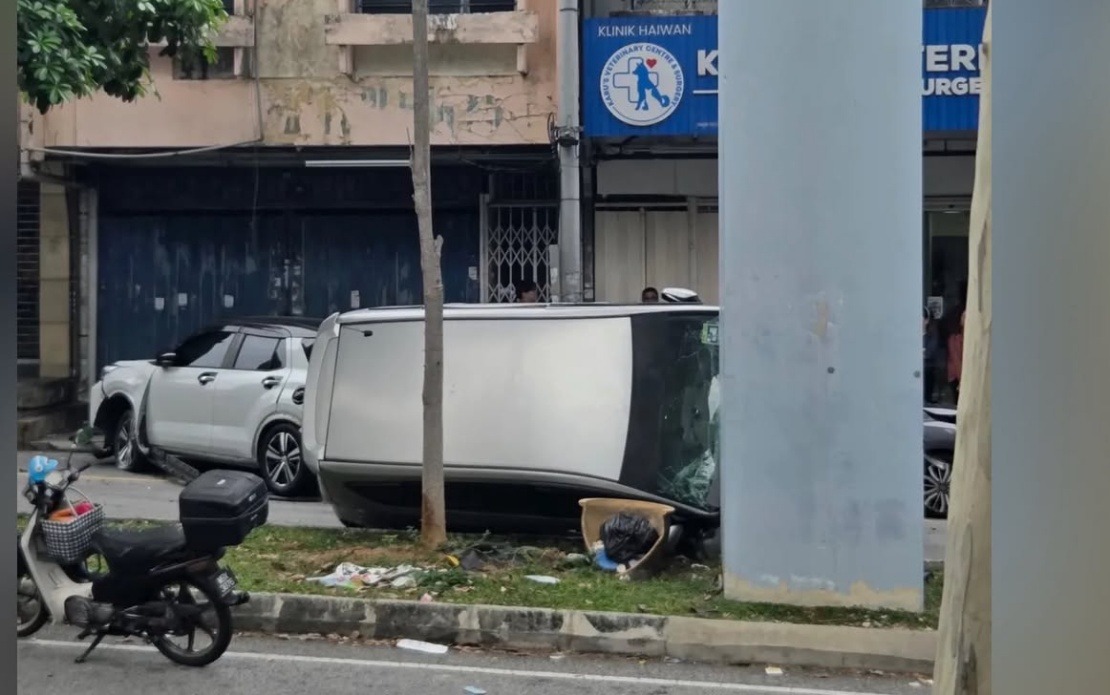
A medical episode left a motorist unable to control his vehicle on a busy Kuala Lumpur residential street on Monday, triggering a collision that damaged six parked cars but fortunately caused no injuries. The incident unfolded around 8.30 am on Jalan Midah 1 in the Cheras district when the 28-year-old driver, operating a BMW 320i, abruptly lost command of the vehicle and veered onto the left shoulder, where it struck multiple parked automobiles in rapid succession.
According to ACP Mohd Zamzuri Mohd Isa, chief of the Kuala Lumpur Traffic Investigation and Enforcement Department (JSPT), the driver is suspected to have experienced a seizure at the moment of impact. The man had been commuting from his residence to his workplace at Taman Midah 1 when the medical episode occurred, rendering him momentarily incapable of steering or braking. The sudden loss of vehicular control resulted in the BMW ploughing into a line of stationary vehicles parked along the roadside, each unoccupied at the time of collision.
The six vehicles struck in the incident belonged to a diverse group of owners. Four vehicles were registered to women aged between 29 and 43, one to a 39-year-old man, and a sixth was a company-registered automobile. None of the vehicles contained occupants during the collision, a fortunate circumstance that prevented what could have escalated into a more serious traffic disaster with potential casualties. The absence of pedestrians or vehicle operators in the impact zone meant that while property damage was sustained across multiple vehicles, no medical emergencies resulted from the crash.
Investigators subsequently learned that the BMW driver possessed a documented medical history extending approximately a decade, during which time he had experienced recurring seizure episodes. This background information became pertinent to understanding the immediate cause of the traffic accident and would inform the ongoing police inquiry. The driver underwent a breathalyser examination at the scene, which returned a negative result, recording zero milligrammes per 100 millilitres of alcohol. This finding essentially ruled out intoxication as a contributing factor to the loss of vehicle control.
The collision has prompted broader questions about medical fitness standards for vehicle operators in Malaysia. Drivers with chronic conditions that may impair their ability to safely operate motor vehicles raise public safety considerations that extend beyond individual incidents. While seizure disorders can often be managed effectively with appropriate medication, the management of driving privileges for those with such conditions remains a nuanced issue balancing personal mobility rights against community safety. The question of whether drivers with a history of seizures should undergo regular reassessment or face restrictions on their driving privileges is an ongoing debate in road safety circles.
Police have classified the incident under Rule 10 of LN 166/59, a provision that typically covers traffic accidents where property damage occurs without injury. This classification indicates that the authorities are treating the matter as a conventional traffic accident rather than a criminal driving offense. The investigation remains ongoing, with authorities gathering statements and examining evidence to establish a complete timeline of events leading up to the collision.
For residents and vehicle owners in the Cheras area, the incident serves as a reminder of the unpredictable nature of road hazards even in residential zones. Parked vehicles on public streets remain vulnerable to sudden collisions caused by medical events, mechanical failures, or driver error. The fact that six vehicles were damaged in a single incident underscores how quickly a localized traffic event can impact multiple property owners and create cascading insurance claims.
Local residents with information concerning the incident are being encouraged to assist the ongoing investigation by contacting the Tun H.S. Lee traffic police station at 03-2071 9999 or their nearest police facility. Eyewitnesses who may have observed the driver's condition before the collision or those with security camera footage from the area are particularly sought by investigators. Such information could prove valuable in establishing whether the seizure occurred suddenly without warning or whether the driver exhibited signs of distress in the moments preceding the loss of control.
The incident highlights the importance of medical disclosure and driver accountability in road safety. Individuals with conditions capable of causing sudden incapacity while operating vehicles bear a responsibility to ensure their fitness to drive and to inform licensing authorities of any significant medical developments. Malaysia's vehicle licensing framework requires drivers to maintain medical fitness standards, though enforcement of these standards and periodic reassessment remain challenges for the licensing authority.
From a broader Southeast Asian perspective, incidents involving medical episodes behind the wheel are increasingly documented as road safety analysts examine factors beyond traditional traffic violations. The aging driving population and the prevalence of chronic conditions in contemporary society mean that medical events will likely constitute a growing proportion of traffic accidents. This incident in Cheras exemplifies a category of traffic incidents that require specialized investigation and public health awareness rather than punitive enforcement approaches.

