Dutch Prime Minister Rob Jetten delivered a formal state apology on Sunday to members of the Moluccan community, acknowledging what he termed an act of historical justice for a population that endured systematic mistreatment across seven decades. Speaking before hundreds of Moluccans gathered in Rotterdam, a visibly emotional Jetten addressed grievances spanning from the immediate aftermath of Indonesian independence through to the present day, marking a watershed moment in Dutch-Indonesian relations and a belated recognition of a historical wrong that has cast a long shadow over both nations.
The Moluccan people, hailing from the spice islands in eastern Indonesia, found themselves caught in the turbulent geopolitical transition of post-World War II Southeast Asia. During the armed struggle for Indonesian independence from Dutch colonial rule, many Moluccans served as soldiers in the Dutch colonial military forces, positioning themselves on the losing side of history. When Indonesia achieved independence in 1949 following years of conflict and negotiation, these Moluccan servicemen and their families faced an uncertain future in a newly independent nation where their wartime allegiance to the colonial power left them vulnerable to retribution and social ostracism.
Dutch authorities responded by organising a mass transfer of approximately 12,500 Moluccans to the Netherlands, framing the relocation as a temporary humanitarian measure designed to shield them from potential reprisals in their homeland. The Dutch government presented this arrangement as a provisional solution, with explicit assurances that the Moluccan population would eventually be repatriated to an independent Moluccan state—a promise embedded in diplomatic negotiations between The Hague and Jakarta at the time. This commitment formed the foundation of what became a catastrophic failure of Dutch governance and moral obligation.
The reality that unfolded over subsequent decades starkly contradicted these initial undertakings. Instead of facilitating a dignified return home, the Dutch government abandoned its repatriation obligations, leaving tens of thousands of Moluccans stranded in a country that neither welcomed them nor invested in their integration. Upon arrival in Rotterdam and other Dutch cities, Moluccan arrivals were subjected to appalling living conditions, housed in converted military barracks and former concentration camps—facilities that carried their own traumatic historical baggage from Nazi occupation. The choice to accommodate Moluccans in former Jewish internment sites represented a particularly insensitive chapter, compounding the community's sense of displacement and abandonment.
Those Moluccans who had served in the Dutch army faced immediate discharge without meaningful support structures or employment assistance. Dutch society made minimal effort to facilitate their social integration, leaving first-generation Moluccans economically marginalised and culturally isolated. The absence of coherent integration policies, combined with systemic discrimination in housing and employment markets, created a segregated underclass whose members found themselves perpetually suspended between a homeland they could not safely return to and an adopted country that refused to fully acknowledge them as permanent residents worthy of investment and opportunity.
The psychological and social cost of this abandonment manifested dramatically in subsequent generations. During the 1970s, second-generation Moluccans—young people who had grown up in the Netherlands with diminishing prospects and deepening alienation—resorted to violent protest actions. These incidents reflected a profound sense of betrayal by a Dutch state that had promised their parents temporary refuge and instead condemned them to permanent limbo. The youth uprising crystallised decades of accumulated frustration at broken promises, denied belonging, and what amounted to a systematic exclusion from Dutch society despite their physical presence within its borders.
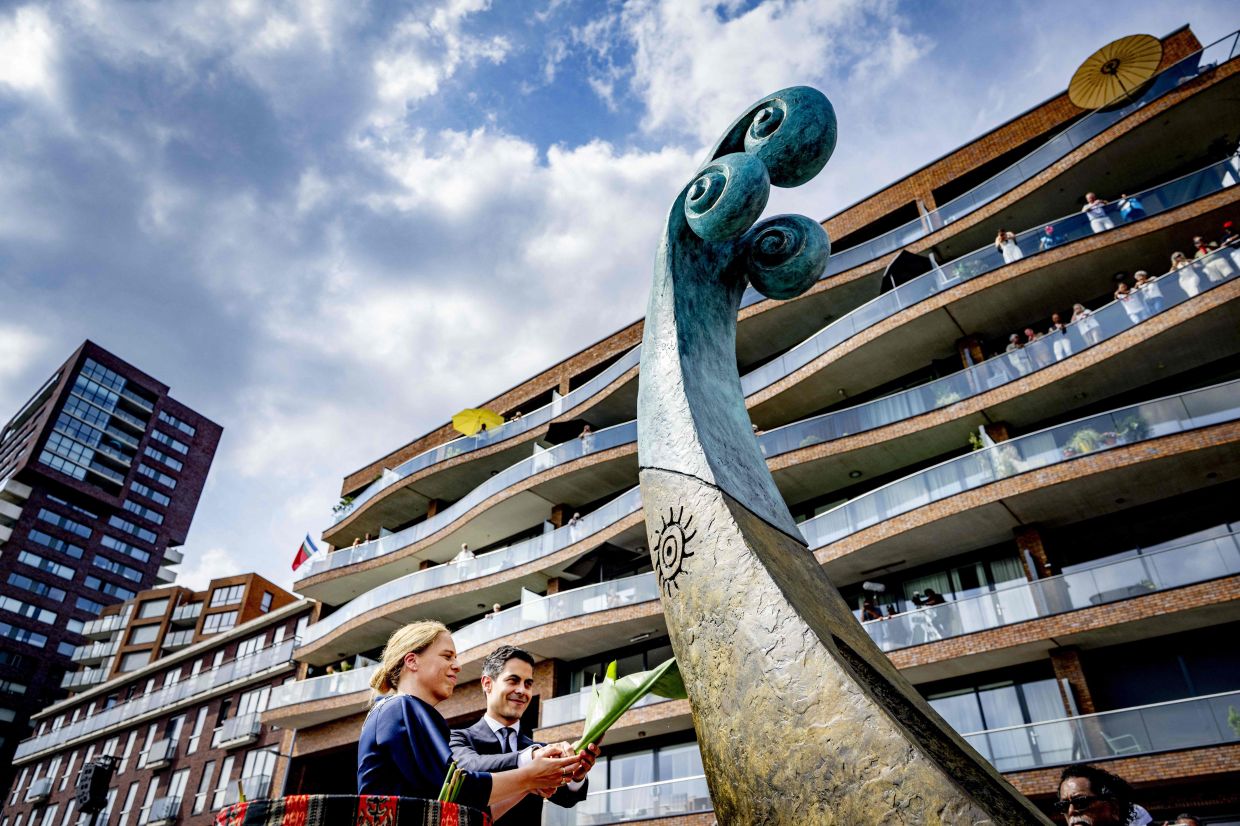
The unveiling of the Ulu Kora monument at the Lloydkade in Rotterdam carried symbolic weight precisely because it marked the arrival point where Moluccan ships first docked in the 1950s, transforming the location into a site of historical reckoning. By positioning the apology at this geographic origin point of the diaspora, Dutch authorities acknowledged that an injustice had been set in motion from the very moment Moluccans stepped onto Dutch soil with false promises ringing in their ears. The monument itself serves as a permanent testament to a community whose displacement became permanent, whose temporary stay became generational exile, and whose contributions to Dutch society were long rendered invisible.
In his remarks, Prime Minister Jetten explicitly enumerated the multifaceted harms inflicted upon the Moluccan community: the failure to provide adequate housing and reception facilities, the systematic invisibility and social abandonment, the unfulfilled longing to return home, and the intergenerational trauma that has fractured countless families. His acknowledgment that an apology cannot retroactively undo historical injustice or restore what was lost represented an unusually candid statement from a European leader, moving beyond performative regret toward something more substantive—recognition that certain historical wrongs require not merely words but fundamental shifts in how a society understands its obligations to vulnerable populations.
For Malaysia and Southeast Asia more broadly, this moment carries relevance beyond its immediate context. The Moluccan experience illuminates how colonial legacies can extend far beyond formal independence, how communities can be instrumentalised during transitions of sovereignty, and how wealthy nations may exploit their economic power to avoid repatriating populations they have displaced. The apology also underscores the importance of holding governments accountable across decades when initial promises prove hollow, a principle with applications across the region where communities displaced by conflict, development projects, or historical injustice continue awaiting equivalent recognition and redress from various governments.
The broader significance of this apology extends to questions about how postcolonial nations in Southeast Asia navigate relationships with former colonial powers and address historical grievances. Indonesia's acceptance of the Dutch apology, and the Moluccan community's participation in the ceremony, suggest possibilities for diplomatic reconciliation grounded in acknowledgment rather than minimisation. Yet the timing—more than seven decades after the events in question—also raises uncomfortable questions about why such recognition took so long and why it required a new generation of Dutch leadership to honour obligations that should have been kept decades earlier.
Moving forward, the apology may open pathways for concrete measures beyond symbolic recognition. Questions remain regarding whether the Dutch government will pursue substantive restitution, support for ongoing integration challenges faced by Moluccan communities, or acknowledgment of broader colonial injustices in the East Indies. The Moluccan case, while historically specific, connects to larger patterns of postcolonial displacement and abandonment that persist throughout Southeast Asia, suggesting that this moment of Dutch accountability might inspire similar reckonings elsewhere in the region where historical wrongs remain unaddressed and communities continue seeking recognition and remedy for generational harms.