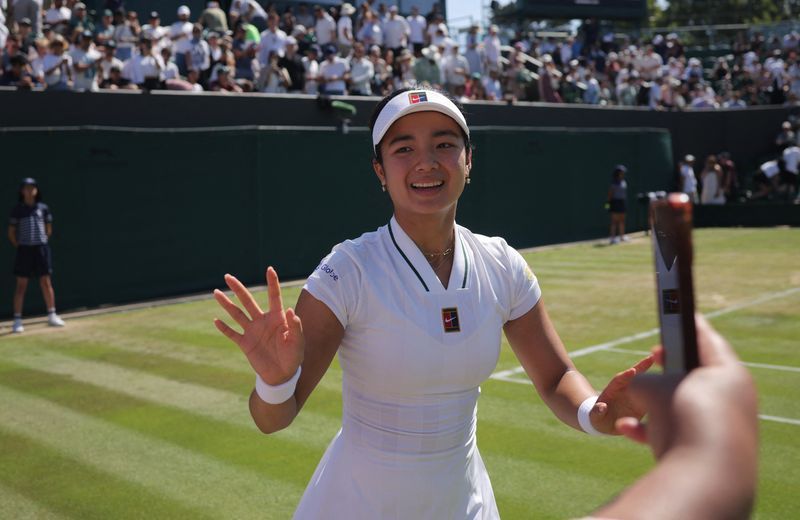
Alexandra Eala's journey at Wimbledon this year represents a watershed moment for Philippine tennis, as the 21-year-old from Quezon City etched her name into the record books by advancing to the third round of the prestigious grass court championship. The 29th-seeded Filipino player dismantled Australia's Maya Joint with a commanding 3-6 6-2 6-0 victory on Thursday, securing a spot in the tournament's next stage and becoming the first representative of the Philippines to achieve this milestone at any Grand Slam event. The accomplishment underscores the remarkable trajectory of Philippine tennis on the world stage, with Eala serving as the sole flag-bearer for her nation in the main draw at the All England Club.
Eala's victory against Joint, who had notably eliminated Serena Williams in the opening round, demonstrated a level of composure and tactical maturity that belied the young player's relatively limited Grand Slam experience. Having contested only six major tournaments in her career, she showcased an impressive ability to recover from an early setback, losing the opening set before dominating the subsequent two frames. The manner of her comeback, rather than merely the fact of her advancement, signals that Eala possesses the mental fortitude and technical proficiency required to compete at the sport's highest echelon. Her opponent Joint, despite her impressive scalp over Williams, proved no match for Eala's accelerating form on the grass surface.
Displayed prominently on the back of Eala's sun visor during her Wimbledon campaign is a Tagalog phrase—"Kapag lumago, hindi na hihinto"—which translates to "once it grows, it cannot be stopped." The sentiment encapsulates the trajectory of her career and, symbolically, the aspirations of Philippine tennis more broadly. Rather than a mere decorative element, the phrase carries profound personal significance, with Eala's sponsor Nike collaborating with her to incorporate cultural markers into her competition kit. This commitment to wearing her heritage visibly while competing on world tennis stages reflects a deliberate choice to remain grounded in her identity even as she ascends to increasingly rarified levels of professional competition.
Eala's appreciation for cultural representation extends beyond mere symbolism. During her Wimbledon debut at the tournament last year, she wore a custom hair tie adorned with a single sampaguita blossom—the national flower of the Philippines. These gestures, whilst seemingly small, carry significant weight for the player, who views her ability to carry elements of her nation's cultural identity onto the court as profoundly meaningful. In comments to reporters following her victory, she articulated the emotional resonance of representing the Philippines on such a prominent global stage, emphasizing that her heritage forms a fundamental component of her identity and aspirations for her future in professional tennis.
The significance of Eala's achievement extends beyond individual accolade to encompass broader implications for sports development and representation in the Philippines. As the sole Filipino competitor in Wimbledon's main draw, she shoulders the responsibility of representing her nation's tennis community and inspiring younger players back home. The historic nature of reaching the third round of a Grand Slam—an accomplishment that no previous Philippine player had attained—provides tangible evidence that Filipino athletes can compete successfully at the sport's apex. This breakthrough comes at a moment when women's tennis globally is experiencing renewed enthusiasm and competitive intensity, creating an opportune environment for players from emerging tennis nations to establish themselves.
Eala now confronts a considerably more formidable challenge in her third-round encounter against defending champion Iga Swiatek, the Polish six-time Grand Slam titlist scheduled for Saturday. By conventional metrics, the matchup appears heavily weighted toward Swiatek, whose pedigree and recent dominance at major tournaments provide substantial competitive advantages. However, Eala's recent performances suggest she approaches the contest with justified confidence rather than trepidation. In her post-match remarks, the Filipino player acknowledged the magnitude of the challenge ahead whilst expressing her readiness to contend with one of tennis's premier competitors. This psychological resilience, combined with her evident comfort on grass courts, could provide grounds for tactical optimism despite the significant disparity in Grand Slam experience.
Eala's comfort on grass surfaces has become increasingly evident through her performances across the professional calendar. In the weeks preceding Wimbledon, she captured the title at Birmingham and reached the semi-finals in Berlin, suggesting that the grass court surface suits her playing style and tactical preferences. These accomplishments, achieved in the immediate lead-up to the Grand Slam, indicate she enters Wimbledon in peak form and with genuine confidence in her ability to sustain success across multiple matches on this particular surface. Her trajectory from fringe Grand Slam competitor to consistent performer at prestigious grass tournaments demonstrates the value of competing regularly at the highest levels and the importance of surface-specific preparation.
The 21-year-old's breakthrough into the professional tennis elite accelerated markedly over the preceding year when she first breached the top 50 in the world rankings. Her continued upward movement this year has consolidated her status as an ascending force in women's tennis, particularly across grass tournaments. This progression has unfolded whilst she trains at the Rafa Nadal Academy in Mallorca, an institution renowned for developing elite-level talent across multiple countries. The combination of intensive training at a world-class facility with consistent match play against competitive opponents has evidently sharpened her technical and tactical capabilities whilst building the mental resilience required for sustained success.
When informed of the historic nature of her achievement for Philippine tennis, Eala displayed characteristic humility mixed with appropriate acknowledgment of the milestone. She characterized her breakthrough as simultaneously a personal accomplishment and a source of national pride, emphasizing that the emotional weight of breaking new ground for her country infuses each successive achievement with additional significance. Her philosophical approach to the distinction between personal goals and broader national representation suggests a mature perspective uncommon among athletes of her relative youth and experience level. Rather than viewing the representative burden as onerous, she appears to embrace it as motivational fuel for further improvement and achievement.
Eala's insistence that she remains true to her values and refuses to become someone she is not provides insight into her character and approach to professional competition. In an era where athletes face intense pressure to conform to perceived commercial or competitive norms, her commitment to maintaining her identity whilst pursuing elite-level success offers a model of authenticity in contemporary professional sports. This philosophical grounding, combined with her technical proficiency and demonstrated mental toughness, positions Eala as a player capable of sustaining competitive relevance across multiple seasons and tournaments. Her achievement at Wimbledon represents both a culmination of years of dedicated development and a launching point for further advancement in her professional career and continued elevation of Philippine tennis on the global stage.

