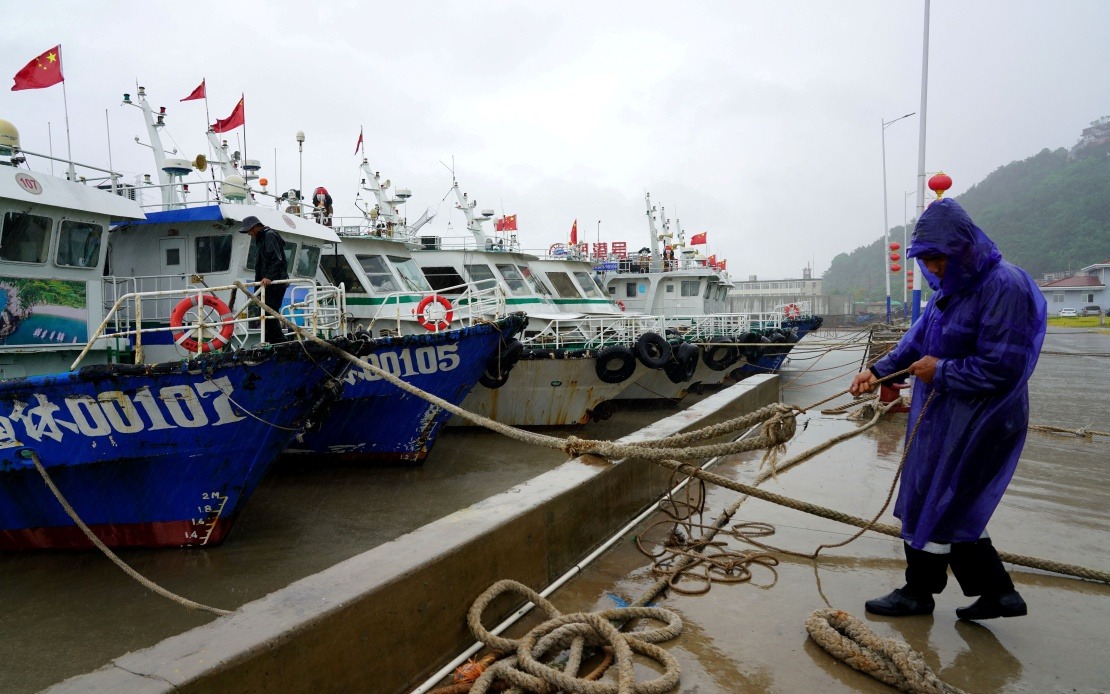
Authorities across eastern China's Zhejiang and Fujian provinces moved to their maximum typhoon alert status on Thursday as Typhoon Dolphin continued its relentless march towards the coast. The dual activation of Level-IV emergency responses marked a coordinated effort to shield millions of residents and critical infrastructure from what meteorologists have characterised as a particularly dangerous weather system. The 13th major typhoon of 2026, Dolphin represents the kind of late-summer threat that regularly tests China's disaster management capabilities and coastal preparedness protocols.
Zhejiang Province formally escalated its maritime emergency procedures at 2 pm Thursday, issuing sweeping directives that compelled local authorities to maintain continuous surveillance of the storm's trajectory while enforcing a comprehensive suite of protective measures. This coordinated activation signals the gravity with which officials view the approaching system and reflects established protocols designed to minimise casualties and economic disruption across one of China's most densely populated and economically vital regions.
At the time of the alert, Typhoon Dolphin remained approximately 1,260 kilometres east of Wenzhou, though the distance belied the storm's potency. The Zhejiang Provincial Meteorological Observatory documented winds near the typhoon's centre reaching Force 14 intensity, a classification indicating gusts capable of causing considerable structural damage. Meteorologists predicted the system would inch northwestward at a measured pace of 15 to 20 kilometres per hour, a relatively slow movement pattern that would allow the storm to concentrate its energy over a smaller geographic area rather than dissipating as it travelled.
The East China Sea, that economically crucial and heavily trafficked waterway, faced escalating danger as Thursday evening approached. Forecasters anticipated wind conditions would commence building that night before intensifying dramatically on Friday and Saturday, with sustained Force 10 to 13 conditions expected across much of the region. Particularly concerning were projections indicating isolated pockets could experience Force 14 to 16 winds, representing storm surge and wave action potentially catastrophic for maritime operations and coastal communities.
Zhejiang's maritime sector, integral to the province's commercial prosperity, had already taken precautionary action well before the formal alert. By Wednesday evening, all 193 offshore construction projects operating in provincial waters had been brought to a complete halt. Simultaneously, authorities shepherded 474 construction and work vessels toward protected anchorages where they could better withstand the anticipated battering. Perhaps most significantly, maritime officials coordinated with local governments to facilitate the organised relocation of more than 10,000 residents living on outlying islands, a logistical undertaking that highlights both the vulnerability of scattered island communities and the systematic approach Chinese authorities employ during major weather emergencies.
Fujian Province, positioned immediately south of Zhejiang along the same vulnerable coast, likewise activated its highest-level typhoon response at 2 pm Thursday. The adjacent province faced a somewhat different timeline than its northern neighbour. Rather than immediate direct impact, Fujian's meteorological observatory calculated that Typhoon Dolphin would make landfall somewhere along the expansive shoreline stretching between the Yangtze River estuary and Fujian's northern coast on Sunday, affording the provincial administration several additional days to intensify preparations and move vulnerable populations away from danger zones.
The meteorological threat encompassed more than wind alone. From Sunday through the following Wednesday, Fujian anticipated a relentless deluge that would drench much of the province, with particular intensity expected across the central and northern sections. Rainfall projections ranged from 100 to 200 millimetres across most affected areas, with certain locations potentially receiving 300 millimetres or more. Such precipitation volumes carry serious implications for flooding, mudslides, and water-related infrastructure damage, concerns that compound the direct dangers posed by violent winds during the initial landfall period.
Recognising these multifaceted hazards, Fujian's flood control authority issued comprehensive guidance to coastal jurisdictions and affiliated agencies. The directives emphasised the necessity of maintaining constant monitoring of the system's evolving position and intensity, conducting thorough risk assessments specific to local geography and infrastructure vulnerabilities, and implementing trigger-based protocols that would activate expanded emergency responses as conditions deteriorated. This layered approach reflects experience accumulated through decades of typhoon encounters across Southeast China.
For Malaysian and Southeast Asian observers, these events underscore the interconnected weather systems that affect the broader region. Typhoons originating across the western Pacific invariably influence monsoon patterns and atmospheric circulation affecting Malaysia and the broader ASEAN region. The methodical Chinese response—from maritime evacuation protocols to advance population relocations—demonstrates approaches and technologies that neighbouring countries often study and sometimes adapt for their own coastal defence frameworks.
The scale of preventive measures undertaken in Zhejiang and Fujian, while appearing dramatic to external observers, reflects the normalised disaster management culture that has evolved in regions experiencing recurrent typhoon impacts. The coordinated suspension of 193 offshore projects across an entire province illustrates how major weather events permeate economic planning in vulnerable areas, with provisions for systematic shutdowns built into operational frameworks rather than constituting extraordinary disruptions. As Typhoon Dolphin continued its offshore approach through Thursday, thousands of officials and emergency personnel across eastern China maintained vigilance, representing an investment in systematic preparedness that continues reshaping how this densely populated region manages interaction with powerful natural forces.

