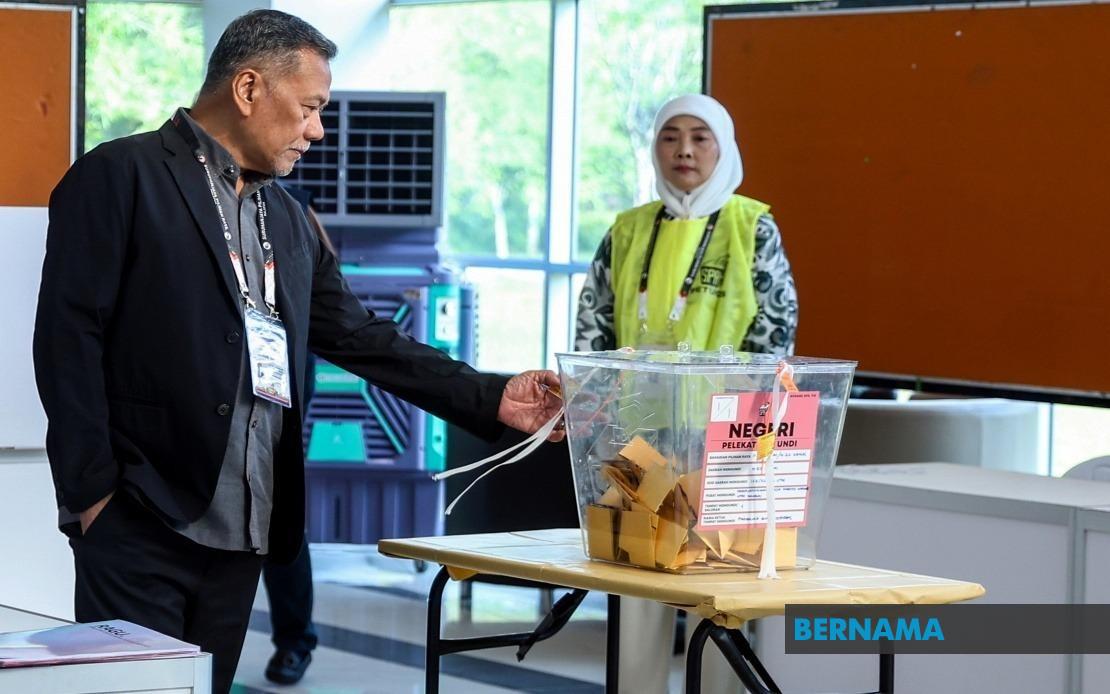
The Election Commission's top official conducted a comprehensive tour of polling stations across Johor Bahru on July 11, personally verifying that voting procedures were running without disruption during the 16th Johor state election. Datuk Seri Ramlan Harun, serving as EC chairman, commenced his ground-level inspection in the morning at approximately 8.50 am, beginning with the Dewan Raya Taman Ungku Tun Aminah facility which served voters from the Skudai constituency through seven separate polling streams.
The chairman's itinerary was deliberately structured to cover a geographically dispersed selection of constituencies and voting arrangements. His second stop took him to the Raja Zarith Sofiah Library situated within the Universiti Teknologi Malaysia campus, where polling for the Senai constituency was facilitated through two polling streams. The third venue visited was Sekolah Agama Taman Bukit Mewah, supporting the Kempas constituency with six operational polling streams. He concluded the inspection circuit at Sekolah Menengah Kebangsaan Bandar Uda Utama, the largest of the four sites, which managed nine polling streams to accommodate voters from the Perling constituency.
This high-level supervisory activity reflects the Election Commission's commitment to maintaining electoral integrity throughout the state election process. By personally visiting multiple polling locations early in voting day, the chairman was able to observe firsthand the practical implementation of electoral protocols and gauge whether staff and voters were operating within established guidelines. Such visible leadership presence on election day serves both as a quality-assurance mechanism and a confidence-building measure for the public.
At each location, election officials provided the chairman with detailed briefings on how the voting process was functioning at that particular centre. These operational updates would have covered aspects such as voter turnout rates, any procedural bottlenecks, the effectiveness of crowd management, and adherence to health and safety measures. The EC leadership's direct engagement with ground-level staff creates an opportunity for identifying issues in real time, rather than learning of problems only through post-election reports.
Beyond observing procedural matters, Ramlan also conducted assessments of the physical infrastructure and amenities provided to both voters and election workers. The availability of adequate seating, clear signage, accessible restroom facilities, and comfortable working conditions for poll officers all contribute to the smooth operation of voting stations. In Malaysia's tropical climate, the provision of adequate ventilation and shade is particularly important for maintaining efficiency throughout what are often lengthy voting days. By evaluating these practical facilities directly, the EC chairman could determine whether the standard of voter experience met acceptable benchmarks.
The inspection tour itself represents an important element of Malaysia's electoral oversight system. While the EC operates with significant autonomy in managing national and state elections, senior leadership's visible involvement in monitoring the implementation of voting procedures demonstrates institutional commitment to transparency and accountability. Malaysian voters, having experienced several competitive elections in recent years, increasingly expect such demonstrations of proper election management as evidence of institutional credibility.
Johor's significance within the Malaysian political landscape makes the conduct of its state election particularly important. As the nation's southernmost mainland state and a substantial economic contributor, Johor has historically been a politically influential entity with a substantial electorate. The professionalism demonstrated during polling day affects not only the immediate outcome of the state election but also public confidence in the broader electoral system that will be utilised for future federal and state contests.
The presence of seven, nine, and six polling streams at different venues reflects variations in voter population densities and logistical considerations across constituencies. The Perling constituency's nine streams, for instance, suggests either a larger electorate or more densely distributed voters requiring greater polling capacity. The varied configurations demonstrate that the EC had undertaken constituency-specific planning rather than applying uniform arrangements across all locations, suggesting a degree of tailored preparation for different demographic and geographic contexts.
The chairman's early-morning start and sequential visits to multiple centres ensured coverage of the voting process during its initial hours. Early voting day periods are particularly critical from an election management perspective, as they establish momentum and reveal whether preparation was adequate. Any procedural issues encountered at the start of voting day can cascade if not addressed promptly, making this timing of inspection strategically important for troubleshooting potential problems before they affect large numbers of voters.
Following completion of the inspection tour, the EC chairman was scheduled to hold a media conference, providing an opportunity to communicate findings and reassurances directly to the public and press. Such press engagement serves multiple purposes: it allows the EC to publicly confirm that voting is proceeding as expected, addresses any concerns that may have arisen, and demonstrates institutional accountability through transparent communication about electoral operations.
The thoroughness of this inspection activity underscores how Southeast Asian electoral bodies increasingly recognise that operational excellence and visible monitoring enhance public trust in democratic processes. For Malaysian voters and particularly Johor residents, such direct oversight by senior election officials provides tangible reassurance that their votes are being recorded and counted within a properly administered framework, an essential foundation for accepting electoral outcomes regardless of personal political preferences.

