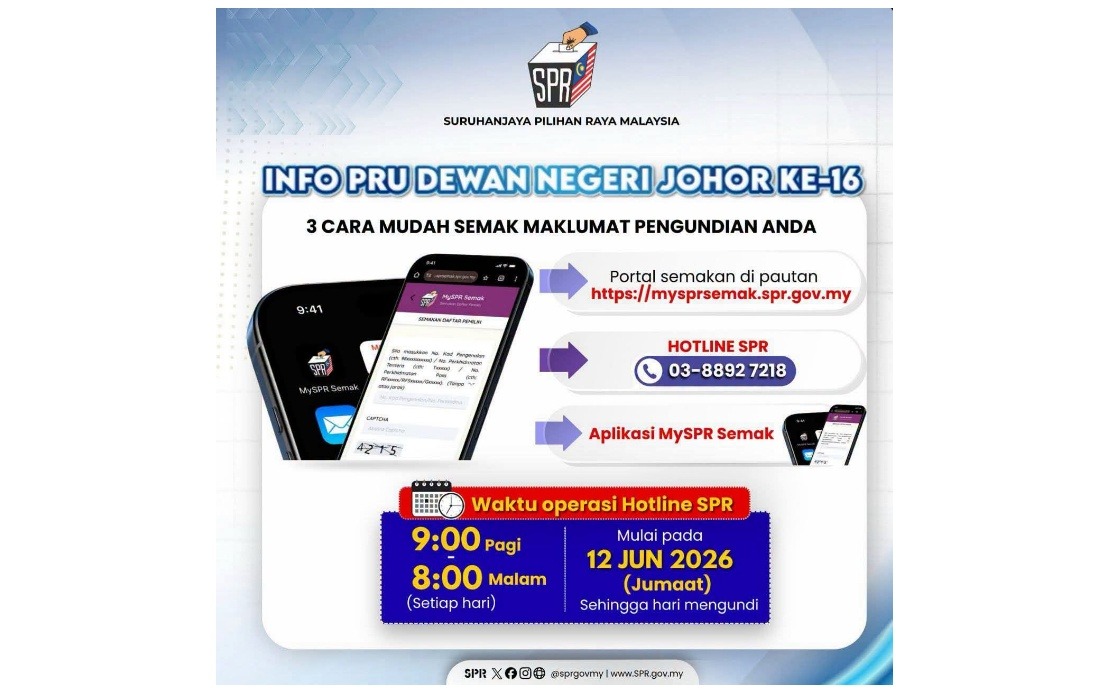
The Election Commission has issued a timely reminder to Johor's registered voters ahead of the 16th state election scheduled for Saturday, July 11, advising them to confirm their designated polling locations and voting procedures to ensure a smooth electoral process. With millions expected to participate in selecting representatives for the state assembly, the EC has emphasised the importance of this preparatory step to prevent confusion or delays at the polls.
Voters can easily verify their polling station assignments and voting streams through two convenient digital platforms: the MySPR Semak online portal or the MySPR Semak mobile application. This accessibility reflects Malaysia's modernisation of electoral administration, allowing citizens to conduct verification from home at their convenience in the days leading up to polling day. The move aims to reduce queuing times and administrative burden on election day itself.
Approximately 2.7 million ordinary voters are eligible to cast ballots in this election, tasked with electing 56 state assembly representatives across Johor. The scale of participation underscores the significance of this electoral exercise for the southern state, one of Malaysia's most populous and economically important regions. Proper preparation at the voter level can substantially improve the efficiency and credibility of the entire electoral process.
The EC's advisory comes after early voting concluded successfully this week, during which 19,471 voters from security and law enforcement sectors participated. The early voting contingent included 7,960 military personnel and their spouses, alongside 11,511 police officers representing various agencies including the General Operations Force and their family members. This structured early voting mechanism ensures that essential services personnel can fulfil their civic duties without compromising their operational responsibilities.
The 16th Johor state election presents a competitive political landscape, with 172 candidates contesting the 56 available seats. Pakatan Harapan and Barisan Nasional each field the maximum 56 candidates, while Perikatan Nasional has put forward 33 contenders. Smaller political players including Parti Bersama Malaysia with 15 candidates, MUDA with four, and single representatives from Parti Orang Asli Malaysia and Parti Sosialis Malaysia also feature on the ballot, alongside six independent candidates.
This unusually diverse candidate pool reflects broader trends in Malaysian politics, where voter options have expanded beyond the traditional two-coalition framework. The presence of multiple competing blocs means that marginal seats could determine overall outcomes, making voter participation across all demographic segments crucial. The diversity also suggests that some constituencies may experience closely contested three-way or four-way races.
For Malaysian voters, particularly those in Johor, understanding the mechanics of their electoral participation remains foundational to meaningful democratic engagement. The EC's emphasis on advance verification aligns with best practices in modern democracies, where informed voters contribute to higher efficiency and lower errors during the actual voting process. The provision of digital tools for this verification represents a practical step toward inclusive electoral participation.
The timing of this reminder, several days before the election, provides sufficient window for voters to address any discrepancies or issues with their registration status. Registered voters who discover errors in their polling station assignment or voting stream can potentially seek corrections from the EC or their local registration office before Saturday. This advance notice thus serves as both a convenience and a safeguard against last-minute complications.
For observers monitoring Malaysian electoral developments, the Johor election serves as a significant barometer of political sentiment in a state that has traditionally influenced national political trajectories. The competitive nature of this contest, combined with the expanded candidate field, suggests voter engagement will be closely watched by political analysts. The EC's organisational preparation, including voter verification mechanisms, contributes to the overall legitimacy and credibility of the electoral outcome.
The southern state's electoral exercise also carries implications for Malaysia's broader political equilibrium, as Johor remains strategically important for coalition formation at the federal level. Results from this contest could signal shifting voter preferences and provide insights into the relative strength of competing political coalitions across different demographic and geographic segments. Proper voter preparedness, therefore, extends beyond mere procedural efficiency to encompass the integrity of the democratic process itself.
As polling day approaches, the EC's advisory serves as a practical call to action for millions of Johor residents. By encouraging voters to engage proactively with available digital resources, the commission acknowledges modern citizens' capacity and preference for self-service preparation. This approach fosters responsibility among the electorate while simultaneously enhancing the operational capacity of the election machinery to handle the large-scale voting exercise efficiently. The combination of thorough voter preparation and well-organised electoral administration ultimately strengthens democratic legitimacy.

